20% Reduction in the Game Industry in the First Year
[Asia Economy Reporter Seungjin Lee] A study has found that classifying gaming disorder (excessive gaming) as a disease could reduce total production by more than 12 trillion won and cause over 80,000 people to lose employment opportunities.
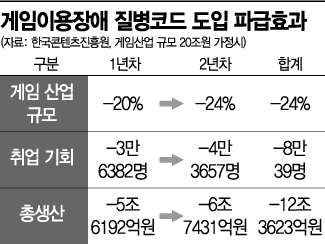
According to the report titled "Impact Study on the Introduction of Disease Code for Gaming Disorder" by the Korea Creative Content Agency on the 27th, if a disease code is assigned to gaming disorder, i.e., gaming addiction, it is analyzed that about 20% of the entire game industry scale will shrink in the first year of introduction. Assuming the total game industry scale is 20 trillion won, the damage to the game industry alone would amount to 4 trillion won. In the second year of introduction, the industry scale is expected to shrink by about 24%, resulting in damage worth 4.8 trillion won, estimating a total game industry damage of 8.8 trillion won over two years. Total production is projected to decrease by 12.3623 trillion won, and the reduction in employment opportunities would reach 80,039.
The introduction of the disease code has sparked a sharp divide between supporters and opponents, resulting in significant social costs. According to a survey conducted among medical experts, game industry experts, and students, about 44% opposed the introduction of the disease code. The study estimates that the social cost consumed by opposition to the introduction is 1.68 trillion won. Conversely, the social cost required to support the introduction also amounts to 1.61 trillion won, indicating that the total cost of social disputes reaches 3.3 trillion won.
Legal issues arising from the introduction of the disease code were also pointed out. If recognized as a disease, not only gaming but also the production and distribution itself could be acknowledged as causing or posing a risk of public health impairment, increasing the likelihood of justifying preemptive and comprehensive prohibitive regulations.
This report was conducted following the World Health Organization's (WHO) passage of the 11th revision of the International Classification of Diseases (ICD-11) in 2019, which classified gaming disorder as a disease, sparking controversy over its introduction domestically. The WHO International Classification of Diseases 11th edition (ICD-11), which classifies gaming disorder as a disease code, came into effect in January this year. Accordingly, governments of the 194 WHO member countries can classify gaming disorder as a disease by referring to WHO standards.
In South Korea, to classify gaming addiction as a disease, the Korean Standard Classification of Diseases and Causes of Death (KCD), revised every five years by Statistics Korea, must be amended. If ICD-11, effective in 2022, is reflected in the KCD, it is expected to be announced in 2025 and implemented in 2026. Meanwhile, regarding the introduction of the disease code, Park Bo-gyun, Minister of Culture, Sports and Tourism, expressed a reserved stance during the confirmation hearing, stating, "We will strive to derive a reasonable alternative suitable for the domestic situation."
© The Asia Business Daily(www.asiae.co.kr). All rights reserved.

















