Korea Inclusive Finance Institute Surveys 7,158 Low-Credit Borrowers
1 in 10 Faces 240% Usury
43% Rejected by Loan Companies Last Year
Over Half Borrow Despite Knowing Illegal Interest Rates
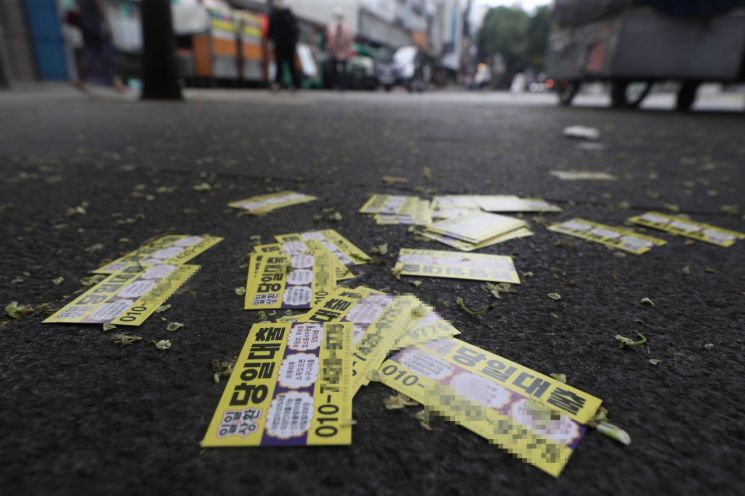 Illegal loan business card-type flyers from loan companies scattered on the streets of Insadong, Jongno-gu, Seoul. / Photo by Moon Honam munonam@
[Asia Economy Reporter Song Seung-seop] A survey found that one out of ten low-credit borrowers suffers from exorbitant interest rates exceeding 240% per annum. More than half of them were aware that the interest rates were illegal, but they had no choice but to borrow money due to a lack of alternatives. The reasons cited include government failures such as the reduction of the maximum interest rate and insufficient policy financing, and many also experienced family conflicts due to illegal private loans.
On the 27th, the Korea Inclusive Finance Agency conducted a survey targeting 7,158 low-credit borrowers (grades 6 to 10) with experience using loan companies or illegal private loans, as well as reputable loan companies. The results showed that 12.8% paid interest rates exceeding 240% per annum last year, a slight increase from 12.3% the previous year. More than 68.4% paid interest rates higher than the legal maximum rate (24%), and one in four bore interest payments exceeding the principal amount.
The burden of interest rates was higher among younger and lower-income groups. Among those in their 20s, 61.5% paid interest rates exceeding the legal maximum, the highest among all age groups. Those in their 30s accounted for 57.7%, the second highest. By income, the group earning between 1 million and 2 million KRW per month had the highest proportion (74.1%) subjected to illegal interest rates. The Korea Inclusive Finance Agency explained, “This indicates that financial exclusion has worsened as the living conditions of low-credit, low-income citizens have become more difficult due to COVID-19.”
The number of risky low-credit borrowers who borrowed from multiple illegal private lenders also increased. The proportion of those who took loans from three or more illegal lenders rose by 5.7 percentage points from 22.8% in 2020 to 27.1% last year.
The problem is that 57.6% of low-credit borrowers borrowed money knowing it was from illegal private lenders. Particularly, among the extremely low-credit group (grades 9 to 10), 76.7% were aware beforehand that the loans were illegal. When asked how they would respond if their loan application was rejected by formal financial institutions in the future, one in ten said they would borrow through illegal private lenders anyway. This reflects the lack of available borrowing channels.
Reduction of Maximum Interest Rate to Help Low-Credit Borrowers... Made Things Even Harder
Low-credit borrowers are effectively being rejected even by loan companies, which are the last bastion of formal finance. Last year, 43.4% of applicants were denied loans by loan companies, up from 39.6% a year earlier. Those who were unemployed, homemakers, or self-employed with unstable income faced even higher rejection rates.
The so-called “paradox of interest rate reduction,” where lowering interest rates beyond a certain level leads to growth in illegal private lending, is cited as the cause. The Moon Jae-in administration lowered the maximum interest rate from 24% to 20% starting July last year, which analysts say worsened the profitability of loan companies, making it harder for them to supply loans. Among the loan companies surveyed, 75% reported a decrease in new loan approvals. Additionally, 25% of loan companies considered selling or closing their businesses due to the maximum interest rate reduction.
There was also analysis that the state’s role in supporting inclusive finance has weakened. The proportion of borrowers who used policy finance programs (such as Sunshine Loans and Smile Loans) or government systems (such as the Credit Recovery Committee’s workout program) after borrowing from private lenders dropped by half, from 24.3% in 2019 to 12.3% last year. The use of policy finance or government programs after being rejected by loan companies also decreased from 24.2% to 22%.
The financially vulnerable bore the brunt of the damage. Among low-credit borrowers, 37.7% continued to endure high interest rates due to illegal private lending, and 18.8% were avoiding contact and evading repayment. Among respondents, 56.7% reported increased distrust within families, and 3.8% said that someone in their family had attempted suicide.
The Korea Inclusive Finance Agency advised, “In preparation for financial exclusion, it is necessary to reconsider and foster the role of the short-term small loan market. For those who find it difficult to access formal financial institutions, efforts should focus on enabling as many people as possible to access finance rather than solely focusing on interest rates.”
© The Asia Business Daily(www.asiae.co.kr). All rights reserved.
![Clutching a Stolen Dior Bag, Saying "I Hate Being Poor but Real"... The Grotesque Con of a "Human Knockoff" [Slate]](https://cwcontent.asiae.co.kr/asiaresize/183/2026021902243444107_1771435474.jpg)











