Ministry of Justice to Provide 7 Types of 'Simple Authentication Services' Starting July 1
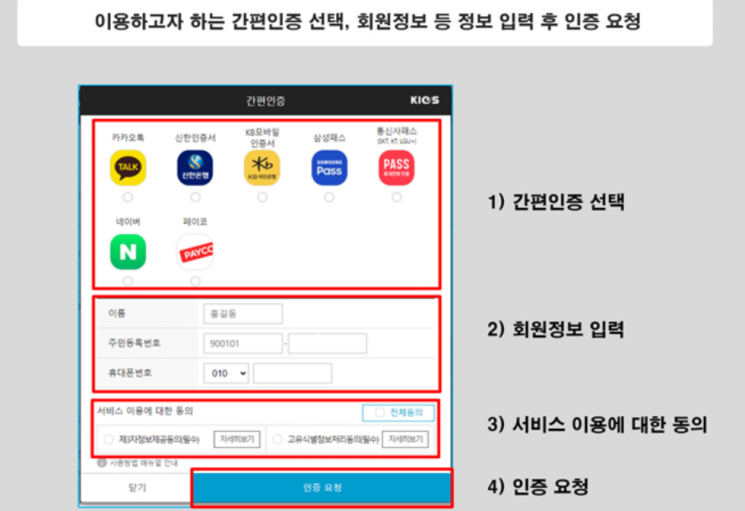 Criminal Justice Portal Simple Authentication Request Screen. / Image provided by the Ministry of Justice
[Asia Economy Choi Seok-jin, Legal Affairs Specialist] Starting next month, it will be possible to verify identity using private certificates such as Naver or KakaoTalk when accessing the Criminal Justice Portal via internet websites or mobile apps.
The Ministry of Justice announced on the 26th that seven types of 'simple authentication services' allowing identity verification on the Criminal Justice Portal through various private certificates, which was previously only possible via joint certificates or fingerprint authentication, will begin on the 1st of next month.
The Ministry of Justice's Criminal Justice Portal provides investigation and trial information from the police and coast guard (investigation) → prosecution (investigation and disposition) → courts (trial) → Ministry of Justice (penal execution).
By registering as a member through the internet or smartphone apps and completing identity verification, users can check case progress, pay fines, or use services such as online civil petition applications.
From the 1st of next month, in addition to the existing identity verification methods of joint certificates and fingerprint authentication, the Ministry of Justice has expanded identity verification options to include seven private certificates for simple authentication: Naver (Naver), KakaoTalk (Kakao), KB Star Banking (KB Kookmin Bank), PAYCO (Payco), PASS (telecom PASS), Samsung PASS (Samsung Pass), and Shinhan SOL (SOL) (the names in parentheses indicate the certificate providers operating the apps).
Meanwhile, starting in 2024, the "Act on the Use of Electronic Documents in Criminal Justice Procedures" (Criminal Procedure Electronic Document Act) will be enforced.
Once this law is enforced, the use of electronic documents will become the principle instead of paper documents in criminal justice procedures, granting electronic documents the same legal effect as paper documents. Case parties will be able to easily and quickly access procedures online to view and print records.
In line with the enforcement of the law, the Ministry of Justice plans to support the creation and distribution of electronic documents in criminal procedures and establish a next-generation Criminal Justice Information System (KICS) applying the latest IT technologies, with services starting in the second half of 2024.
Specifically, the Ministry of Justice is promoting ▲ transparency of procedures through the production and distribution of digitized records ▲ acceleration of procedures by expanding non-face-to-face work such as remote video investigations and mobile-based field investigations ▲ expansion of online civil services and reduction of time and costs through real-time responses by intelligent chatbots.
The Ministry of Justice stated, "We will do our best to successfully complete the ongoing next-generation Criminal Justice Information System construction project and provide the public with easier and more convenient criminal justice services."
© The Asia Business Daily(www.asiae.co.kr). All rights reserved.

















