38% of University Presidents Cite 'Controversy Over Fairness in Children's College Admissions', 23% Point to 'Research Ethics Violations'
60% of University Presidents Oppose Expansion of Semiconductor Quotas in the Seoul Metropolitan Area
60% Support Expanding 'Student Record-Based Admissions' After Full Implementation of High School Credit System
Mixed Opinions on Expanding CSAT-Based Admissions... Over 30% of Metropolitan Universities Prefer It
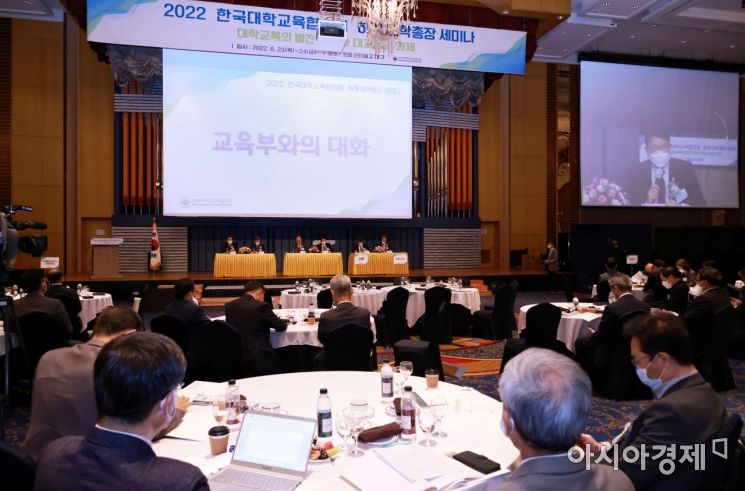 On the 23rd, the '2022 Summer Presidents Seminar' hosted by the Korea Council for University Education was held at the Inter-Burgo Hotel in Suseong-gu, Daegu.
[Asia Economy Reporter Han Jinju] The top disqualification reason for high-ranking public officials, including the Minister of Education, as identified by university presidents, was 'controversy over the fairness of their children's college admissions.'
According to a survey conducted on June 23 by the Ministry of Education press corps among 86 university presidents attending the 2022 Summer Presidents Seminar, the most cited disqualification reason for high-ranking officials in the education sector (multiple responses allowed) was 'controversy over the fairness of their children's college admissions,' accounting for 38%.
Following that were violations of research ethics (23%), sexual misconduct (17%), and personnel corruption (10%). The percentage of respondents who cited 'drunk driving,' a controversial issue in the background of Education Minister nominee Park Soon-ae, as a disqualification reason was only 6%.
Regarding the plan to expand the quota for advanced fields at universities in the Seoul metropolitan area to nurture semiconductor talent, 6 out of 10 university presidents opposed it. Among the 86 respondents, 58 (67.44%) were presidents of universities located outside the metropolitan area, reflecting the perception that increasing quotas primarily for metropolitan universities would relatively disadvantage non-metropolitan universities.
If the high school credit system is fully implemented in 2025, universities are likely to increase the proportion of 'Comprehensive Student Record Screening' in their admissions process. The response indicating an increase in Comprehensive Student Record Screening was the highest at 60.47%, followed by Student Record Screening based on coursework at 22.09%, and College Scholastic Ability Test (CSAT)-focused screening at 15.12%. Notably, among metropolitan universities, 70.37% agreed on the need to expand Comprehensive Student Record Screening, while 60% of non-metropolitan universities agreed. For national and public universities, both Comprehensive Student Record Screening and coursework-based screening were equally selected at 41.18% each.
University presidents considered a 20-30% proportion of CSAT-focused admissions appropriate if the high school credit system is introduced. The next preferences were ▲less than 10% (17.28%) ▲30-40% (16.05%) ▲10-20% (14.81%) ▲more than half (13.58%) ▲40-50% (11.11%). Opinions on the proportion of CSAT-focused admissions varied distinctly by region. Among metropolitan universities, 60% believed that 30% or more was appropriate, whereas 73% of non-metropolitan universities thought less than 30% was suitable. Non-metropolitan universities prefer recruiting freshmen through early admissions, suggesting that this trend will not significantly change even after the full implementation of the high school credit system.
Among the Yoon Seok-yeol administration's higher education regulatory reform plans, the most urgent regulations identified by university presidents were 'university financial support evaluation' (44.3%) and 'tuition fees' (40.51%). During a dialogue with the Ministry of Education's vice minister on the 23rd, university presidents expressed difficulties caused by tuition freezes, and Vice Minister Jang Sang-yoon stated, "We will soon finalize specific countermeasures." Following these were quotas (5.06%), academic management and operations (3.80%), and international student recruitment (3.16%).
Opinions were evenly split on transferring administrative and financial authority over non-metropolitan universities to local governments, with 50.56% in favor and 49.44% opposed. Among metropolitan universities, 71.43% supported the transfer, while 59.65% of non-metropolitan universities opposed it. National and public universities overwhelmingly opposed it at 82.35%, whereas private universities mostly supported it at 57.14%. The main reasons for opposition were the local governments' lack of expertise in university policies (65.91%) and concerns over collusion between local power groups and universities (15.91%).
Regarding the government's plan to expand and reorganize local education finance grants for higher education, the majority opinion favored 'distribution based on scale' (54.02%). The next most common response was 'decisions should be made by forming regional consultative bodies' at 33.33%. Opinions that the matter should be entrusted to provincial governors or education offices were low at 4.60% and 3.45%, respectively.
© The Asia Business Daily(www.asiae.co.kr). All rights reserved.
!["The Woman Who Threw Herself into the Water Clutching a Stolen Dior Bag"...A Grotesque Success Story That Shakes the Korean Psyche [Slate]](https://cwcontent.asiae.co.kr/asiaresize/183/2026021902243444107_1771435474.jpg)
















