Labor and Management Deeply Divided Again This Year
Clash Over Raise Amid Soaring Prices
Likely to Exceed Legal Deadline... Public Interest Committee Holds Casting Vote
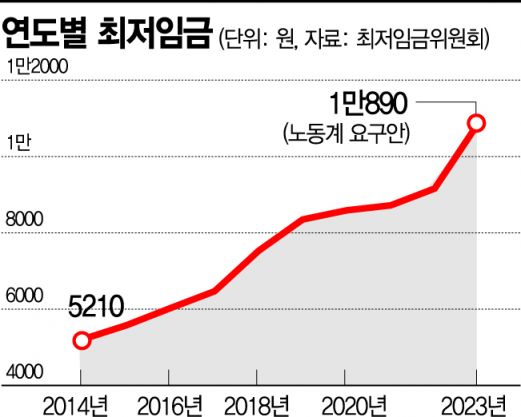
With only three days left until the legal deadline for deciding next year's minimum wage, labor and management will continue discussions this week over the rate of increase. Both sides plan to hold plenary meetings on the 28th and 29th to reach a conclusion within the legal deadline if possible, but given the significant differences in their positions, it is expected to be challenging.
According to the Minimum Wage Commission (MWC) on the 26th, the labor side proposed a minimum wage of 10,890 won for next year, an 18.9% increase from this year, while the management side demanded a freeze at 9,160 won. At the 6th plenary meeting on the 23rd, the MWC engaged in intense discussions over the initial proposals from both sides, but as the gap remained wide, Chairman Park Joon-sik requested both labor and management to submit revised proposals by the next plenary meeting.
The minimum wage deliberations proceed by narrowing the gap between the initial proposals submitted by labor and management. The legal deadline for deciding next year's minimum wage is the 29th. However, except for 2014, deliberations and decisions have exceeded the legal deadline in the past decade. Since the official announcement deadline for the minimum wage is August 5 each year, the MWC has typically conducted deliberations by mid-July, considering objection procedures.
This year, the MWC has scheduled plenary meetings on the 28th and 29th to decide the minimum wage within the legal deadline. If labor and management reach an agreement by then, it will be the first time in eight years that the legal deadline for the minimum wage is met. If both sides present revised proposals closer to an agreement at the 7th plenary meeting on the 28th, the deliberations could accelerate.
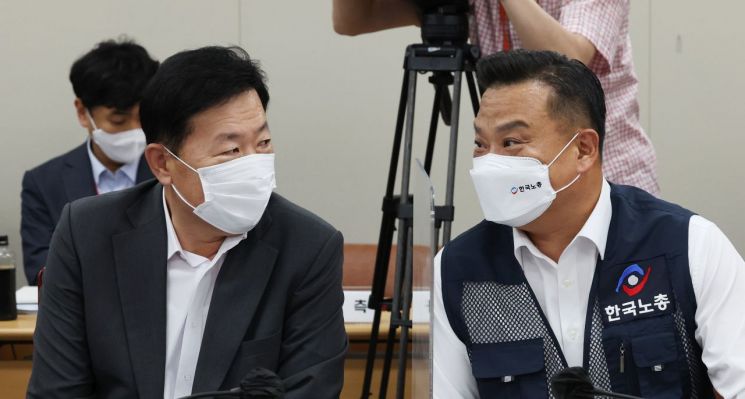 On the afternoon of the 21st, at the 5th plenary meeting held in the Minimum Wage Commission meeting room at the Government Complex Sejong in Sejong City, Ryu Ki-jung, Executive Director of the Korea Employers Federation, a user committee member (left), and Lee Dong-ho, Secretary General of the Korean Confederation of Trade Unions, a worker committee member, are seated and conversing.
 [Photo by Yonhap News]
However, since the gap between management and labor remains large, discussions are expected to be difficult. On the 24th, the Korean Confederation of Trade Unions (KCTU) demanded the management side withdraw its shameless call to freeze the minimum wage, which they said pushes workers to the brink of survival amid soaring inflation, and vowed to strongly fight both inside and outside the MWC for a substantial minimum wage increase.
The Federation of Korean Trade Unions (FKTU) also plans to start a tent sit-in protest in front of the Ministry of Employment and Labor on the 27th to oppose the deterioration of the minimum wage system and demand a significant increase. The FKTU argues that due to the current rapid inflation worsening the hardships of workers and ordinary citizens, and the shock of interest rate hikes increasing the risk of bankruptcy for minimum wage worker households, a substantial increase in the minimum wage is more necessary than ever.
On the other hand, management claims that small businesses are struggling to bear a minimum wage increase amid the aftermath of COVID-19 and a complex economic crisis. Ryu Ki-jung, Executive Director of the Korea Employers Federation (KEF) and a management committee member, said in his opening remarks at the plenary meeting, "Management believes that the most important factor in wage determination is the 'payment capacity of companies,'" adding, "The payment capacity of small business owners and micro and small enterprises is already at its limit."
The Korea Employers Federation (KEF) also demanded a freeze, stating, "The triple crisis of high inflation, high interest rates, and high exchange rates, along with declines in production, consumption, and investment, has created a 'perfect storm' crisis," and explained that although the cumulative minimum wage increase rate from 2017 to last year was 44.6%, labor productivity per person increased by only 4.3%, indicating no grounds for a minimum wage increase.
If the gap between labor and management is not narrowed, as in previous years, it is highly likely that the public interest commissioners will propose a single plan at the final stage of deliberations and decide the minimum wage level by vote. The MWC consists of 27 members: 9 worker representatives, 9 employer representatives, and 9 public interest commissioners. Since the positions of worker and employer representatives are clearly divided, the public interest commissioners usually hold the 'casting vote.'
© The Asia Business Daily(www.asiae.co.kr). All rights reserved.


















