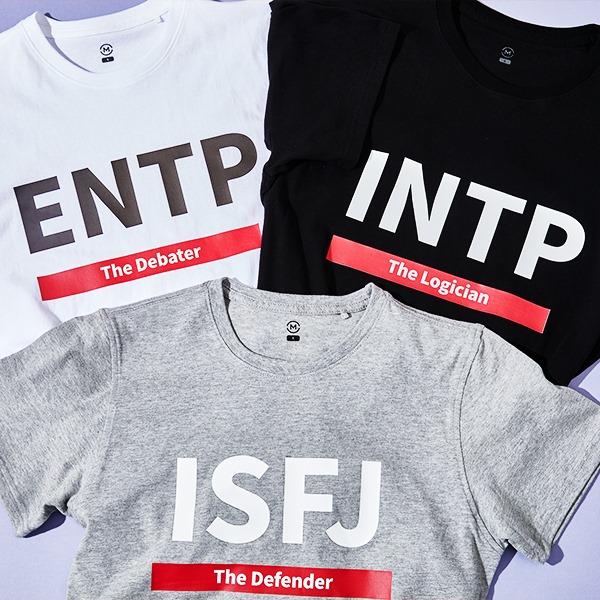
[Asia Economy Reporter Chunhee Lee] The personality type test 'Myers-Briggs Type Indicator (MBTI)' is causing a huge trend. It is having a wider impact than past personality classifications based on blood type or zodiac signs. However, recently, concerns about over-immersion in MBTI have emerged, as some people blindly trust MBTI results, form prejudices against others, or even announce 'no application' for certain MBTI types classified as introverted (I) during hiring processes.
MBTI is a personality type test developed by the mother-daughter duo Katherine Briggs and Isabel Myers. It is a self-report inventory measured by respondents answering questions themselves. While there are complex tests and versions for children and adolescents, it is generally conducted using 'Form M' consisting of 93 two-choice questions or 'Form Q' with 144 questions.
MBTI is based on Carl Gustav Jung's 'Psychological Types' theory. Jung believed that there are four basic psychological functions in human consciousness: Thinking (T), Feeling (F), Sensing (S), and Intuition (N). Everyone uses these functions, but the degree to which each is developed varies, resulting in individual personality differences.
Based on this, the MBTI test classifies personality into two types in four dimensions: ▲Extroverted (E), sociable and lively, versus Introverted (I), quiet and reserved ▲Sensing (S), focusing on concrete facts, versus Intuition (N), focusing on ideas and meanings ▲Thinking (T), analytical and objective, versus Feeling (F), empathetic and emotional ▲Judging (J), systematic and orderly, versus Perceiving (P), flexible and spontaneous. These four indicators are combined as letters to create 16 personality type combinations.
How much can we trust MBTI? ... "There must be limitations"
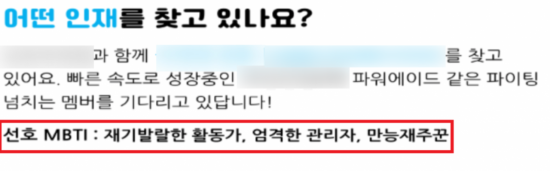 A job posting from a company specifying the preferred MBTI type of applicants.
 Photo by JobKorea capture
For evaluating psychological tests, 'reliability' and 'validity' are key indicators. MBTI results often change each time the test is taken. To trust a test, similar results should appear upon repeated testing. While the four indicators of MBTI individually have a high probability of reproducibility, the chance of reproducing the exact 16 personality types is lower. Even if the reproducibility of each of the four indicators reaches 90%, the probability of getting the same personality type is only about 65.6%. In terms of validity, MBTI's dichotomous question structure and self-report format inherently limit its accuracy in measuring personality.
Professor Oh Jooyoung of the Department of Psychiatry at Gangnam Severance Hospital pointed out, "Most people do not lean extremely toward one side of the personality traits distinguished by MBTI but often have characteristics of both sides. If one trait is not prominent, dichotomous classification may not be accurate." He also noted, "In self-report tests, if individuals cannot accurately assess themselves, the results may differ from their actual personality." He added that since only 16 personality types can be classified, MBTI has limitations in properly distinguishing the diverse personalities of many people.
In fact, MBTI tests are rarely used in most psychiatric clinical settings. MBTI does not categorize personalities as good or bad, nor is it designed to assess pathological conditions. In psychiatry, personality problems requiring treatment are diagnosed based on the 'Diagnostic and Statistical Manual of Mental Disorders (DSM-5)' criteria, and personality disorders are diagnosed when problems exist. These are classified and treated into Cluster A (paranoid, schizoid, schizotypal), Cluster B (histrionic, narcissistic, antisocial, borderline), and Cluster C (obsessive-compulsive, avoidant, dependent).
In clinical practice, the 'Minnesota Multiphasic Personality Inventory (MMPI)' is widely used. It helps effectively diagnose various mental pathologies of patients visiting psychiatry beyond personality. It is known as the most widely used objective psychological test worldwide. Other tests include the 'Temperament and Character Inventory (TCI),' which distinguishes innate temperament from acquired personality, and the 'Big Five Inventory (BFI),' which evaluates five personality traits: openness, conscientiousness, extraversion, agreeableness, and neuroticism.
Rather than being trapped in the MBTI framework, complement your strengths and weaknesses yourself
 Oh Ju-young, Professor of Psychiatry, Gangnam Severance Hospital
Professor Oh advised, "Since MBTI has several limitations, one should not rigidly categorize personality types or make definitive judgments about others' personalities." He said, "There is certainly an advantage in lightly using MBTI as a tool to understand one's own or others' personality traits and to communicate with others," but added, "Because every individual's personality is different, blindly trusting the results and forming prejudices or making quick judgments about others is undesirable."
He also advised that instead of confining oneself within a single MBTI category, it is better to consider the test as a reference to leverage one's personality strengths and improve weaknesses to become a better person. The DSM-5 also seriously considers a dimensional approach, recognizing that mental disorders, including personality disorders, exist on a continuum rather than simply categorizing them as present or absent. Professor Oh said, "Since people's personalities can exist on various continuums, rather than easily categorizing them as good or bad, it is necessary to keep in mind that everyone's personality is different and to use MBTI in a desirable way."
© The Asia Business Daily(www.asiae.co.kr). All rights reserved.


















