Samsung Electronics Accelerates Development of Automotive LED Technology
Samsung Electro-Mechanics Boosts Automotive MLCC Business
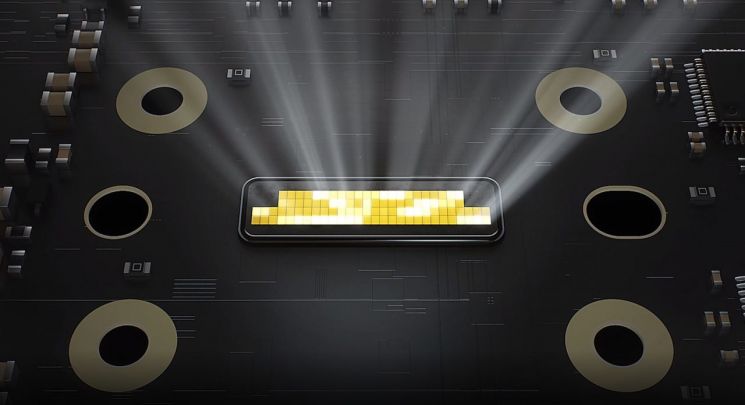
[Asia Economy Reporter Moon Chaeseok] Samsung is accelerating its high-quality automotive parts business. The eldest sibling, Samsung Electronics Semiconductor (DS) Division's Light Emitting Diode (LED) business team, has begun to gain recognition for automotive LED technology domestically, while Samsung Electro-Mechanics is actively attracting customers by holding exhibitions showcasing its automotive stacked ceramic capacitor (MLCC) technology. They have found new business opportunities in the explosively growing electric and autonomous vehicle sectors.
According to Samsung, on the 21st, the DS Division LED business team’s automotive pixel LED received the Presidential Award at the 'International Optical Convergence O2O Expo.' Samsung Electronics attributed this award to "reaffirming LED technology leadership." It was recognized as a top-tier domestic expert and is accelerating efforts to become world-class. Leveraging its capabilities as a traditional LED powerhouse, Samsung plans to speed up its automotive LED business.
Samsung Electronics DS Division directly manages the automotive LED business to improve technological efficiency and create business synergy. From a technical perspective, semiconductor technology allows reducing the emitting area and simplifying design to enhance production efficiency. The process steps of semiconductor and LED, such as substrate patterning (photo process → etching → cleaning) and exposure (printing circuit patterns on wafers with light), are generally similar, enabling synergy. The main difference is the use of wafers other than silicon wafers used in semiconductors.
Samsung Electronics possesses the technological capability to implement the principle of gathering segments?the smallest unit of individually driven light-emitting elements per LED chip?into a single LED chip. Instead of installing individual LED segments on the substrate, about 100 segments are integrated into one LED. This is similar to battery cell companies increasing density to fit as many batteries as possible inside a vehicle. For pixel LEDs, by simplifying the optical system and heat dissipation structure design, the required brightness can be achieved with only about 1/16 of the emitting area compared to other intelligent headlamp LED modules. This allows reducing headlamp size by 30-50%. Additionally, by installing partitions between each of the approximately 100 segments to minimize light interference, a contrast ratio of 300:1?three times higher than conventional LEDs?can be realized.
What is even more noteworthy is the business aspect. This is also a strategic move to diversify the portfolio beyond LEDs to include image sensors and system semiconductors. Alongside fierce competition with Taiwan's TSMC in foundry 3-nanometer process yield (the ratio of good products among finished goods), Samsung cannot neglect business expansion. According to market research firm Omdia, the global LED market size last year grew 15.4% year-on-year to $17.65 billion, with an expected compound annual growth rate of 4.5% from 2021 to 2027. Narrowing down to automotive LEDs, the market is expected to grow to about $2.96 billion by 2026.
However, it is true that Samsung is still a follower in the automotive LED sector rather than the entire LED market. Maeng Kyung-moo, Executive Director of Samsung Electronics LED Business Team’s Strategic Marketing Team, said, "The excellence of Samsung Electronics' automotive LED technology and its innovation toward a safe and comfortable life have been recognized," adding, "We will continue to innovate to provide high-quality light source solutions suitable for future vehicles centered on pixel LEDs and realize sustainability in all areas of life."
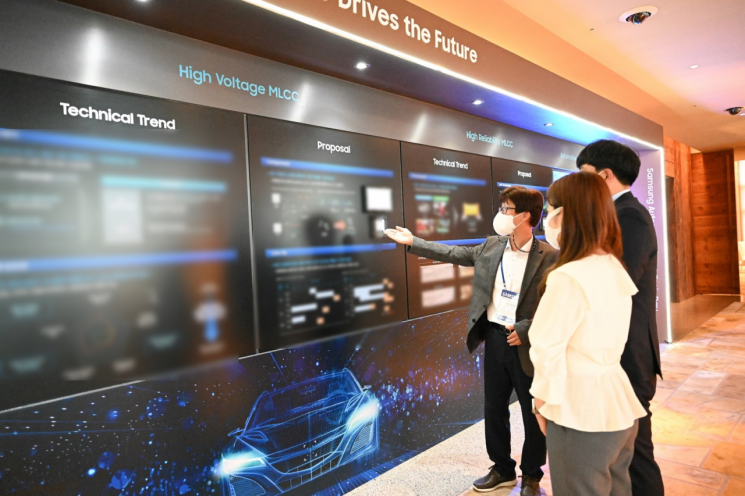 An employee explaining a product to a customer at the Samsung Electro-Mechanics Tech Day. (Photo by Samsung Electro-Mechanics)
Samsung Electro-Mechanics is strengthening its automotive MLCC business. It is diversifying its portfolio in response to the electric and autonomous vehicle era. Jang Deok-hyun, CEO of Samsung Electro-Mechanics, emphasized at the recent shareholders' meeting, "With the expansion of the electric and autonomous vehicle market, automotive products will become a future growth axis for Samsung Electro-Mechanics," and added, "We are focusing our capabilities on the automotive business along with next-generation information technology (IT) products."
On the 23rd and 24th, the company held the '2022 MLCC Tech Day' at its Busan plant for the first time in three years since 2019, introducing its automotive MLCC technology to about 100 customers from automakers and parts suppliers. The event shared the mid-to-long-term vision for its automotive MLCC and proposed high-level technical solutions such as high-capacity, high-voltage, and high-reliability (bending strength, high temperature) products to customers. The MLCC manufacturing process was disclosed to aid product understanding and showcase technological prowess. Cho Guk-hwan, Vice President and Head of Strategic Marketing at Samsung Electro-Mechanics, said, "Samsung Electro-Mechanics' automotive MLCC can provide differentiated solutions to customers based on excellent high-capacity, high-voltage, and high-reliability technology," and added, "We will continue various marketing events to maintain closer communication with customers."
Samsung Electro-Mechanics is expanding its automotive business. As demand for electric and autonomous vehicles increases, automotive MLCCs are naturally gaining attention. Although MLCCs account for about half of the company's sales, the automotive MLCC segment is considered insufficient, and plans are underway to expand it to more than 10% of total sales. Since cars are much larger than smartphones, they require more MLCCs. While a flagship smartphone contains about 900 to 1,100 MLCCs, internal combustion engine vehicles use 3,000 to 5,000, and electric vehicles can have more than 10,000. Samsung Electro-Mechanics' expansion of 'automotive management' is also observed in other affiliates such as Samsung Electronics, which is growing its market position through automotive Light Emitting Diodes (LEDs) like pixel LEDs for electric and autonomous vehicles.
Already recognized as a global MLCC manufacturer, Samsung Electro-Mechanics is developing and producing automotive MLCCs for advanced driver assistance systems (ADAS), powertrains, and braking systems (ABS). The company is fully focused on expanding its automotive MLCC portfolio. Particularly, based on technology such as ultra-fine materials and next-generation equipment development, it has secured industry-leading competitiveness in product lifespan, product stability, and withstand voltage characteristics. Withstand voltage refers to the maximum voltage a product can endure without damage. Samsung Electro-Mechanics stated, "Based on technology in ultra-small, ultra-high-capacity MLCCs, we plan to strengthen our automotive product lineup equipped with high temperature, high pressure, and high reliability to expand the market."
© The Asia Business Daily(www.asiae.co.kr). All rights reserved.
![Clutching a Stolen Dior Bag, Saying "I Hate Being Poor but Real"... The Grotesque Con of a "Human Knockoff" [Slate]](https://cwcontent.asiae.co.kr/asiaresize/183/2026021902243444107_1771435474.jpg)

















