Pain focused on hands and soles with lymph node discomfort
Most cases naturally recover within 4 weeks
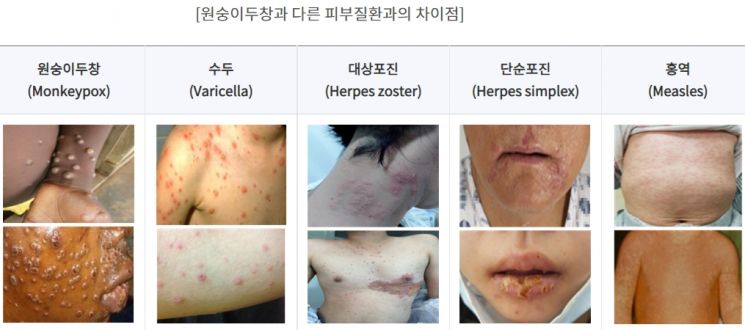
[Asia Economy Reporter Jo In-kyung] As the first confirmed case of monkeypox in Korea is receiving treatment, another foreigner who was classified as a suspected case and tested around the same time was ultimately diagnosed with chickenpox, not monkeypox. Experts explain that although the main symptom of monkeypox, vesicular rash, appears similar to other diseases such as chickenpox or shingles at first glance, there are differences in the shape and spreading pattern of the rash, as well as lymphadenopathy in the neck and armpits.
According to data from the Korea Disease Control and Prevention Agency and the Korean Society of Infectious Diseases on the 25th, patients infected with monkeypox typically begin with acute fever above 38.5℃, headache, lymphadenopathy, muscle pain, back pain, and severe fatigue, followed by a rash appearing mainly on the face within 1 to 3 days.
The rash, which starts as round red papules, develops into vesicles (blisters) or pustules (pus-filled lesions) and spreads to other parts of the body. It tends to concentrate on the face, palms, and soles, and also appears on the mouth, genitals, and eyes. These symptoms last about 2 to 4 weeks, progressing to the crusting stage, and most cases naturally recover within 4 weeks. Symptoms are generally known to appear within 5 to 21 days after infection, with an average of 6 to 13 days.
However, some patients may progress to severe illness. Treatment is generally symptomatic according to the symptoms, but in severe cases, antiviral drugs used for smallpox or immunoglobulins are administered. Children and immunocompromised individuals have a higher risk of severe infection and may develop complications such as pneumonia, encephalopathy, or sepsis, requiring careful attention.
Because the vesicular rash of monkeypox resembles other skin diseases, it is not easy to distinguish based on appearance alone.
For example, chickenpox, like monkeypox, features vesicles and pustules spreading throughout the body. Monkeypox rash progresses from the head toward the limbs, whereas chickenpox mainly spreads on the trunk. Also, monkeypox rashes have clear borders, while chickenpox rashes have unclear borders. About 75% of monkeypox patients show rashes on the palms and soles, which is rare in chickenpox. Lymphadenopathy with firm tenderness in the neck and armpits is also a prominent symptom of monkeypox.
Shingles also produces vesicles and pustules but appears in a band-like pattern along nerve ganglia (dermatomes), making it relatively easy to distinguish. When shingles spreads throughout the body, differentiation becomes difficult, but like chickenpox, it rarely affects the palms and soles. In contrast, measles causes rashes all over the body but does not produce vesicles or pustules.
The government issued a monkeypox alert level of "interest" on the 31st of last month and designated it as a second-class legal infectious disease on the 8th of this month. Accordingly, confirmed patients must be hospitalized and isolated for treatment. Medical institutions are obligated to report suspected cases to quarantine stations, medical institutions, or public health centers, and health authorities conduct separate epidemiological investigations.
The Korea Disease Control and Prevention Agency plans to import 500 doses of the monkeypox treatment drug "Tecovirimat" domestically next month. Additionally, before this treatment is introduced, they have secured 100 doses of the antiviral drug "Cidofovir" and "Vaccinia Immunoglobulin" for use.
© The Asia Business Daily(www.asiae.co.kr). All rights reserved.
![Clutching a Stolen Dior Bag, Saying "I Hate Being Poor but Real"... The Grotesque Con of a "Human Knockoff" [Slate]](https://cwcontent.asiae.co.kr/asiaresize/183/2026021902243444107_1771435474.jpg)











