Public Hearing on '2040 Seoul Urban Basic Plan' Held on the 24th
At Seosomun Annex Welfare Building, Seoul City Hall
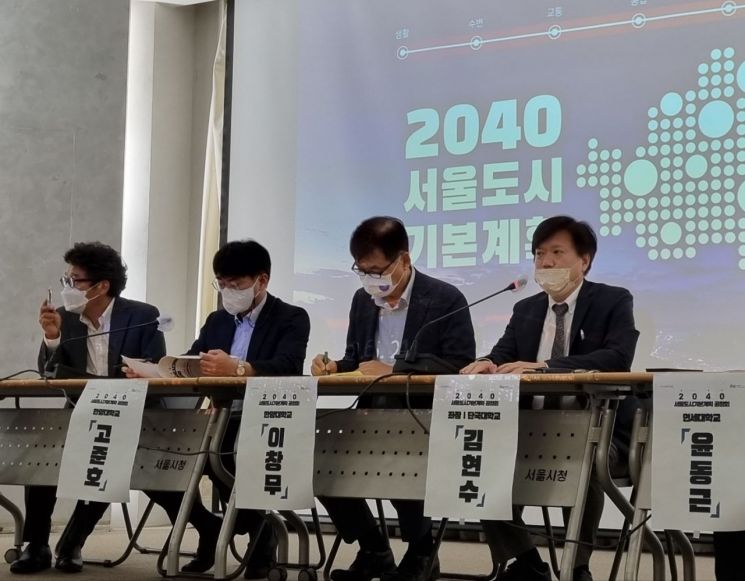 On the afternoon of the 24th, the Seoul Metropolitan Government held a public hearing on the '2040 Seoul Urban Master Plan' at the Welfare Building of Seosomun Annex, Seoul City Hall, listening to the opinions of citizens and experts. Photo by Hwang Seoyul
[Asia Economy Reporter Hwang Seoyul] It has been pointed out that for the smooth progress of the ‘2040 Seoul Urban Master Plan,’ it is important how Seoul City will mediate conflicts arising from deregulation. As the plan includes the introduction of a flexible zoning system and the relaxation of the ‘35-floor rule,’ there may be increased demands for deregulation in redevelopment areas such as maintenance projects in the future.
At the ‘2040 Seoul Urban Master Plan Public Hearing’ held on the 24th at the Seosomun Annex Welfare Building of Seoul City Hall, Professor Lee Chang-moo of Hanyang University’s Department of Urban Engineering stated, “For Seoul City’s plan to proceed properly, it is important to manage the demands and conflicts related to deregulation.” The urban master plan is the highest-level spatial plan and a legally effective plan for detailed plans to be developed later.
On the same day, the city introduced ‘Urban Planning Transformation,’ one of the six major spatial plans, and announced its intention to create a flexible master plan system. Through the new zoning system called ‘Beyond Zoning,’ the plan aims to increase autonomy in land use introduction and enable the city to perform multifunctional roles. It also includes the deletion of the ‘35-floor height standard’ to create a more flexible cityscape. Kim In-hee, a senior researcher at the Seoul Institute who presented the plan, said, “The city will make use of land use changes and management flexibilization within the legal framework and work with the Ministry of Land, Infrastructure and Transport to reform the legal system and establish a new zoning system.”
Professor Lee Chang-moo’s remarks are interpreted as anticipating conflicts that may arise when drafting subordinate plans under the broad framework of ‘Beyond Zoning.’ If land use or floor area ratios are set differently for each project area, dissatisfaction may arise, potentially slowing the city’s plan progress. In fact, maintenance project association officials attending as citizens on the day showed strong interest in deregulation related to specific floor area ratios and height restrictions in maintenance districts.
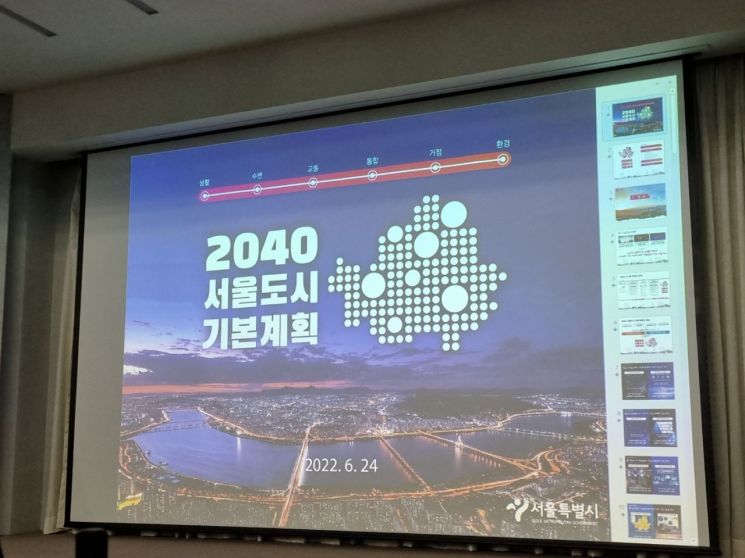
There were also voices that the content related to the climate crisis was not well reflected in the spatial plan. Professor Yoon Dong-geun of Yonsei University’s Department of Urban Engineering said, “While the climate crisis is included in sectoral plans, there is a lack of connection to spatial planning,” adding, “Since the climate crisis will be a major issue for future generations, it should be actively addressed in urban planning.” A citizen identified as A, who attended the public hearing, also expressed regret, saying, “While changes in Seoul due to technological innovations in housing and transportation infrastructure were focused on, I hope measures related to climate change are also included in the plan.”
Meanwhile, in addition to ‘Urban Planning Transformation,’ the six major spatial plans include ▲creating a ‘Walkable Daily Life Zone’ where daily life can be enjoyed within walking distance ▲reorganizing waterfront-centered spaces such as the Han River ▲innovating central areas with the three axes of Seoul downtown, Gangnam, and Yeouido ▲three-dimensional infrastructure development such as undergrounding ground-level railroads ▲and expanding future transportation infrastructure.
The final announcement of the ‘2040 Seoul Urban Master Plan’ is expected to be released as early as October to November after the public hearing, following consultations with related agencies such as the Ministry of Land, Infrastructure and Transport, national planning evaluations, opinions from the city council, and deliberations by the Urban Planning Committee. Cho Nam-jun, Director of the Urban Planning Division of Seoul City’s Urban Planning Bureau, said, “We were able to hear various voices through the public hearing,” and added, “We will strive to ensure that the master plan is not only a basic urban plan but also a plan for genuine future development.”
© The Asia Business Daily(www.asiae.co.kr). All rights reserved.


















