[DTx Era⑥] VR DTx Experience
New World Unveiled Wearing the Device
Organizing Numbers 1-10 and Trash Room in Order
Algorithm Designed in Collaboration with Leading Medical Professionals
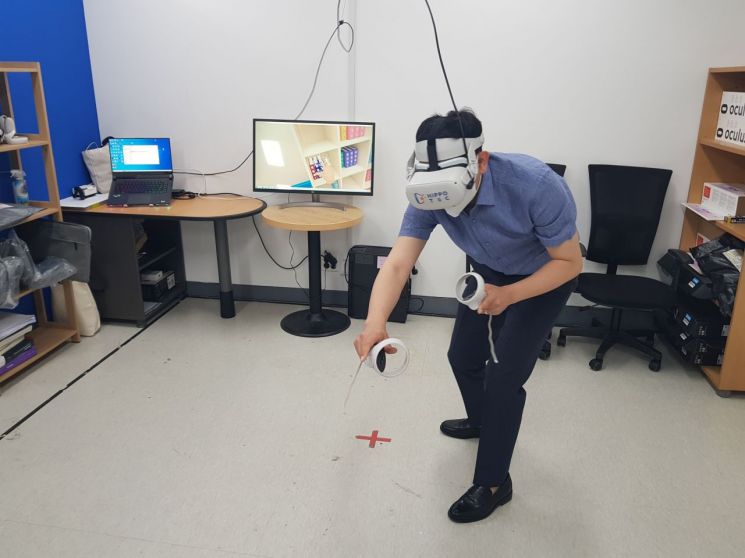 A reporter from this publication is experiencing Hipoti&TC's ADHD digital therapeutic 'AttentionCare (Attnkare)'.
The moment I put on the virtual reality (VR) device, a new world opened up. There was a small two-story house between the blue sky and lush trees, and a cute character resembling a jjukkumi (webfoot octopus) appeared and greeted me warmly. After a brief introduction and explanation of the controller, the game began. The first mission was to organize numbers. I had to arrange the numbers scattered messily on the blackboard in order from 1 to 10 together with the character. The character found number 1 first and immediately found number 2 to place next in order. The character’s friend only found the numbers after moving their 2nd and 3rd fingers. Slowly, we filled in the numbers one by one and finished up to 10.
After completing the first mission, the next scene was a room scattered with trash and books here and there. Now, the task was to clean up this room. By moving the controller in my hand, I could pick up trash and books lying on the floor. Trash was put into the trash bin, and books were neatly placed on the bookshelf. It was no different from cleaning a real room. The VR world, which I was experiencing for the first time, was amazing, and seeing the room clean and tidy gave me a sense of pride as a bonus.
Just as I thought I had enjoyed a fun game, all the games ended and the results of the concentration and self-control test came out. The results sheet showed a graph indicating the levels of indicators composed of items such as concentration, memory, planning ability, sociability, and self-control. It was not just a game to enjoy but a diagnosis of whether the player had Attention Deficit Hyperactivity Disorder (ADHD). Hipoti&TC’s ‘AttnKare’ is a digital therapeutic (DTx) that diagnoses children’s concentration and other abilities through VR and treats ADHD.
Can ADHD really be accurately diagnosed through such VR activities? The accuracy of AttnKare showed results almost identical to diagnoses by psychiatric specialists and judgments by parents about their children. This was possible because all algorithms were designed in collaboration with medical staff from prestigious domestic hospitals such as Samsung Medical Center and Seoul National University Bundang Hospital. The diagnosis is never made simply. It comprehensively evaluates not only whether the given game was performed well but also behaviors and gaze during the task. Tae-myung Jeong, CEO of Hipoti&TC (professor of Software Engineering at Sungkyunkwan University), explained, “Children with poor concentration sometimes suddenly look out the window or get angry in the middle of a mission. We do not judge based on whether they do well or poorly in the game but analyze all behavioral patterns including hand gestures, foot movements, and gaze to diagnose.”
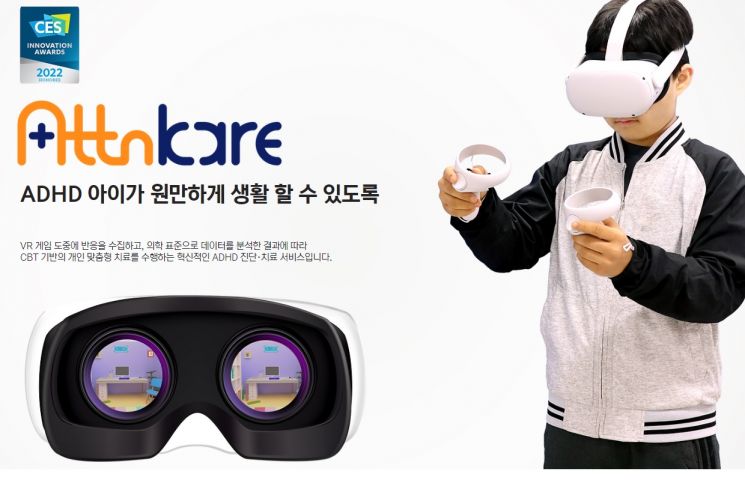
After diagnosis, treatment through games and missions is also possible. Using a tablet, children perform missions such as adventure games for intellectual development and planning room cleaning to enable a more organized lifestyle. There are also missions that assign homework to parents. Upon completing the given missions, rewards such as items to decorate the virtual room are provided. CEO Jeong said, “Skinship between parents and children is important for autism and ADHD,” adding, “We give missions like ‘Go buy a cola with your child’ and help them carry it out.”
The innovation of AttnKare was proven by winning two awards (Virtual & Augmented Reality category and Digital Health & Wellness category Innovation Awards) at CES 2022, the world’s largest information and communication technology and home appliance exhibition. On the 15th, it also received medical device approval from the Ministry of Food and Drug Safety. Currently, clinical research is underway at Samsung Medical Center, Samsung Changwon Hospital, and others, with plans to begin confirmatory clinical trials with the Ministry of Food and Drug Safety in September to October.
CEO Jeong hopes AttnKare will become a DTx for children. It is estimated that 350,000 children in Korea suffer from ADHD, and depending on symptoms, some face bullying at school or have difficulty living properly. He said, “Many parents try to hide it and are afraid to go to the hospital. If AttnKare is installed somewhere, diagnosis can be done even outside hospitals, and based on the results, they can seek hospital care.”
© The Asia Business Daily(www.asiae.co.kr). All rights reserved.


















