Next Year's Minimum Wage Deliberations See Clash Between Business and Labor Sectors
Producer Prices Hit Record High... Five Consecutive Months of Increase
"Will Labor Costs Add to Inflation?" Concerns Raised by Self-Employed
Key Issue: 'Differential Application by Industry,' Focus on Continued Discussions
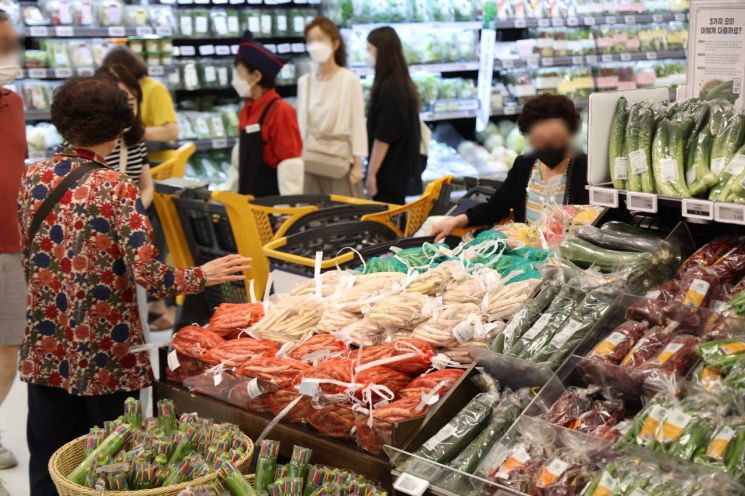
[Asia Economy Reporter Kim Jeong-wan] In the deliberations on next year's minimum wage, the business sector initially proposed maintaining the current rate of 9,160 won, while the labor sector suggested 10,890 won. Among small business owners, concerns are rising that the burden of labor costs will sharply increase following the rise in food ingredient prices.
On the 23rd, at the 6th plenary meeting of the Minimum Wage Commission held at the Government Complex Sejong, the business representatives proposed freezing the minimum wage at 9,160 won for next year. Ryu Ki-jung, Executive Director of the Korea Employers Federation and a user representative, stated in his opening remarks, "From 2017, the minimum wage has increased by 44.6% over five years, but labor productivity per person increased by only 4.3%, and hourly labor productivity by 11.5% during the same period." He added, "Considering companies' payment capacity and the statutory decision criteria, it is difficult to raise the minimum wage next year compared to this year."
Earlier, on the 21st, the labor sector proposed an initial demand for next year's minimum wage of 10,890 won, which is 1,730 won higher than the current rate. The worker representatives of the Minimum Wage Commission stated, "This is about 80% of the appropriate subsistence wage we calculated ourselves, which is 13,608 won per hour (2,844,070 won per month)." They added, "We considered the current economic situation and assumed a gradual achievement."
The minimum wage has been steadily rising recently, but the amount proposed by the labor sector represents an 18.9% increase compared to the current rate. If this demand is reflected, it would mark the highest increase rate since 2018. Since 2017, the minimum wage trend has been △2017: 6,470 won △2018: 7,530 won △2019: 8,350 won △2020: 8,590 won △2021: 8,720 won △2022: 9,160 won, showing an upward trend. However, after the 16.4% increase from 6,470 won in 2017 to 7,530 won in 2018, the increase rate has never exceeded 15%.
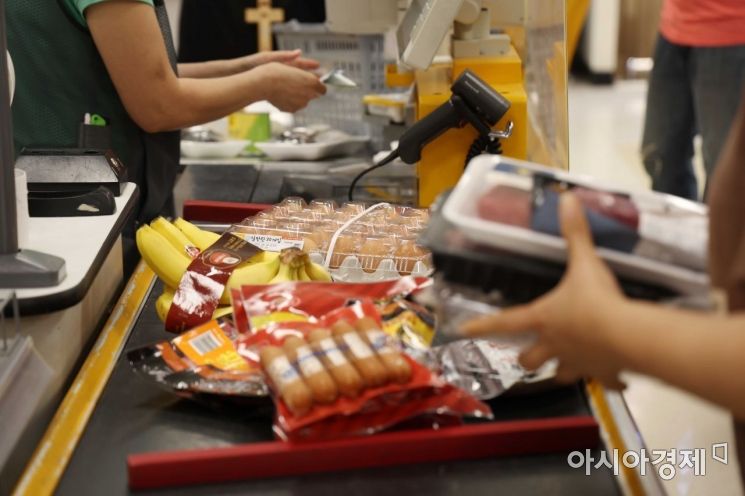 Rising prices of ingredients and other goods continue, increasing concerns among self-employed business owners about labor costs.
Among self-employed restaurant owners in the food service industry, there are concerns that the proposed wage exceeding 10,000 won will add to the burden of rising food ingredient prices. Kang (in his 50s), who has operated a restaurant in Mapo-gu, Seoul for 11 years, said, "Even if many people come after social distancing measures were lifted, there is little profit left after buying ingredients. All food ingredient prices have gone up." He lamented, "If they tell us to raise labor costs too, small business owners like us are being told to go out of business."
Prices in the grocery basket are rising day by day. According to last month's inflation rate from Statistics Korea, prices of livestock products rose significantly: chicken by 16.1%, pork by 20.7%, and imported beef by 27.9%. Processed foods also saw price increases in 69 out of 73 items, including noodles by 33.2%, flour by 26%, and cooking oil by 22.7%. Additionally, major food items such as vinegar rose by 21.5%, soybean paste by 18.7%, and soy sauce by 18.4%, all increasing by more than 10%.
There are opinions that if the minimum wage rises sharply, businesses will have to reduce staff and revert to family-run operations to survive. Kwon (in his 40s), who runs a pub in Jongno-gu, said, "After the losses during COVID-19, we thought things were easing up, but now I am worried." He added, "Business hours have increased and there are more customers, so we need more part-time workers, but with the minimum wage going up, we can't just lay them off next year." He continued, "If it goes up too much, I will have to ask for help from family members. Other prices are also rising, so the burden is too great."
Last month, domestic producer prices also hit an all-time high. According to the 'Producer Price Index for May 2022' released by the Bank of Korea on the 23rd, the producer price index last month was 119.24, up 0.5% from the previous month. Producer prices have been rising for five consecutive months since January this year. Son Jin-sik, head of the Price Statistics Team at the Bank of Korea's Economic Statistics Bureau, explained, "The Ukraine crisis and supply chain disruptions have pushed up raw material prices such as international oil prices, which have been reflected in import prices, driving up producer prices."
 A convenience store in Seoul operating at night. The photo is unrelated to specific expressions in the article.
There are also concerns that industries operating continuously, such as convenience stores and PC rooms, face unavoidable burdens due to fixed expenses.
Kim (47), who runs a convenience store, said, "Due to the 24-hour operation nature, fixed labor costs inevitably occur. Convenience stores don't follow trends, and profits are always similar, but considering the four major insurances and weekly holiday allowances, the burden is real." He added, "I hope differential application can be made for jobs with less difficulty."
Meanwhile, conflicts between the business and labor sectors continue over whether to apply differentiated minimum wages by industry. Although the proposal was rejected after votes on the 16th and 17th, conflicts surrounding this issue persist.
© The Asia Business Daily(www.asiae.co.kr). All rights reserved.
![Clutching a Stolen Dior Bag, Saying "I Hate Being Poor but Real"... The Grotesque Con of a "Human Knockoff" [Slate]](https://cwcontent.asiae.co.kr/asiaresize/183/2026021902243444107_1771435474.jpg)


















