[Seoul District News] Seongbuk-gu Signs Agreement with 13 Seongbuk-style Care SOS Center Service Providers on the 22nd... Dongdaemun-gu Installs Landscape Lighting on Yeonryukgyo Bridge and Improves Pedestrian Environment around Chuljangso Hill, Installs Movie-Themed Murals and Artworks near Dapsimni Chuljangso Intersection... Seocho-gu Operates 'Seoripul Ilgakeun' to Care for Pets When Single-Person Households Go on Business Trips or Travel
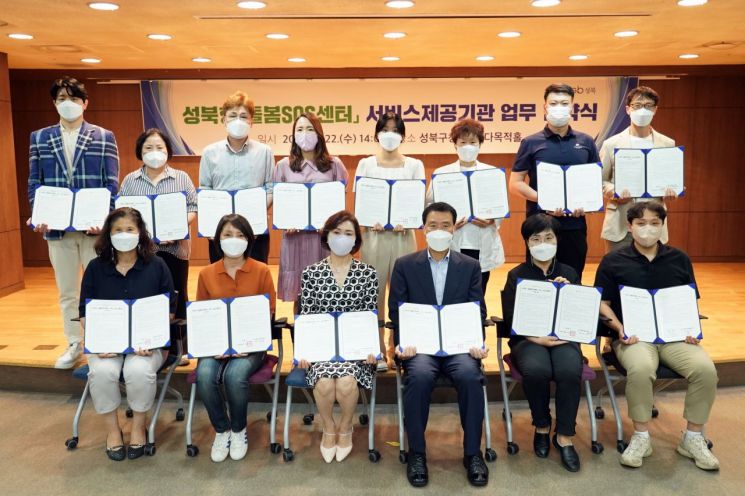
[Asia Economy Reporter Park Jong-il] Seongbuk-gu (Mayor Lee Seung-ro) signed an agreement on the 22nd with 13 service providers to strengthen the Seongbuk-style 'Care SOS Center' service.
Seongbuk-gu recruited service providers from May 23 to secure partners for the Care SOS project, receiving applications from a total of 7 institutions and selecting 2.
Additionally, among the 13 institutions whose agreements had expired, 11 were selected through a re-agreement evaluation and renewed their contracts.
The Seongbuk-style Care SOS project began in August 2020 and is now in its third year. In January 2022, Care SOS Centers were established in all neighborhoods (dong), and care managers (social welfare public officials) were assigned to eliminate care blind spots. Currently, agreements are in place with 48 institutions, and as of May 2022, 1,774 care services have been provided.
The service provides temporary home care, short-term facility care, meal support, accompaniment support, and residential convenience services to those urgently and temporarily in need of care. Even after the service is completed, it approaches long-term care by linking with public care systems such as long-term care, disability activity support, and customized elderly care, as well as conducting welfare checks and case management.
Those in urgent need of care can apply by visiting their local community service center. Costs are fully covered for basic livelihood security recipients, near-poverty class, and households with income below 85% of the median.
Lee Seung-ro, Mayor of Seongbuk-gu, stated, “During the difficult times of COVID-19, we started the Care SOS project and have since provided customized care services to residents in care gaps, playing a significant role in improving their health and welfare. Seongbuk-gu will continue to actively identify those in need of care and build an integrated community care system through mutual cooperation with service providers, so that residents can live healthily in Seongbuk-gu for a long time.”
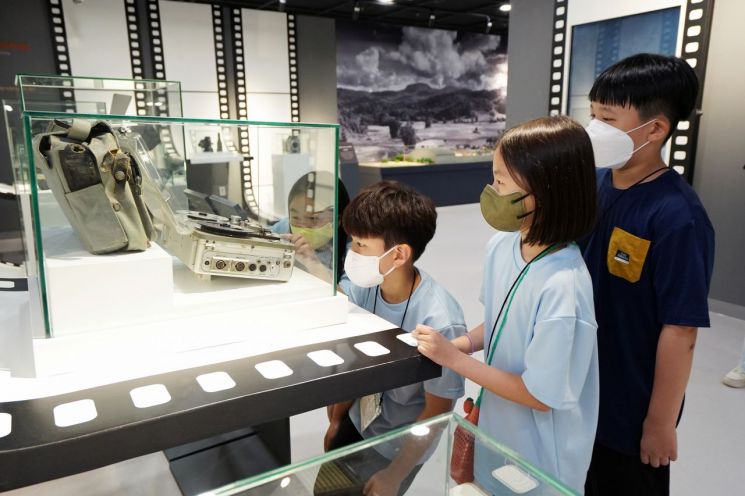
The area around Dapsimni Filming Studio Hill in Dongdaemun-gu, which led the golden age of Korean cinema in the 1960s, has been transformed into a movie street commemorating Korean films.
Dongdaemun-gu (Mayor Yoo Deok-yeol) announced the completion of the ‘Dapsimni Movie Street’ cultural and artistic space themed on Korean cinema, stretching from Chwalyeongso Intersection to Dapsimni Intersection along Chwalyeongso Hill.
The Dapsimni Filming Studio in Dongdaemun-gu was the center of Korean film production from 1964 to 1969, with over 80 films shot there. Currently, only place names such as Chwalyeongso Hill and Chwalyeongso Intersection remain.
Accordingly, Dongdaemun-gu began the ‘Dapsimni Movie Street Creation Project’ to modernly reinterpret the nostalgia of the 1960s Korean film production site and create a cultural and artistic complex space themed on movies.
Renovation of sidewalks around Chwalyeongso Hill under the theme ‘A Walk with Korean Cinema’
The district carried out a sidewalk renovation project around Chwalyeongso Hill to create ‘A Walk with Korean Cinema.’
From April to November 2019, in line with the ‘Dapsimni Movie Street Creation’ project, landscape lighting and structures shaped like film reels were installed on the Chwalyeongso Hill overpass, marking the first step in creating the movie street.
From 2020 to 2021, with cooperation from the Korean Film Association, representative films and filmmakers from each era were selected, and sidewalk environment improvements were actively carried out.
The district installed 1,793 design sidewalk blocks engraved with movie titles, directors, actors, and staff names from Chwalyeongso Intersection to Dapsimni Intersection and from Dongdaemun Sports Center to the entrance of Dongdap Hanshin Apartment. Additionally, 147 pillar-type facilities featuring photos, awards, and representative works of selected filmmakers, and 46 handprint sites of representative actors such as Eom Aeng-ran, Namgung Won, and Choi Bul-am were installed, creating a distinctive movie street around Chwalyeongso Hill.
Creation of movie-themed spaces through Dapsimni Movie Street mural project
The district exhibited movie-themed murals and artworks (public art project - Reflect) at five locations including the retaining walls on both sides of Dapsimni Filming Studio Hill Road near Dapsimni Filming Studio Intersection, providing diverse attractions.
Also, famous lines and scenes from Korean films produced from the 1960s, when the Dapsimni Filming Studio was active, through the 2010s were depicted along 260 meters of retaining walls on both sides of Chwalyeongso Hill Road. This area uses phosphorescent paint, allowing enjoyment even at night.
The retaining wall opposite Dongdaemun Sports Center is decorated with silhouettes of 12 directors and actors, adding symbolic meaning. The wall opposite Dapsimni Movie Media Art Center is adorned with rainbow-colored fragments representing over 80 films shot at the 1960s Dapsimni Filming Studio, offering a glimpse into the studio’s history.
The bus stop located on Dapsimni Movie Street recreates the appearance of the old Dapsimni Theater as a photo zone, featuring movie film relief sculptures, art benches, parody posters and signboard sculptures using Dongdaemun-gu’s character ‘Kkumdong-i.’
Although the project faced difficulties obtaining copyright and portrait rights consent for over 200 film scenes and actor images, it was successfully completed, modernly realizing Dapsimni Movie Street and creating a space for empathy and communication.
Opening of ‘Film & Media Convergence Cultural Art Space’ Dapsimni Movie Media Art Center
As part of the Dapsimni Movie Street project, the district remodeled the Dongdaemun-gu Cultural Center located at Dapsimni Filming Studio Hill and completed the creation of the ‘Dapsimni Movie Media Art Center,’ a film and media convergence cultural art space. The opening ceremony will be held at 10:30 a.m. on the 28th.
With a total project cost of about 7 billion KRW, the ‘Dapsimni Movie Media Art Center’ project took approximately 3 years and 5 months from design in 2019 to completion in May 2022.
The basement floor houses a media education center with editing rooms, recording rooms, Foley recording rooms, classrooms, equipment rooms, and storage. The first floor features a permanent exhibition hall and special exhibition hall showcasing Korean cinema and the Dapsimni film era, as well as a free movie theater. The second floor includes a virtual studio and film studio for hands-on filming experiences. The third floor contains a one-person media room, radio studio, media education room, citizen broadcasting reporter room, and cultural arts school, equipped with cutting-edge media facilities.
The Dapsimni Movie Media Art Center is operated by the Dongdaemun Cultural Foundation and will conduct pilot operations until June, with full program operations starting in July.
An official from the district said, “We created the movie street to re-examine the old memories of the Dapsimni Filming Studio, the birthplace of Korean cinema, and to transform the Chwalyeongso Hill area into a cultural and artistic space themed on movies. We hope that centered around the Dapsimni Movie Media Art Center, Dapsimni Movie Street will become a nationwide attraction and a cornerstone for the further development of Korean cinema.”
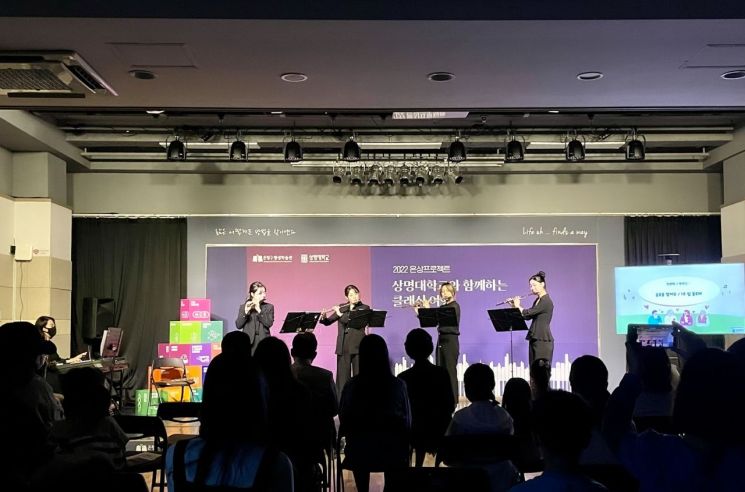
Eunpyeong-gu (Mayor Kim Mi-kyung) will hold a classical music concert titled ‘Classical Journey with Sangmyung University’ on the 25th at the 4th floor Midi Hall of the Eunpyeong-gu Lifelong Learning Center.
This concert is part of the ‘Eunsang Project,’ a collaborative initiative between Eunpyeong-gu and Sangmyung University to allow residents to enjoy high-quality cultural arts locally. It aims to invigorate the Eunpyeong area using university professional resources and provide university students with opportunities to gain major-related experience.
The performance will be presented under the theme ‘Classical Encountered through Woodwind Quintet.’ Various pieces including Air on the G String and Arirang will be performed with musical explanations, featuring flute, oboe, clarinet, bassoon, and horn ensemble.
The concert is free and open to any citizens wishing to embark on a classical journey. Applications can be made through the Eunpyeong-gu Lifelong Learning Center website by the 23rd.
Concerts will be held 1 to 2 times monthly through the end of the year. Previously, the Eunpyeong-gu Lifelong Learning Center signed a business agreement with Sangmyung University’s Department of Music in May and has been hosting classical concerts featuring various instruments. The first concert, a flute ensemble performance in May for Family Month, received positive responses.
For inquiries about the concert, please refer to the website or contact by phone.
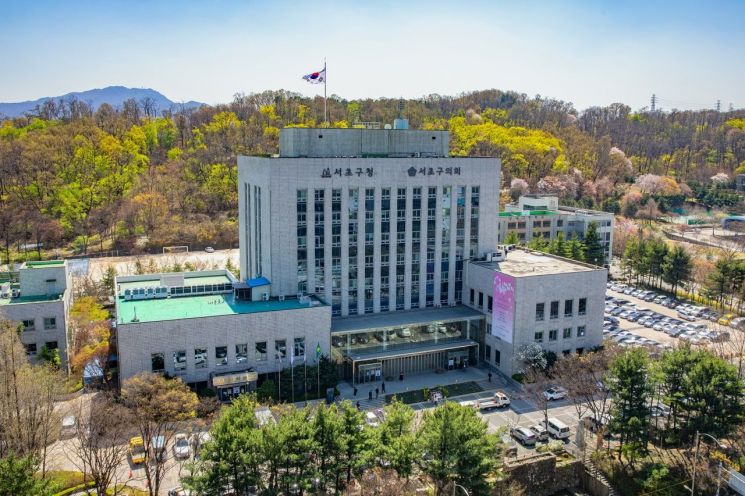
Seocho-gu announced that starting next month, it will operate a pet care service called ‘Seoripul Ilgagyeon (一家犬)’ to ease the worries of single-person households about leaving their dogs alone at home when going out.
‘Seoripul Ilgagyeon (一家犬)’ is a service for single-person households to safely entrust their dogs to professional care providers when they go out due to business trips, travel, hospitalization, etc. The name is a contraction of ‘dogs raised by single-person households.’
Seocho-gu is the first local government to provide continuous pet care services for single-person households.
Single-person households receive various free care services from two local professional pet care companies staffed with experts holding certifications from the U.S. KPA training institution.
The private pet care centers commissioned by the district provide a hotel-like atmosphere where dogs can comfortably enjoy their stay, relieving the worries of single-person households. When dogs are left at the care centers, experts provide feeding, toileting, and play activities under supervision. In the evening, dogs rest comfortably in individual hotel rooms. Staff monitor the dogs’ safety 24/7 via CCTV. Additionally, liability insurance is subscribed to prepare for any accidents.
Eligible applicants are single-person households residing in Seocho-gu with income below 150% of the median, whose dogs are registered and have completed vaccinations within one year. Those wishing to use the service must apply by phone 2 to 3 days before the desired date and submit the animal registration number and vaccination certificate to the Seocho Single-Person Household Support Center.
The care service can be used for 24 hours per session, up to 6 times annually.
The district initiated this project in response to the increasing number of single-person households raising pets as family members for emotional stability, aiming to support care services so that dogs left alone without their owners do not feel lonely, enabling single-person households and their pets to live happily together.
In addition to single-person households, the district also offers pet care services during summer vacations, Chuseok, Lunar New Year, and other holidays through the Seocho Animal Love Center, where professional pet sitters care for dogs.
Park Seong-jun, Director of the Bright Future Bureau, said, “We hope this project will help single-person households who worried about having no one to care for their dogs to raise their pets with peace of mind. We will continue to discover and provide tailored policies for single-person households to offer thorough support.”
© The Asia Business Daily(www.asiae.co.kr). All rights reserved.



















