25th Energy Committee Meeting Held... Discussion on Yoon Administration's Energy Policy Direction
22 Million TOE Energy Reduction Over 5 Years... Equivalent to 6 Years of Seoul's Electricity Consumption
Energy Cashback Expanded to 226 Cities and Counties... Review of Local Tax Reductions
Electric Vehicle Grading System Reform Also Promoted... Introduction of Fuel Efficiency System for Medium and Large Trucks
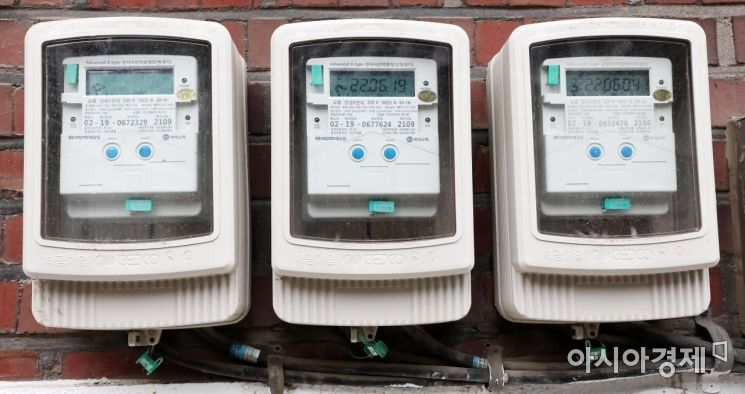 On the 19th, when the announcement on the electricity rate hike was imminent, an electric meter installed in a residential area in Seoul was seen. As prices of essential goods and energy soar across the board, and even public utility rates such as electricity, water, and gas increase, these have become major causes of rapid inflation, deepening the concerns of inflation authorities. If the government accepts Korea Electric Power Corporation's request for an electricity rate hike, there are concerns that the consumer price inflation rate, which has already recorded the mid-5% range, could exceed 6%. Photo by Kim Hyun-min kimhyun81@
[Asia Economy Sejong=Reporter Lee Jun-hyung] The government plans to improve national energy efficiency by 25% by 2027. The idea is to save the amount of electricity used in Seoul for six years over the next five years by enhancing energy efficiency.
The Ministry of Trade, Industry and Energy announced on the afternoon of the 23rd that it held the 25th Energy Committee meeting at The Plaza Hotel in Seoul. This was the first Energy Committee meeting since the inauguration of the Yoon Seok-yeol administration last month. The Energy Committee is a decision-making body that determines the direction of national energy policy. The Minister of Trade, Industry and Energy serves as the chairperson, with related ministries such as the Ministry of Economy and Finance, Ministry of Foreign Affairs, and Ministry of Environment participating.
Two agenda items were presented at this committee: ‘New Government Energy Policy Direction’ and ‘Comprehensive Measures for Energy Demand Efficiency Based on Market Principles.’ The new government energy policy direction discussed at the committee included detailed policies to implement the Yoon Seok-yeol administration’s national tasks in the energy and climate sectors, such as becoming a leading nuclear power nation and establishing energy security. The Ministry of Trade, Industry and Energy plans to finalize and announce the new government energy policy direction next month after gathering opinions from industry and experts.
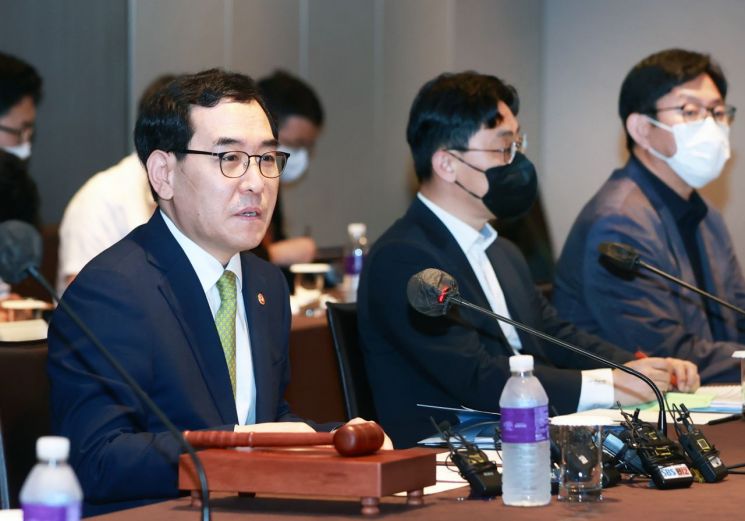 Minister Lee Chang-yang of the Ministry of Trade, Industry and Energy (left) is presiding over the 25th Energy Committee at The Plaza Hotel in Seoul on the afternoon of the 23rd.
 [Photo by Ministry of Trade, Industry and Energy]
Reduction of Six Years’ Worth of Electricity Usage in Seoul
The comprehensive measures for energy demand efficiency include a goal to reduce energy consumption by approximately 22 million TOE (tons of oil equivalent; 1 TOE equals the heat content of 1 ton of crude oil) over the next five years. This amount is equivalent to the electricity consumption in Seoul for about six years. If energy consumption decreases as targeted by the government, national energy efficiency in 2027 will improve by 25% compared to 2019.
The reason the Ministry of Trade, Industry and Energy is pushing for energy efficiency improvements is simple: South Korea is among the top 10 energy-consuming countries globally and is a low-efficiency consumer. According to the ministry, South Korea’s energy consumption is more than 1.7 times the average of the Organisation for Economic Co-operation and Development (OECD). Energy efficiency ranks 33rd out of 36 OECD countries.
Accordingly, the ministry plans to significantly enhance energy efficiency focusing on three major sectors: industry, households/buildings, and transportation. First, in the industrial sector, energy efficiency innovation at high energy-consuming sites will be actively promoted through incentives. The ministry is pushing to sign a ‘Voluntary Energy Efficiency Innovation Agreement (KEEP 30)’ with 30 high energy-consuming companies that use more than 200,000 TOE annually. The goal is to set energy efficiency innovation targets with companies and encourage innovation through government support such as ESG (Environmental, Social, and Governance) certification and awards.
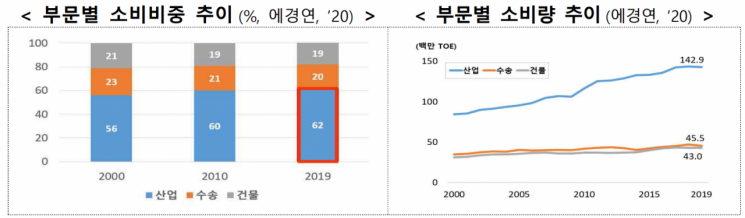 Energy consumption share and consumption trends by the three major sectors: industry, transportation, and buildings.
 [Photo provided by the Ministry of Trade, Industry and Energy]
Promotion of Regulatory Innovation Including Standby Power Reduction System
The ‘Energy Supplier Efficiency Improvement System,’ currently in pilot operation, will be made mandatory. This system obligates energy public enterprises such as Korea Electric Power Corporation, Korea Gas Corporation, and district heating corporations to support customers in improving energy efficiency according to assigned targets. A ministry official explained, “This system allows energy suppliers, who have expert personnel and consumer information, to promote efficiency improvements,” adding that it is recognized as a ‘good regulation’ proven effective in energy savings and market creation in the United States and the European Union (EU).
To enhance the effectiveness of three major efficiency management systems related to devices, including the standby power reduction system, regulatory innovation will also be pursued. Items with reduced management necessity due to market changes will be removed from the standby power reduction system, while items requiring active management will be transferred to a grading system by 2027. The high-efficiency equipment certification will be reorganized focusing on the efficiency grading system, which has a significant effect on improving product efficiency.
Additionally, the ministry plans to expand private sector participation by improving systems to enhance energy efficiency in the household and building sectors. The Energy Cashback program, currently piloted in three cities/counties including Sejong City, will be expanded to 226 cities/counties. Energy Cashback is a system where neighboring complexes and households compete on electricity reduction rates, and outstanding performers receive cashback proportional to their savings.
Collaboration between the central government and local governments will also be strengthened. To reinforce energy efficiency management for large existing buildings with a total floor area of 3,000㎡ or more, the ministry plans to delegate energy diagnosis authority to local governments and promote measures to increase energy self-sufficiency rates. Tax reductions at the local government level will also be considered after consultations with related ministries.
Revision of the ‘Rational Use of Energy Act’ Planned
In line with the trend of expanding eco-friendly vehicles, efficiency systems in the transportation sector will also be revised. The ministry plans to reorganize the current simple display system for electric vehicle electricity consumption into a grading system classified from 1 to 5. It is also pursuing the introduction of a fuel efficiency system targeting medium and large passenger and freight vehicles over 3.5 tons, which consume 21% of total transportation energy.
The construction of next-generation intelligent transportation systems (C-ITS) will also be accelerated. The government plans to pilot C-ITS on approximately 2,400 km of expressways in the Gyeongbu and metropolitan areas next year. The measures include a plan to establish C-ITS on nationwide roads by 2024.
Research and development (R&D) for energy efficiency innovation based on data will also be expedited. The ministry plans to build an ‘Energy Consumption Data Integration Platform’ targeting about 4,300 high energy-consuming business sites using new technologies such as digital twins. This platform will integrate and manage energy consumption data held by energy suppliers, allowing consumers and related service providers easy access to the data.
Furthermore, tax support for energy efficiency investments will be strengthened, and green guarantees will be newly introduced. Existing loan and subsidy systems will be operated more flexibly to increase incentives. The ministry will also strengthen the organization responsible for energy demand efficiency tasks. The Ministry of Trade, Industry and Energy plans to revise the ‘Rational Use of Energy Act’ to establish a policy foundation.
© The Asia Business Daily(www.asiae.co.kr). All rights reserved.



















