Price Competitiveness and Some Foreign Exchange Gains Are Positives
Management Uncertainty Rises and Global Economy Declines
Shipbuilding Industry Cannot Smile
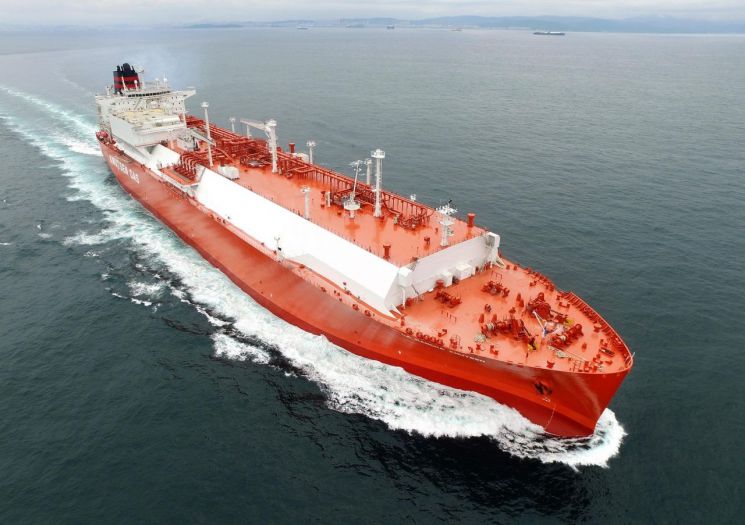 The photo shows an LNG carrier built by Hyundai Heavy Industries. The photo and the article content are not directly related. [Image source=Yonhap News]
The exchange rate has surpassed 1,300 won per dollar, but even industries traditionally known to benefit from a high exchange rate are finding it difficult to celebrate. This is because factors that have driven the exchange rate increase, such as the U.S. interest rate hikes and tightening measures, as well as rising raw material prices, are worsening business conditions.
According to the Seoul foreign exchange market on the 23rd, at around 2:09 p.m., the won/dollar exchange rate broke through 1,300 won, reaching 1,301.4 won per dollar. This is the first time in 12 years and 11 months since July 14, 2009 (when the high was 1,303.0 won) that the won/dollar rate has exceeded 1,300 won during trading hours. The sustained global inflation, the Federal Reserve's aggressive tightening stance, and the prolonged Ukraine war are analyzed as the causes of the dollar's strength and the resulting exchange rate rise.
Price Competitiveness and Some Exchange Gains Are Positive Factors
The shipbuilding industry receives payment for ship construction in dollars and is classified as a beneficiary of a high exchange rate. Generally, a high exchange rate brings price competitiveness and temporary exchange gains to export companies, including those in shipbuilding.
According to Korea Credit Rating, the net export exposure of the shipbuilding industry is 59.7%, the highest among major export sectors. Net export exposure is an indicator that measures the level at which net exports?exports minus imports?are exposed to exchange rates. The higher this value, the greater the effect of increased won revenue due to exchange rate appreciation.
Accordingly, the rise in the exchange rate can be good news for the performance improvement of shipbuilders. Exchange rate fluctuations during the contract period are directly reflected in won revenue changes, so sales increase proportionally to the exchange rate volatility. The industry estimates that overseas orders account for more than 90% of total sales for shipbuilders.
A shipbuilding industry official said, "It is true that price competitiveness and exchange gains benefit from a high exchange rate," but added, "However, with growing concerns about a global economic downturn recently, it is difficult to say that the shipbuilding industry is benefiting solely based on the economic indicator of the exchange rate."
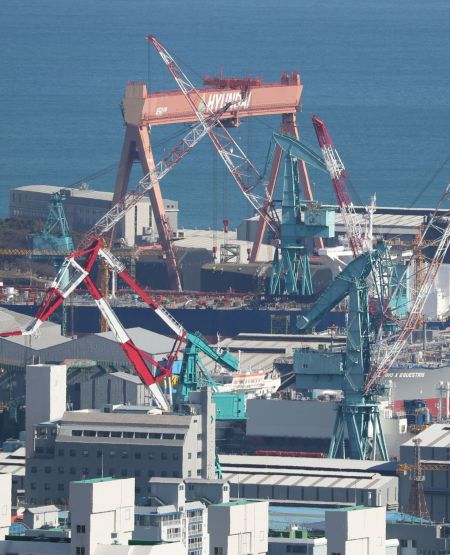 The Hyundai Heavy Industries shipyard can be seen beyond the downtown area of Dong-gu, Ulsan. The photo and the article content are not directly related.
 [Image source=Yonhap News]
Increased Management Uncertainty and Global Economic Downturn... Shipbuilding Cannot Smile
Management uncertainty caused by prolonged high exchange rates and high interest rates is a risk that does not discriminate by industry. The proposition that "exchange rate increases benefit export companies" and "will improve profitability" may not hold true this time. This is because concerns about the global economy are significant.
The shipbuilding industry also views the current situation with concern. Interest rate hikes could be accompanied by an economic recession, and if a recession materializes, the momentum for ship orders could weaken.
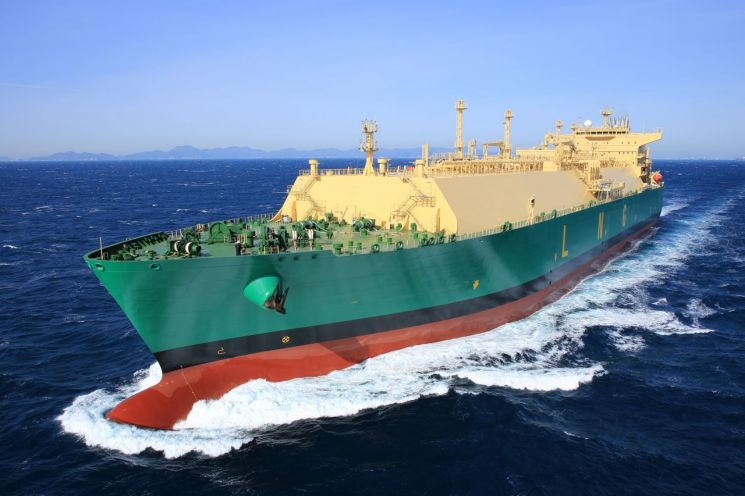 The photo shows an LNG carrier built by Samsung Heavy Industries. The photo and the article content are not directly related.
If the high exchange rate persists, the cost burden paid in dollars will also increase. Key equipment such as cargo tanks and compressors for liquefied natural gas (LNG) carriers, which the domestic shipbuilding industry continues to secure orders for, depends on imports. In particular, the French company GTT, which holds the original design technology for LNG carriers, takes 5% of the order price per LNG ship as royalties. Since French GTT holds the original design technology for membrane-type cargo tanks, domestic shipbuilders reportedly pay about 5% of the ship price, approximately 10 million dollars (about 13 billion won), as royalties for each LNG carrier built. Meanwhile, the operating profit margin per ship for shipbuilders is known to be around 1-2%.
A shipbuilding industry official said, "Companies are preventing uncertainties caused by exchange rate fluctuations through a certain level of foreign exchange hedging," adding, "While this prevents exchange losses due to exchange rate fluctuations, it also reduces exchange gains accordingly, thereby diminishing the influence of the exchange rate."
© The Asia Business Daily(www.asiae.co.kr). All rights reserved.
![Clutching a Stolen Dior Bag, Saying "I Hate Being Poor but Real"... The Grotesque Con of a "Human Knockoff" [Slate]](https://cwcontent.asiae.co.kr/asiaresize/183/2026021902243444107_1771435474.jpg)


















