Generally Positive for Export Companies but Risks from Rising Raw Material Prices
Industry Slump Including LCD Panel Price Declines
"High Management Uncertainty... Monitoring Exchange Rates"
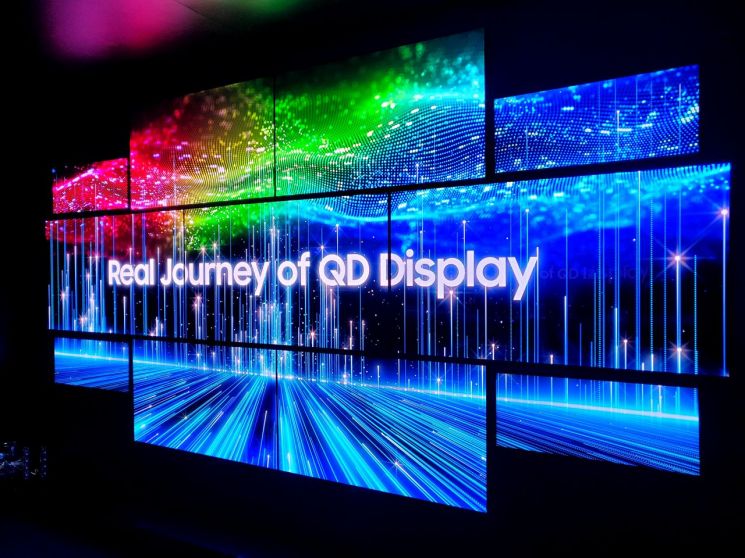 Samsung Display unveiled its QD display on January 4, 2022 (local time), one day before the opening of CES 2022, at a private booth inside the Encore Hotel in the United States. The photo shows a QD display embedded with quantum dots. (Image source=Yonhap News)
[Asia Economy Reporter Moon Chaeseok] The rise in the won-dollar exchange rate due to the strong dollar is expected to act as a positive factor for export-oriented display companies. However, the industry is closely monitoring future exchange rate trends amid significant management uncertainties such as soaring raw material prices and persistent negative factors like the decline in liquid crystal display (LCD) panel prices.
On the 23rd, the won-dollar exchange rate surpassed 1,300 won intraday for the first time in 13 years in the Seoul foreign exchange market. The industry noted that while the rise in the dollar's value is not necessarily negative news, it could have adverse effects if combined with soaring raw material prices and resulting inflation. An industry insider said, "Although export companies may have similar situations, even if there are positive aspects when the dollar value rises, if it coincides with raw material imports and intensifies inflation, negative effects can simultaneously occur."
There is also a cautious view that basic countermeasures such as currency hedging (risk avoidance) should be prepared first, and future trends should be observed. However, many believe it is difficult to make premature 'bets' on a sustained rise in the exchange rate in the second half of the year. Another industry official said, "Even if the exchange rate rise is a boon for export companies, it does not significantly affect short-term performance. We are preparing for exchange rate fluctuations through hedging, but if sharp exchange rate volatility continues long-term, management uncertainties increase, so we are monitoring closely."
For now, the securities industry is issuing negative forecasts for the display sector's second-quarter earnings. As a result, industry expectations for short-term performance gains due to the exchange rate rise are not high. On the same day, Kim Yangjae, a researcher at Daol Investment & Securities, lowered LG Display's target stock price from 24,000 won to 18,000 won, stating, "Due to logistics difficulties in Shanghai, China, there are disruptions in procuring key display materials, so it will take considerable time to improve panel supply and demand. The TV industry's shipment targets have been lowered by 10-15% after the second quarter, indicating that short-term shocks from the LCD market downturn are inevitable."
There is also an analysis that industry-specific negative news such as the decline in LCD panel prices outweighs the positive effects of the exchange rate rise. Kwon Seongryul, a researcher at DB Financial Investment, said, "The exchange rate rise is clearly a positive for export companies, but due to other sluggish factors, the benefits of the exchange rate rise are not prominent. It seems that the effects of the exchange rate rise are overshadowed by the decline in LCD prices and conservative shipment targets of TV companies."
© The Asia Business Daily(www.asiae.co.kr). All rights reserved.
![Clutching a Stolen Dior Bag, Saying "I Hate Being Poor but Real"... The Grotesque Con of a "Human Knockoff" [Slate]](https://cwcontent.asiae.co.kr/asiaresize/183/2026021902243444107_1771435474.jpg)
















