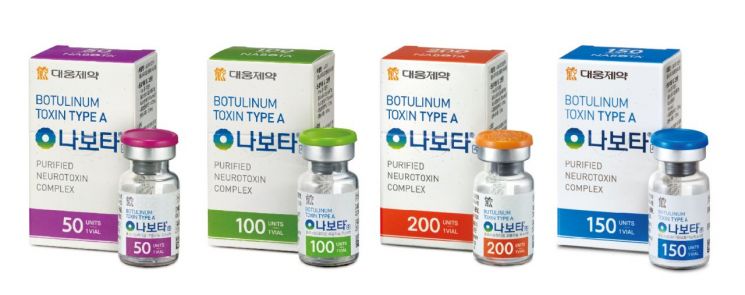
[Asia Economy Reporter Lee Chun-hee] Last year, the domestic botulinum toxin market in South Korea grew rapidly by 34%, with significant shifts in market share as companies experienced mixed fortunes. Daewoong Pharmaceutical surged to the top in production volume, led by its product 'Nabota,' while Hugel maintained steady growth. In contrast, Medytox's growth stalled.
According to the Ministry of Food and Drug Safety on the 23rd, the total value of botulinum toxin produced by domestic companies last year reached 310.8 billion KRW, a 33.7% increase compared to the previous year.
The main driver of this growth was Daewoong Pharmaceutical. The company produced botulinum toxin worth 94.9 billion KRW last year, marking a 64.5% increase from 57.7 billion KRW the previous year. Since Nabota received product approval in 2013 and entered the botulinum toxin market, it has become the top producer domestically within nine years. Notably, Nabota's production value nearly doubled from 55.5 billion KRW to 92.3 billion KRW.
Hugel, led by 'Botulax,' also recorded production worth 80.3 billion KRW, an 11.3% increase from 72.1 billion KRW the previous year, continuing its steady double-digit growth.
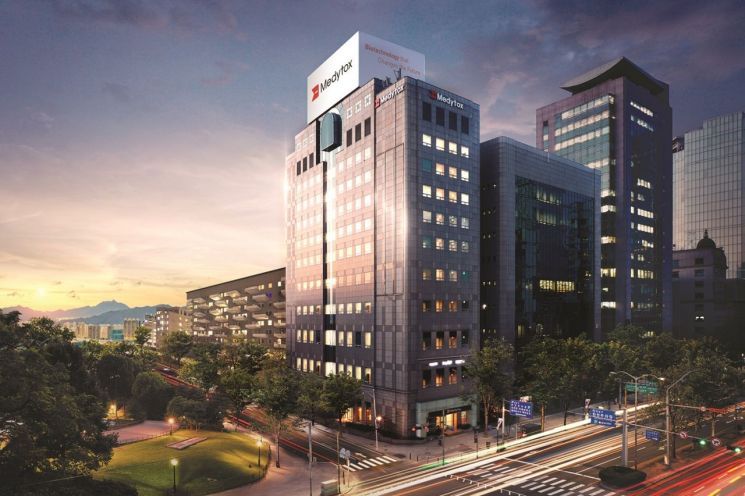
On the other hand, Medytox recorded production worth 73.4 billion KRW last year, a 0.6% decline from 73.8 billion KRW the previous year. Among its product lines, only Coretox showed sharp growth, rising from 2.8 billion KRW to 6.7 billion KRW. However, the main product line Medytox saw only slight growth, and Innotox's production halved from 12.6 billion KRW to 6.2 billion KRW. This represents a significant reduction compared to previous years when production was substantial?104.5 billion KRW in 2017, 127.2 billion KRW in 2018, and 117.1 billion KRW in 2019?making Medytox the highest producer in the domestic botulinum toxin market since its entry in 2006. However, the decline in production has somewhat lessened compared to 2020, when results dropped by 37% year-on-year.
This contraction in production is believed to be influenced by recent government regulatory tightening. In 2020, the Ministry of Food and Drug Safety took a tough stance against Medytox, canceling approvals for its botulinum toxin products due to the use of raw materials different from those approved and sales of export products without national batch release approval. Although legal actions by Medytox have suspended the effect of approval cancellations until the final verdict, sales were inevitably halted, causing significant damage.
Besides Daewoong Pharmaceutical, Hugel, and Medytox, other companies producing botulinum toxin include Medica Korea ('Toxnine'), InnoBio ('InnoBo'), Jetema ('Jetema Derma Toxin'), Chong Kun Dang ('Wondertox'), PharmaResearch Bio ('Lientox'), Protox ('Protoxin'), Korea BNC ('Bionox'), Korea BMI ('Hytoks'), and Huons Biopharma ('Liztox'), indicating intensifying market competition.
Among these, Lientox (14.9 billion KRW), Liztox (12.5 billion KRW), Wondertox (10.7 billion KRW), and Jetema Derma Toxin (10.4 billion KRW) have surpassed 10 billion KRW in production, actively expanding the market. Notably, Wondertox, a product of Chong Kun Dang, is contract-produced by Huons Biopharma, effectively making Huons Biopharma a strong player with production worth approximately 25.6 billion KRW.
© The Asia Business Daily(www.asiae.co.kr). All rights reserved.


















