Policy Forum on Workforce Development Strategies for Advancing as a Global Vaccine Hub
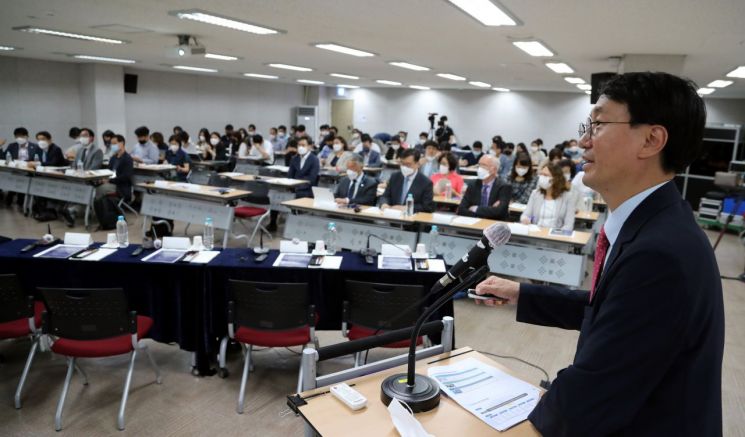 At the policy discussion on "Establishing a Bio Workforce Training Hub for Advancing into a Global Vaccine Hub," Lee Kang-ho, Head of the Global Vaccine Hub Promotion Team at the Ministry of Health and Welfare, is delivering the keynote presentation.
"The World Health Organization (WHO) considers the most important success factor in enhancing vaccine production capacity to be the possession of skilled professionals. In this regard, among the 15 countries that expressed willingness to participate in the 'Global Bio Workforce Training Hub,' Korea was selected, and within less than six months of being designated as a hub, Korea has shown remarkable achievements by starting vaccine production process training." (Dr. Ronoa Pascal, WHO)
At the policy forum titled 'Establishing a Bio Workforce Training Hub for the Leap toward a Global Vaccine Hub,' held on the 22nd at the Yeosu Expo Convention Center in Jeollanam-do by the Ministry of Health and Welfare and the Korean Association for Public Administration, domestic and international bio and vaccine experts expressed high expectations for Korea’s pharmaceutical production capacity, educational infrastructure, and the Korean government's strong commitment to resolving vaccine inequality issues.
In February, Korea was uniquely designated by WHO as the global bio workforce training hub, recognizing its excellence in biopharmaceutical production capacity and educational infrastructure. Following the start of practical production process training for 35 bio production personnel from the Asia-Pacific region this month, the Korean government plans to provide biopharmaceutical production process and quality control training to a total of 510 people, including 370 personnel from low- and middle-income countries and 140 domestic personnel, in the second half of this year.
Lee Kang-ho, head of the Ministry of Health and Welfare’s Global Vaccine Hub Promotion Team, stated, "Korea has secured the world’s second-largest biopharmaceutical production capacity and has experience in contract manufacturing COVID-19 vaccines for Novavax, Moderna, and AstraZeneca." He added, "We will nurture global bio professionals by providing customized education linked to production sites and offering facility-based tour programs." He confidently said, "Once the Global Bio Campus is established in 2026, we will be able to train more than 2,000 specialists annually."
Dr. Bruno Cristina of WHO said, "While technology transfer of messenger ribonucleic acid (mRNA) to low- and middle-income countries is being promoted to achieve equitable vaccine distribution, there is a significant difference in technological maturity among vaccine manufacturers in beneficiary countries receiving the technology transfer." He added, "We hope that personnel from various countries will receive comprehensive training on production processes and specific technologies at Korea’s workforce training hub and be able to continuously produce vaccines."
Various strategies were proposed at the forum to successfully establish the bio workforce training hub. Opinions were shared that, for quality workforce training, policy continuity, consistent additional education, linkage to research fields, and customized education considering each country’s circumstances are necessary.
Professor Ahn Kwang-seok (Director of Seoul National University Virus Research Center) emphasized, "The bio workforce training hub project should not aim for profit generation but sustain sustainable policy momentum. Education should not be one-off but continue through online education systems and refresher training even after trainees return to their home countries."
Kim Barun, Vice President of SK Bioscience, said, "Vaccine development does not happen overnight; Korea has accumulated capabilities over 15 to 20 years." He added, "We hope Korea’s workforce training hub will help build capacity in low- and middle-income countries and create new market opportunities through this."
Song Manki, Scientific Secretary of the International Vaccine Institute, suggested, "Interest in vaccines tends to fade after a pandemic ends, so securing sustainability is most important. We must be able to provide customized education according to the needs of demand countries."
The government plans to host the '2022 World Bio Summit' in Seoul on October 25-26, inviting heads of state, health ministers, international organization leaders, vaccine and bio companies, civil society groups, and vaccine and infectious disease experts from various countries to discuss ways to strengthen future infectious disease response capabilities. Lee Kang-ho stated, "Based on the experience and lessons from COVID-19, we will prepare for the next infectious disease, lead mid- to long-term health agendas, and secure global leadership in the bio sector."
© The Asia Business Daily(www.asiae.co.kr). All rights reserved.
![Clutching a Stolen Dior Bag, Saying "I Hate Being Poor but Real"... The Grotesque Con of a "Human Knockoff" [Slate]](https://cwcontent.asiae.co.kr/asiaresize/183/2026021902243444107_1771435474.jpg)
















