Fear of Economic Recession Triggers Employment Freeze... Cause of Vicious Cycle of Rising Prices and Wages
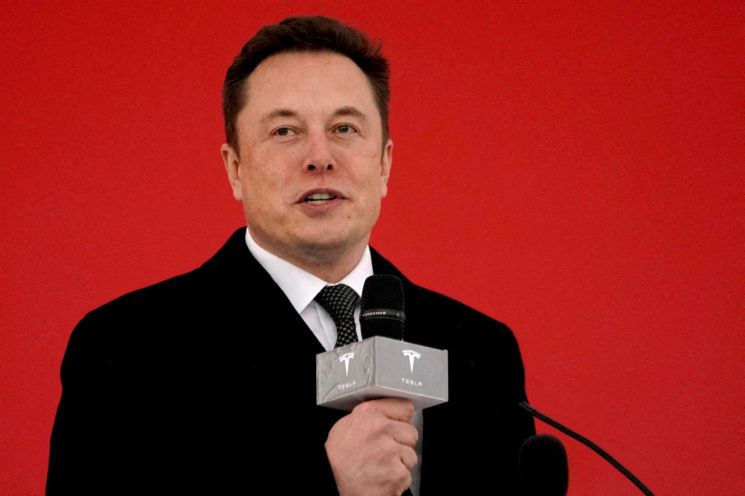 Elon Musk, CEO of Tesla, stated on the 21st, "There is a considerable possibility that the economy will enter a recession in the near future," and added, "We plan to reduce 3 to 3.5% of the total workforce over the next three months."
 [Photo by Reuters]
[Asia Economy Reporter Park Byung-hee] The fear of an economic recession has begun to impact corporate employment.
Elon Musk, CEO of Tesla, stated in a virtual interview at the Qatar Economic Forum hosted by Bloomberg on the 21st (local time) that the economy will soon enter a recession, and Tesla plans to reduce its workforce by 3.0 to 3.5% over the next three months.
Earlier, Musk announced a 10% workforce reduction in an email titled "Global Hiring Freeze" sent to Tesla executives. In the interview, Musk explained that the 10% cut applies to salaried full-time employees. He plans to increase the number of part-time workers instead of full-time employees, estimating that about 3.5% of the total workforce will be affected by this layoff plan.
Although the weekly unemployment claims reported by the U.S. Department of Labor remain at a low level, the four-week moving average, which shows the trend, has recently turned upward. This indicates signs of a shift toward increasing unemployment. Bloomberg reported that job posting growth rates on the job site Indeed have also shown signs of slowing down recently.
Greg Summers, president of staffing firm Cielo, said regarding unfilled jobs since COVID-19, "It is harder to lay off employees, so vacancies remain unfilled for a long time." As recession concerns grow, more companies are hesitating about whether to fill open positions.
Christopher Pissarides, professor at the London School of Economics, said in an interview with CNBC that the labor market will be worse than during the global stagflation of the 1970s, adding, "The core concern is the secondary effects of inflation."
The secondary effects of inflation refer to a spiral effect where high prices lead to wage increases, which in turn cause further inflation. This ultimately increases costs for companies, leading to employment reductions.
In fact, protests demanding wage increases are rising worldwide. The UK railway union launched its largest strike in 33 years on the same day, and similar cases are spreading across Europe.
At Brussels Airport in Belgium, all departures were canceled due to a security staff strike the day before. Employees at France’s Charles de Gaulle Airport plan to strike starting July 1, demanding wage increases and improved working conditions. Spanish crew members of low-cost airline easyJet are demanding at least a 40% pay raise and will strike for nine days in July.
In the U.S., union organizing efforts have recently been active at companies such as Apple, Amazon, and Starbucks. President Joe Biden has proposed raising the federal minimum wage as a campaign pledge and is actively supporting union formation in companies.
© The Asia Business Daily(www.asiae.co.kr). All rights reserved.
![Clutching a Stolen Dior Bag, Saying "I Hate Being Poor but Real"... The Grotesque Con of a "Human Knockoff" [Slate]](https://cwcontent.asiae.co.kr/asiaresize/183/2026021902243444107_1771435474.jpg)
















