One Busan Corporate Taxi Company Declares Suspension from July
Severe Impact from COVID-19, Domino Effect of Sales and Suspensions Expected
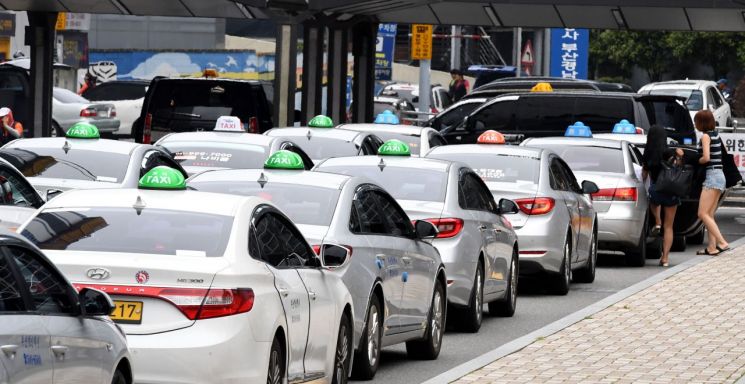
[Asia Economy Yeongnam Reporting Headquarters Reporter Kim Yong-woo] The taxi industry is crying. Taxi drivers, already exhausted from losing income, are leaving, and company owners are struggling desperately to shake off the shadow of deficits. In short, there is no 'answer.' The government and local authorities holding the keys cannot come up with a similar solution either.
Taxi drivers who have moved to other industries do not return, company debts are increasing, and late-night taxi passengers explode in frustration while waiting. This is the current state of the 'taxi' industry.
Looking at taxis idling without being disposed of, there are even company representatives who stop the few taxis still operating.
Although the 'darkness' of COVID-19 is lifting, the corporate taxi industry is sinking deeper into a quagmire.
"Operating taxis only accumulates deficits, so there is no answer other than suspension," said a taxi company representative who made a decisive decision.
Next month, for the first time in Busan, a taxi company will enter an indefinite full suspension.
Kim Kyung-hyun, CEO of Geumryun Industry in Suyeong-gu, Busan, informed employees on the 15th that the company would enter full suspension.
CEO Kim explained that sales have decreased due to COVID-19, and even drivers have left. "Even if we work hard, we run at a loss," he sighed, saying, "I am sorry to the citizens during a time when it is hard to catch a taxi late at night."
Founded in 1978, this company has been struggling for over 40 years and is now reeling from the direct impact of COVID-19. Like other companies, it is suffering severe management difficulties due to reduced passenger demand caused by social distancing and business restrictions after the pandemic.
With even fewer drivers, CEO Kim decided to completely stop taxi operations for the time being, judging that the company could not escape the growing cycle of deficit management.
Out of the company's 191 taxis, 121 are currently stopped, and only 70, accounting for 37%, are operating. The company explained that operating one taxi results in an operating loss of 1 million KRW per month.
Geumryun Industry reported a total operating loss of 1.8 billion KRW over the past three years, averaging about 580 million KRW annually. Last year's total sales dropped to half of 2019's level.
CEO Kim said, "During the COVID-19 business restriction period, sales dropped significantly, and drivers who could not meet their daily quotas moved to other places, making the company's situation very dire," adding, "If we operate, fixed expenses such as fuel and driver wages increase the deficit, creating the worst situation."
With the rise in minimum wage and LPG prices, it has become impossible to endure further. Drivers who left for more profitable delivery jobs like parcel delivery or 'rider' services have no reason to return to the low-profit taxi industry, and even if they do, the rising costs are too much to bear.
During the full suspension period, Geumryun Industry plans to pay 70% of the average wage as suspension allowance to its 83 employees. This is merely a desperate measure to delay further losses.
Since drivers are leaving for other industries such as delivery or 'rider' services, it is difficult to recruit drivers. Newcomers, already aware of the industry's situation, are not applying, and even if hired, the company cannot bear the risk of safety accidents caused by inexperienced drivers.
The number of taxi transport workers in the Busan area decreased from 10,863 in 2019, before COVID-19, to 7,215 in May this year.
As the number of drivers decreased, so did the so-called daily quota income, putting the taxi industry in a dilemma.
An industry insider said, "There is a deficit of about 500 million to 700 million KRW per year per 100 taxis," adding, "More than 80% of owned vehicles must be operated just to cover expenses, but currently only about 50% are running, so the deficit is inevitably increasing."
A representative from the Busan City Taxi Transport Business Association explained, "Companies facing bankruptcy are trying to sell their businesses at rock-bottom prices." He added, "I understand that many companies are taking suspension measures like Geumryun Industry to reduce deficits for the time being."
Another insider said, "About three years ago, taxis were sold for around 45 million KRW each, but last year one company sold them for about 26 million KRW."
Since taxi licenses are regulated, license transactions usually occur around 50 million KRW per taxi, but now they are being sold at half price, indicating the worst situation.
Under these tightening crises, the taxi industry is desperately trying to fill severe management difficulties by receiving reduction compensation or support for vulnerable industries.
According to Busan City, about 1,000 taxis applied for the reduction compensation project conducted until May. Last year's total compensation applications were about 400, so this year's applications in five months have more than doubled compared to last year.
This year's reduction compensation quantity is 194 units, and Busan City supports 28 million KRW per unit. Even this is an insufficient support.
The taxi industry has proposed measures to increase operating revenue, such as extending nighttime surcharge hours and raising base fares. Busan City is also considering indirect support measures such as special loan guarantees.
A Busan City official said, "Since the corporate taxi economy is not good, we are considering support measures, but there is no definitive solution yet," adding, "If the supplementary budget is compiled this year, we are reviewing special guarantee support so that corporate taxis can receive loans."
Jang Seong-ho, director of the Busan City Taxi Transport Business Association, lamented, "About 50 years ago in 1970, when the bus fare was 10 KRW, the taxi base fare was about six times that at 60 KRW, but now the taxi base fare of 3,800 KRW is less than three times the bus fare of 1,300 KRW," adding, "Moreover, buses receive thousands of billions of KRW in support from local governments through the quasi-public system."
Director Jang raised his voice, saying, "Either taxi fares should be deregulated, or financial support should be provided like the bus quasi-public system."
He pointed out the double standard where taxis are treated as public fares and price-controlled only when public utility rates increase, but when requesting financial support, they are denied because they are not public transportation.
The government's taxi fare control, enforcement of full wage management, COVID-19 crisis, rising minimum wage and raw material costs, departing taxi drivers, and the risk burden of hiring novice drivers?all tangled issues?cannot be left solely to the taxi industry to solve. Otherwise, dissatisfaction among taxi workers and inconvenience to taxi consumers are expected to snowball.
© The Asia Business Daily(www.asiae.co.kr). All rights reserved.
![Clutching a Stolen Dior Bag, Saying "I Hate Being Poor but Real"... The Grotesque Con of a "Human Knockoff" [Slate]](https://cwcontent.asiae.co.kr/asiaresize/183/2026021902243444107_1771435474.jpg)
















