The Software Market Dominated by the U.S.
If Government and Companies Do Not Foster SW, They Cannot Escape Being 'Subcontractors'
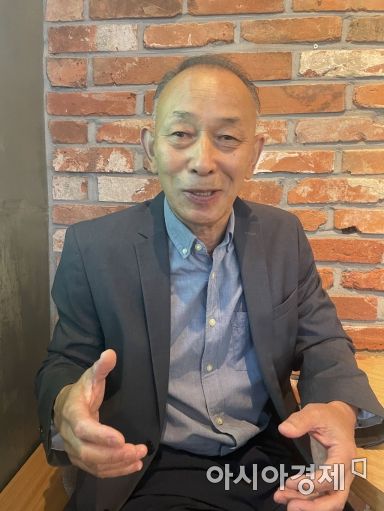
[Asia Economy Reporter Park Sun-mi] "Aiming for the world's No.1 system semiconductor? It is impossible without fostering the software industry. South Korea's system semiconductor market share, at about 3% globally, is on the same trajectory as its software market share, which is less than 1%."
Moon Song-cheon, Korea's first Ph.D. in computer science and emeritus professor at KAIST, lamented the new Yoon Seok-yeol administration's advanced industry promotion policy that neglects software and focuses only on hardware. He believes that unless South Korea steps into the software market, which is almost monopolized by American companies, the goal of becoming the world's No.1 in system semiconductors will remain an eternal challenge.
In an interview with Asia Economy on the 24th, Professor Moon stated, "In the global semiconductor market, memory accounts for 27%, while non-memory including system semiconductors accounts for 73%, highlighting the importance of the system semiconductor sector." However, he asserted, "South Korea's software capabilities to develop system semiconductors are weak, making it difficult to achieve the No.1 goal." He also noted, "Samsung's outright rejection of acquiring Android in the past, which was then purchased by Google and now holds over 80% of the global smartphone operating system market, is a lesson worth remembering."
Currently, the system semiconductor market is dominated by the software powerhouse, the United States. Even the software used to design semiconductors is standardized by American products, with Intel leading CPUs (Central Processing Units), and Apple and Qualcomm leading APs (Application Processors). In the global smartphone and PC operating system (OS) markets, Google, Microsoft (MS), and Apple hold monopolies.
Professor Moon emphasized, "Although South Korea is considered an IT powerhouse, it is strong only in hardware and weak in software, so it cannot be called a true IT advanced country." He reiterated, "Since software accounts for 80% of IT, the core of the Fourth Industrial Revolution era lies in software, and the nation must make efforts to nurture it."
He explained, "Because South Korea lacks specialized software companies like Google and MS, graduates who could become software experts often go abroad to work for foreign companies after graduation." He added, "IT giants like Samsung need to invest in growing the software industry to nurture and secure talent."
He pointed out, "For example, MS employs 3,000 coding personnel working around the clock for 18 months to develop the next-generation Windows upgrade. Given that top software companies put in such efforts due to the high added value of the market, if we do not join even belatedly, South Korea will remain merely a 'subcontractor' strong only in hardware manufacturing, not only in semiconductors but also in other advanced industries."
Regarded as a leading authority in computer databases, Professor Moon is the first Korean to earn a Ph.D. in computer science from the University of Illinois, USA, where he succeeded in building the world's first supercomputer. He has served as a professor in the computer science departments at the University of Cambridge and the University of Edinburgh in the UK, and at KAIST. He also served as the Asian representative of the European IT Society, one of the world's top three IT academic societies. Currently, he is an emeritus professor at the KAIST Graduate School of Management.
© The Asia Business Daily(www.asiae.co.kr). All rights reserved.
![Clutching a Stolen Dior Bag, Saying "I Hate Being Poor but Real"... The Grotesque Con of a "Human Knockoff" [Slate]](https://cwcontent.asiae.co.kr/asiaresize/183/2026021902243444107_1771435474.jpg)











