Haeundae Yacht Tour Establishes Itself as a Must-Do Busan Travel Course
Popular Night View Spots Include Byeolbada Busan and Night City Tours
Urban Regeneration 'F1963' Gains Spotlight as a New Hot Place
[Asia Economy Reporter Kim Heeyoon] "The sunset was beautiful even at the beach. However, it changed moment by moment. It became dusk too quickly."
One hundred years ago, novelist Lee Taejun, known as the "Maupassant of Joseon," depicted the atmosphere of Haeundae in Busan in his novel "Sunset" like this. He portrayed the beautiful scenery that changed every moment as disappearing too quickly, and the approaching weight of darkness soon turned into dusk. The seashore, once covered in darkness, has transformed over a century into a space that holds a night view sparkling brighter than starlight. With the travel demand that had been quiet due to the COVID-19 pandemic increasing, Busan's night has newly established itself as a travel destination shining brighter than any city in the world.
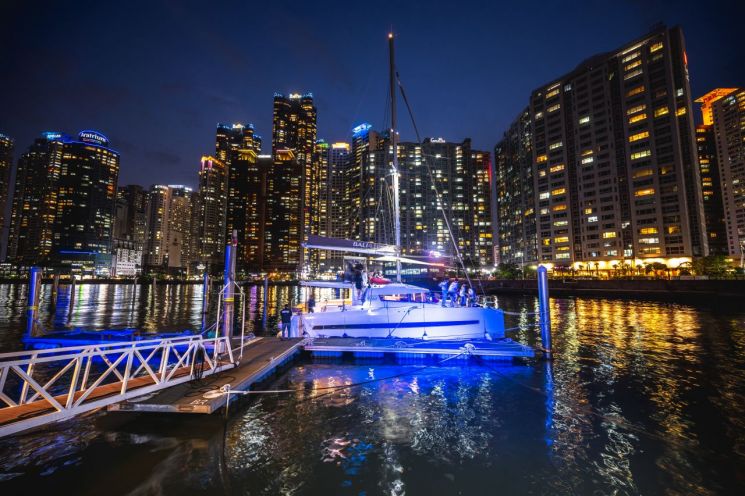
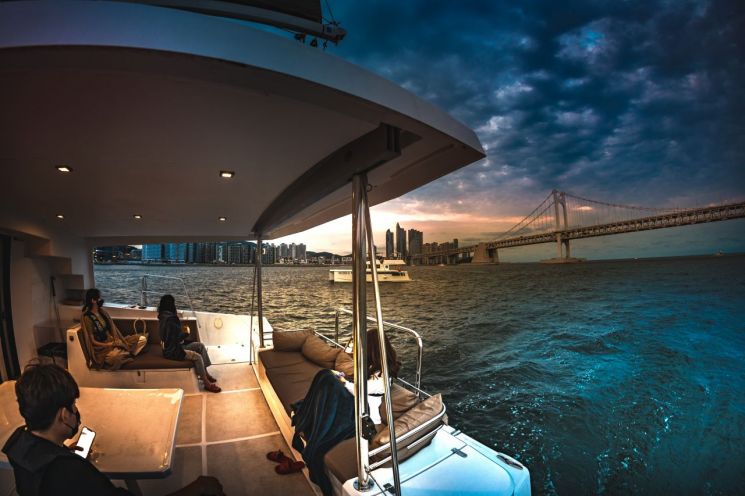
When the sunset fades and darkness arrives, the Gwangandaegyo Bridge cutting coolly across the sea and the towering skyscrapers of Marine City light up as if waiting. Yachts leisurely cruising on the sea have recently become an essential course among tourists visiting Busan. After 7 p.m., when the yacht tours start at the Haeundae pier, many people gather.
As the yacht cutting through the refreshing waves approaches Gwangandaegyo Bridge, the night view of Marine City seen in the distance decorates the background as if starlight is pouring down. When the hands frequently move to take "life photos," the fireworks prepared as an event also provide unforgettable memories.
As much as the night view on the sea, the quiet city nightscape viewed from the mountain summit adds to Busan's charm. The Hwangnyeongsan Observatory, where the beacon tower that transmitted urgent military information during the Joseon Dynasty was located, has emerged as a new night view spot where the city can be seen at a glance in tranquility based on its geographical characteristics.
Hwangnyeongsan, towering across four districts of Busan?Busanjin-gu, Yeonje-gu, Suyeong-gu, and Nam-gu?offers a vibrant city vitality where the sea and old downtown scenery such as Gwangalli, Haeundae, and Dongnae spread out refreshingly below the multicolored shining transmission towers and observatory.
The Cheonmasan Sky Observatory, which appeared as the backdrop in the movie "Ode to My Father," offers a panoramic view of the mountain village landscape that holds the history of a city developed as refugees flocked after the Korean War. In particular, the old downtown of Busan and the Busan Port area lined up in a row are known as famous spots where photographers' footsteps never cease. Yeongdo Bongnaesan and Igidae Riverside Park, along with Yeongdo Bridge and Busan Harbor Bridge beside them, capture the attention of unfamiliar travelers.
The new urban regeneration space "F1963," where the past and present coexist, is gaining a reputation as a new hot place in Busan. Passing through the Maengjongjuk Sound Road, where the sound of wind and bamboo leaves colliding is beautiful, visitors are welcomed by F1963, reborn as a complex cultural space from a factory that produced wire for 45 years since 1963. Various cultural spaces, including Terra Rosa Suyeong Branch where machines actually used in the factory are placed, International Gallery Busan Branch, and Yes24, the largest used bookstore in Korea, newly fill the space once full of wire.
Composed of 40% mountains, 30% coastal plains, and 30% fields, Busan has achieved a remarkable transformation from a city of refugees devastated after the war to a cutting-edge city concentrated with advanced technology. The Busan night tour, where you can directly feel that dynamism, is a new story travel program that captivates the hearts of travelers on vacation by traveling between the past and present.
© The Asia Business Daily(www.asiae.co.kr). All rights reserved.


















