Korea Federation of SMEs to Hold 'Agri-Food Manufacturing Committee' on 21st
Appeal for Expansion of Direct Delivery Volume and Adjustment of Allocation Criteria and Methods
Advocate for Extension of Self-Quality Inspection Cycle from Current 3 to 6 Months
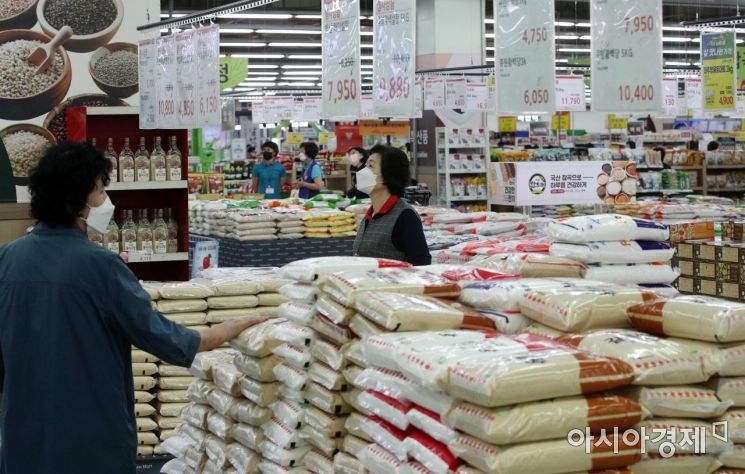 On the 5th, citizens were shopping at a large supermarket in Seoul. Amid the recent severe inflation situation, with last month's consumer price inflation rate exceeding 5%, the international grain price surge caused by the Ukraine crisis and export restrictions from major grain-producing countries is being transmitted domestically. Additionally, recent drought damage has further contributed to unstable living costs, particularly for some agricultural and livestock products. Photo by Kim Hyun-min kimhyun81@
[Asia Economy Reporter Kim Bo-kyung] Small and medium-sized food companies have voiced difficulties in securing raw materials due to the sharp rise in imported grain prices. They argued that stable grain supply measures, such as expanding direct allocation volumes, and regulatory relaxation are necessary.
The Korea Federation of SMEs held the '2022 1st Agricultural and Food Manufacturing Committee' on the 21st at the Federation of SMEs in Yeouido, Seoul. The Agricultural and Food Manufacturing Committee is composed of small and medium-sized food manufacturers such as tofu and noodles to discuss industry issues and prepare customized policy responses.
The meeting was attended by about 10 representatives of industry-specific cooperatives, including Chairman Jeong Rak-hyeon of the Korea Bamboo Salt Industry Cooperative, who is also the committee chairman, Jeong Jong-ho, president of the Korea Yeon Food Cooperative Federation, and Kim Ho-gyun, chairman of the Korea Meal Service Cooperative.
The Ministry of Agriculture, Food and Rural Affairs explained the '2022 Food Industry Status and Policy Directions' and exchanged questions and answers with the committee members.
Lee Soo-hyun, director of the Food Industry Policy Division at the Ministry of Agriculture, Food and Rural Affairs, said, "The policy direction for the food industry this year is future growth industrialization," adding, "To this end, we will expand the scale of the comprehensive food and dining fund and support the development of online non-face-to-face sales channels to lay the foundation for the future industrialization of small and medium food companies."
At the subsequent issue briefing, participants commonly expressed difficulties in securing raw materials due to the surge in imported grain prices and insisted on the need for stable grain supply measures such as expanding direct allocation volumes that small food SMEs can utilize, and adjusting allocation criteria and methods. Direct allocation refers to the TRQ management method where government-designated institutions such as aT import quantities and sell them domestically at designated prices.
Jeong Jong-ho, president of the Korea Yeon Food Cooperative Federation, said, "Among tofu companies nationwide, 98% are small businesses with fewer than five employees, and direct allocation is the only raw material supply method that small businesses on the brink can rely on," urging, "Additional supply of this year's soybean shortage or early supply of next year's quota is necessary."
Kim Ho-gyun, chairman of the Korea Meal Service Cooperative, argued, "Companies with mandatory HACCP certification focus on managing hazards throughout the entire process from raw material distribution to sales, so the self-quality inspection cycle, which is currently every three months, should be relaxed to six months to reduce the double burden."
Representatives from the confectionery, bakery, and rice cake sectors also claimed, "If production stops due to red bean shortages, the volume of grains supplied decreases, and the current allocation method, where allocated volumes decrease as performance declines, is unfair to SME groups."
Yang Chan-hoe, head of the Innovation Growth Headquarters at the Federation of SMEs, said, "We launched the 'SME Regulatory Innovation TF' to discover and resolve SME issues," adding, "We will actively identify tasks to improve the difficulties of small food manufacturers and strengthen policy proposals to the government and the National Assembly."
Committee chairman Jeong Rak-hyeon emphasized, "While we agree on the importance of food safety management to protect consumers, excessive and overlapping regulations are a direct blow to small food manufacturing businesses," stressing, "Application of tariff quotas and regulatory improvements for food manufacturers are necessary."
© The Asia Business Daily(www.asiae.co.kr). All rights reserved.

















