Ministry of the Interior Advisory Committee Recommendations to Be Announced This Afternoon
Discussion on Establishing Police Bureau and Senior Official Recommendation Committee
Abolition of Civil Affairs Office Responsible for Personnel Verification
Leads to Strengthening Minister's Personnel Proposal Authority
Police Side Proposes "Strengthening National Police Commission" Alternative
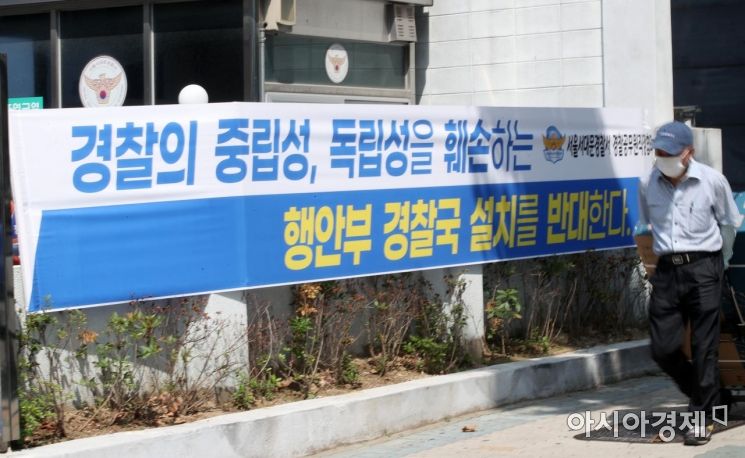 On the 21st, when the Ministry of the Interior and Safety's Police System Improvement Advisory Committee is scheduled to announce recommendations on police control measures, a banner opposing the establishment of the Police Bureau is hung in front of Seodaemun Police Station in Seoul. The Ministry of the Interior and Safety's Police System Improvement Advisory Committee will announce the recommendations on this day. Photo by Kim Hyun-min kimhyun81@
[Asia Economy Reporters Seongpil Jo, Byungdon Yoo] The conflict between the Ministry of the Interior and Safety and the police over ‘police control’ appears to be entering a worsening phase. When the Police System Improvement Advisory Committee under the direct supervision of the Minister of the Interior and Safety announces its recommendations, including the establishment of a Police Bureau, on the afternoon of the 21st, collective police opposition is expected to spread further. Legal amendments and enforcement decree enactments necessary for implementing the recommendations will also be difficult due to the National Assembly’s situation and police opposition, raising the possibility of prolonged conflict.
According to comprehensive reporting, the advisory committee formed last month under Minister Lee Sang-min’s directive has settled on a plan to formalize the currently non-statutory Security Policy Office within the Ministry of the Interior and Safety and establish a Police Bureau (tentative name). The Police Bureau will take on roles similar to the Prosecutor’s Office within the Ministry of Justice, overseeing personnel, budget, and inspection affairs. Discussions in the advisory committee meetings also included establishing a nomination committee for candidates for the Commissioner General of the National Police Agency and the Chief of the National Investigation Headquarters, as well as a recommendation committee for senior officers at the rank of Senior Superintendent or above. There was also talk of creating a tentative ‘National Police Agency Command Regulation’ to codify the Minister’s command authority over the Commissioner General. These proposals form the core of the advisory committee’s recommendations to be announced that day.
The core and trigger of the conflict within the recommendations is ‘personnel affairs.’ Internal backlash against the Ministry of the Interior and Safety’s police control efforts ignited last month when it became known that Minister Lee individually interviewed candidates for the Senior Superintendent position. Within the police, there was open dissatisfaction, calling it blatant ‘police taming.’ On the other hand, Minister Lee drew a line, stating it was a preliminary procedure to assess the suitability of candidates for Senior Superintendent. Inside and outside the police, there is talk of a butterfly effect caused by the abolition of the Blue House’s Civil Affairs Office. The Civil Affairs Office previously handled personnel verification for senior police officers. The Minister of the Interior and Safety’s role was limited to formal personnel recommendations. With the abolition of the Civil Affairs Office under the Yoon Seok-yeol administration, the Minister of the Interior and Safety has secured justification for exercising legally guaranteed personnel recommendation rights. The means to this end is the establishment of the Police Bureau.
Establishing the Police Bureau requires amending laws such as the Government Organization Act. Considering that the second half of the National Assembly’s organization has not been formed and the current legislature is a minority government, prompt processing is physically difficult. There is a proposal to create a new enforcement decree under the executive branch’s jurisdiction, but it faces issues of conflict with higher laws and weak legal grounds. If the police file a constitutional dispute or injunction against this, the conflict between the two institutions is likely to continue until rulings from the Constitutional Court or courts are issued.
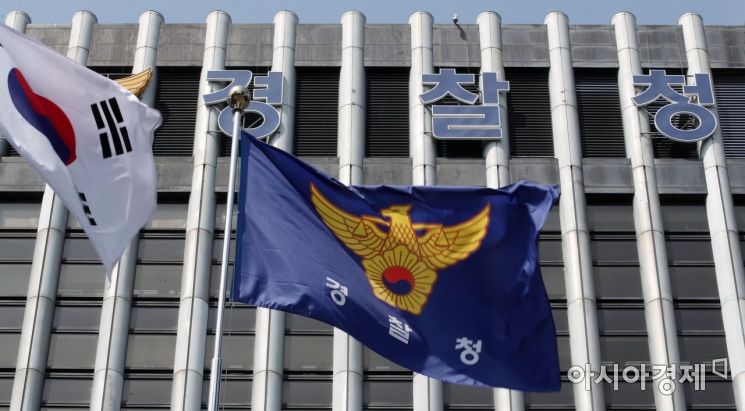 On the 21st, when the Ministry of the Interior and Safety's Police System Improvement Advisory Committee is scheduled to announce recommendations on police control measures, the police flag is fluttering in the wind at the National Police Agency in Seodaemun-gu, Seoul. The Ministry of the Interior and Safety's Police System Improvement Advisory Committee will announce the recommendations on this day. Photo by Kim Hyun-min kimhyun81@
The police side is proposing strengthening the status of the National Police Commission as an alternative. The National Police Commission was established in 1991 as a check-and-balance supervisory body when the Security Headquarters under the Ministry of Home Affairs (now the Ministry of the Interior and Safety) was separated into the National Police Agency. Ultimately, the police argue that civic control, rather than government power control, aligns with the flow of our constitutional history. However, this approach faces the major challenge of making the National Police Commission independent from the Ministry of the Interior and Safety and granting its members democratic legitimacy by having them recommended by the National Assembly, similar to Supreme Court justices or Constitutional Court judges. Especially considering that the current National Police Commission is composed of members appointed during the previous Moon Jae-in administration with nearly two years left in their terms, physical time and difficulties are inevitable.
Professor Daekyung Kwak of Dongguk University’s Police Administration College said, “It is right to strengthen the status of the National Police Commission and explore various effective control measures, but the current situation is not like that. The National Police Commission and the Ministry of the Interior and Safety need to closely cooperate and coordinate opinions to create systems or policies.” Professor Woonghyuk Lee of Konkuk University’s Department of Police Science also said, “Even if the National Police Commission is to be established as an independent agency, it is expected that the ruling party will strongly oppose it during the National Assembly’s legislative process. Despite practical difficulties, it is essential for the National Police Commission, government, and National Police Agency to coordinate and consult with each other.”
© The Asia Business Daily(www.asiae.co.kr). All rights reserved.
![Clutching a Stolen Dior Bag, Saying "I Hate Being Poor but Real"... The Grotesque Con of a "Human Knockoff" [Slate]](https://cwcontent.asiae.co.kr/asiaresize/183/2026021902243444107_1771435474.jpg)

















