Expected to Exceed 5% Significantly for the Time Being
Surge Period Likely to Surpass 2008 Growth Rate
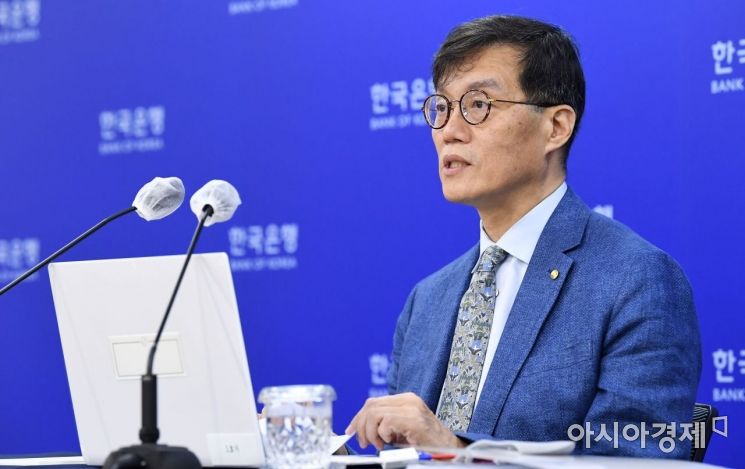 Lee Chang-yong, Governor of the Bank of Korea, holds a briefing on the status of inflation targeting operations at the Bank of Korea press room in Jung-gu, Seoul on the 21st. Photo by Moon Ho-nam munonam@
[Asia Economy Reporter Seo So-jung] The Bank of Korea has forecast that consumer prices will significantly exceed 5% for the time being due to the impact of rising international raw material prices. Accordingly, not only is this month's consumer price inflation rate expected to surpass that of May (5.4%), but the annual consumer price inflation rate for this year is also likely to exceed that of 2008 (4.7%), a period of past price surges. It is also anticipated that the monthly consumer price inflation rate will enter the '6% range' for the first time since 2000.
On the 21st, the Bank of Korea released this inflation outlook in its 'Price Stability Target Operation Status Review Report.' The Bank stated, "The consumer price inflation rate in June is expected to be higher than in May as the price increases of petroleum products, processed foods, and dining out expand," adding, "In the second half of the year, the impact of overseas supply factors, centered on crude oil and grains, is expected to continue, leading to a wider increase than in the first half."
Since October last year, the consumer price inflation rate had been in the 3% range, but it exceeded 4% in March and reached 5.4% last month, the highest in 13 years and 9 months since August 2008 (5.6%). With the June consumer price inflation rate expected to be higher than in May, concerns are rising that a 6% inflation rate, not experienced since the 2000s, will become a reality.
In particular, the Bank of Korea expects future inflation trends to exceed the May forecast path, considering the expanding upward trend in international oil prices. On the 26th of last month, the Bank raised its annual consumer price inflation forecast from 3.1% to 4.5%, an increase of 1.4 percentage points at once, implying that the actual annual inflation rate could be even higher.
Bank of Korea Governor Lee Chang-yong stated, "Going forward, monetary policy needs to be conducted flexibly and based on data, comprehensively considering economic indicators to be announced, such as inflation, the economy, financial stability, and foreign exchange market conditions." He added, "However, in the current phase where the inflationary trend is continuously expanding, it is desirable to operate monetary policy focusing on inflation until the steep inflation trend changes."
© The Asia Business Daily(www.asiae.co.kr). All rights reserved.

















