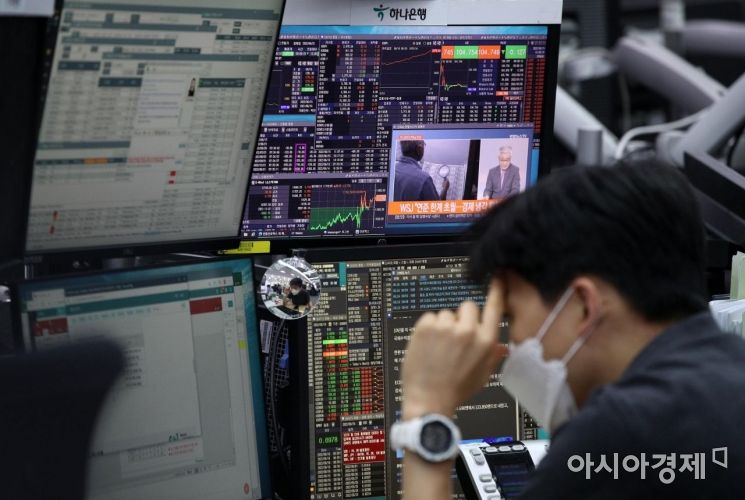
[Asia Economy Reporter Kwon Jae-hee] Foreign investors have sold about 69 trillion won worth of listed stocks in the domestic stock market over the past two years. With the U.S. Federal Reserve (Fed) signaling its intention to continue aggressive interest rate hikes, concerns are growing that the foreign selling trend may persist.
Due to liquidity withdrawal by foreigners, there are pessimistic forecasts that the KOSPI index could fall to 2300, a 30% correction from last year's all-time high of 3305.
According to the Korea Exchange on the 19th, foreigners have net sold 68.9006 trillion won in the KOSPI (Korea Composite Stock Price Index) and KOSDAQ markets over the past 2 years and 5 months, from 2020 to the 17th of this month.
Foreigners have maintained a 'selling' stance since 2020, actively offloading stocks.
Looking at the annual net selling amounts by foreigners, it increased from 24.8148 trillion won in 2020 to 25.7948 trillion won last year, and reached 18.2911 trillion won as of the 17th this year.
The reason foreigners could cash out is that individual investors bought the stocks. During this period, individuals net purchased about 168 trillion won worth of stocks.
As individual investors absorbed the profit-taking sales from foreigners, the index reached an all-time high last year.
The KOSPI fell to 1457.64 in March 2020 due to the impact of COVID-19 but turned upward thanks to individual buying and global economic stimulus, reaching an all-time high of 3305.21 in July last year. The KOSDAQ index also rose from 428.35 in March 2020 to surpass 1000 last year for the first time in 20 years since the dot-com bubble.
However, as the stock market entered a bearish phase this year, the KOSPI fell to 2396.47 during trading on the 17th, and the KOSDAQ index dropped to the 780 level.
Market experts believe that foreign investors' return to the domestic stock market will be difficult for the time being due to interest rate hikes.
Hwang Se-woon, senior researcher at the Korea Capital Market Institute, explained, "If the Korean won weakens and the Korea-U.S. interest rate differential reverses, foreign funds will flow out further and be absorbed by the U.S. market. If the interest rate inversion widens, the risk increases, making it difficult to expect foreign buying within this year."
Wall Street experts predict that the Fed will raise interest rates by 0.75 percentage points again in July following this month, with the U.S. benchmark rate expected to rise from the current 1.5?1.75% annually to 3.25?3.5% by the end of the year. The median value on the Fed's dot plot (which shows interest rate projections) has increased to 3.4%.
Korea's benchmark interest rate is currently 1.75% annually, making the gap with the U.S. effectively 0.00?0.25 percentage points, nearly equal.
If the Korea-U.S. interest rate differential reverses, foreign investors have no incentive to carry out carry trades (investments exploiting interest rate differentials) by bringing in low-interest yen or dollars domestically, as investment returns in the U.S. become higher.
Accordingly, the Bank of Korea's Monetary Policy Committee is expected to raise the benchmark interest rate at all four monetary policy meetings this year (in July, August, October, and November), with the possibility of one big step (a 0.50 percentage point increase at once).
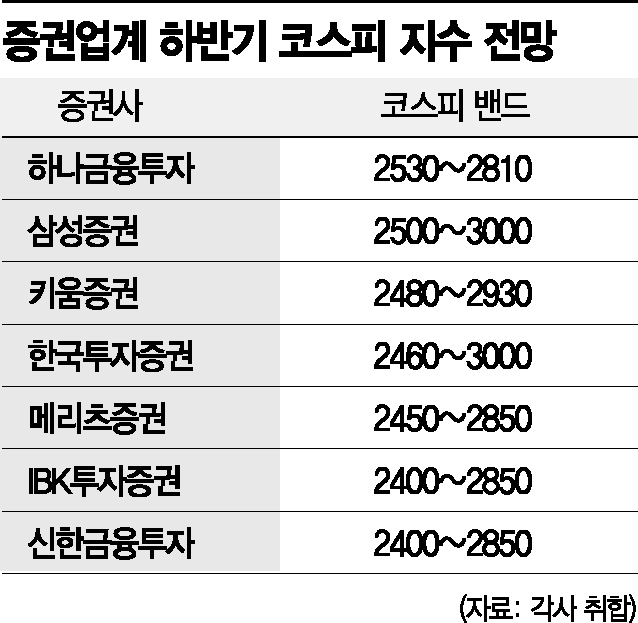
If foreign investors find it difficult to return to buying, it will be hard to expect a reversal of the KOSPI's upward trend. The KOSPI, which fell below 2400 during trading on the 17th, may lower its bottom further.
Kim Ji-san, head of the Kiwoom Securities Research Center, said, "If inflation persists and the Fed's policy effects fail to materialize, the index will continue in a box range with a lower bottom. If the KOSPI breaks below the 2400 level, the next support level is around 2280."
Eugene Investment & Securities, which set the lower bound of the KOSPI forecast at 2330, said, "If the stock price falls further, we will adjust the forecast."
Senior researcher Hwang of the Korea Capital Market Institute forecasted, "This year, the KOSPI will lower its bottom to around 2300, a 30% drop from last year's peak."
Securities firms such as NH Investment & Securities, Hana Financial Investment, Shinhan Financial Investment, and IBK Investment & Securities have set the lower bound of their KOSPI forecasts for the second half of the year at 2400 and have no plans to change them yet.
Hana Financial Investment considers the KOSPI to be in an oversold phase if it falls further from the current level.
Lee Kyung-min, head of the investment strategy team at Daishin Securities, maintained the view that the KOSPI will test support around 2400 in the short term and then make a technical rebound.
However, he added, "The KOSPI may make a technical rebound in the third quarter but could resume a second decline from the fourth quarter. The real bottom might come in the first quarter of next year or around the end or beginning of the year."
Senior researcher Hwang pointed out, "If the Korea-U.S. benchmark interest rates peak next year, we must also prepare for a pessimistic scenario where the KOSPI lowers its bottom to 1500."
© The Asia Business Daily(www.asiae.co.kr). All rights reserved.
![Clutching a Stolen Dior Bag, Saying "I Hate Being Poor but Real"... The Grotesque Con of a "Human Knockoff" [Slate]](https://cwcontent.asiae.co.kr/asiaresize/183/2026021902243444107_1771435474.jpg)

















