In the Seoul Metropolitan Area→Seoul Commute, Over 3 Hours Spent on Commuting
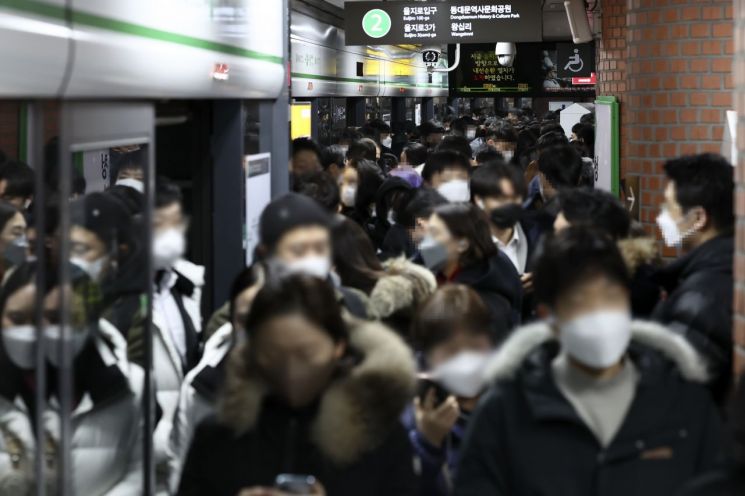 Commuters are waiting for the subway at City Hall Station in Seoul during rush hour.
 [Photo by Yonhap News]
[Asia Economy Reporter Park Hyun-joo] #. Kim, a worker in his 20s, confesses that he feels "completely drained" even before going to work. He commutes on Line 9, notorious for its "Jiokcheol" (literally "hell train," referring to extremely crowded subways), and every time he sees the packed subway, he feels suffocated. The same happens on his way home after work, where he is also crushed by the crowd.
According to Statistics Korea, as of 2020, 3.57 million people (15.3%) spend more than an hour commuting. While the average commute time among 26 major OECD countries is 28 minutes, the average commute time for Koreans is 58 minutes. This means Koreans spend about twice as much time commuting compared to workers in other OECD countries.
Kim, who commutes within Seoul, is in a relatively better situation. As the joke goes, "Gyeonggi-do residents spend 20% of their lives on public transportation," citizens commuting from the metropolitan area to Seoul spend even more time commuting. According to the Ministry of Land, Infrastructure and Transport's '2020 Metropolitan Area Public Transportation Usage Survey,' citizens using public transportation from the metropolitan area to Seoul spent an average of 1 hour and 27 minutes commuting to work. It took 1 hour and 30 minutes from Incheon to Seoul, and 1 hour and 24 minutes one way from Gyeonggi to Seoul.
However, since this is based on collected transportation card data, when including the distance traveled from home and workplace to the stations, metropolitan area citizens effectively spend more than 3 hours commuting daily. The number of people commuting from the metropolitan area to Seoul reached approximately 1,419,800 as of 2020.
The problem is that such long commute times are lowering the quality of life for workers. Long commute times and severe traffic congestion increase mental and physical stress and reduce life satisfaction. As commute times increase, personal time available for hobbies and leisure activities decreases.
The biggest reason workers prefer telecommuting is the "commute time." According to a survey conducted on June 13 by the employment platform Saramin, targeting 4,534 adult men and women, 81.3% cited "saving commute time" as the reason for preferring telecommuting. Among reasons for including "telecommuting availability" as a criterion for choosing a company, "being free from commute stress" was the highest at 61.1%.
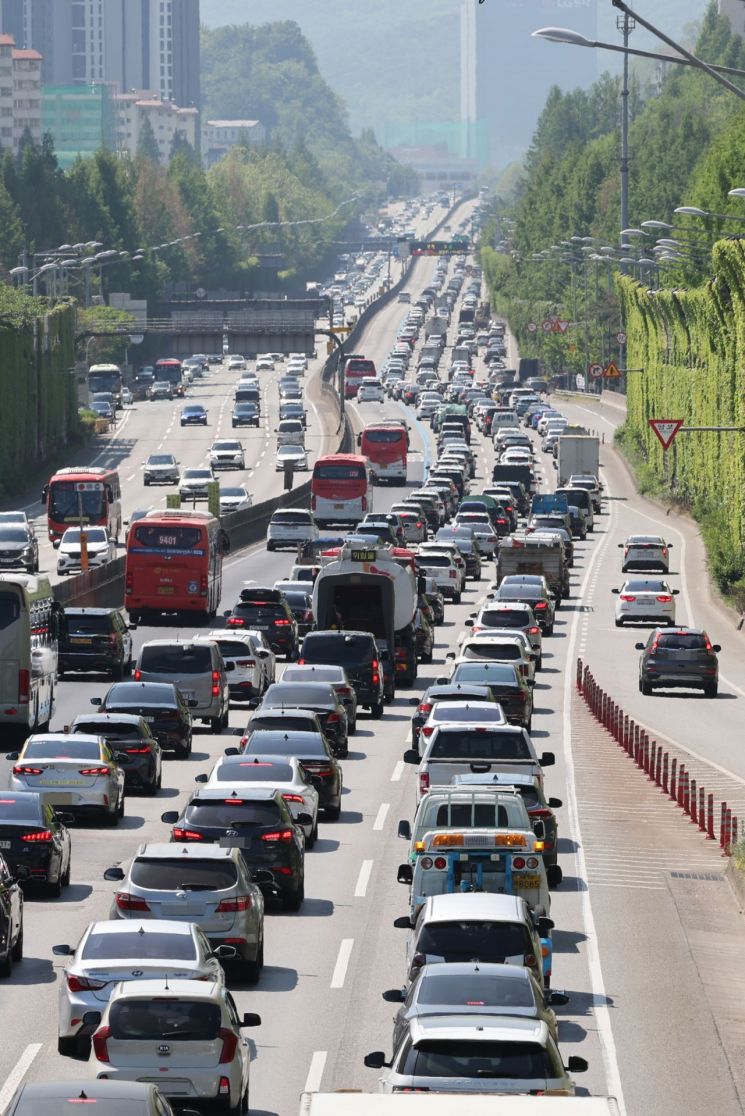 The southbound lanes of the Gyeongbu Expressway in Seocho-gu, Seoul are experiencing congestion. [Image source=Yonhap News]
Experts point to three main reasons for the long commute times in the metropolitan area. Professor Yoo Jung-hoon of Ajou University’s Transportation Systems Engineering said, "First, there are spatial and structural problems. As the city expanded beyond the greenbelt to form new towns, the distance to central Seoul became too far," adding, "Also, when developing new town sites, transportation networks should have been planned first, following the principle of 'transportation first, then housing,' but this was not done. The new towns are structurally distant from central Seoul, and there are no express railways or wide-area roads."
He continued, "Lastly, when constructing express railways and wide-area roads, they should have been built as express and straight routes, but instead, they were made as local and winding routes. Although subways were installed in Bundang and Ilsan, their speeds are slow," adding, "Subways in Seoul run at about 30 km/h, and high-speed express lines run in the high 40 km/h range, but connections from the outskirts of Gyeonggi to Seoul are actually slower than 50 km/h, and should be at least 70 km/h."
© The Asia Business Daily(www.asiae.co.kr). All rights reserved.


















