Publicly Revealed 6 Years After Discovery
Intricate Gold Leaf Crafting Took Half a Year to Unfold
No Similar Cases Found, Purpose to Be Determined Later
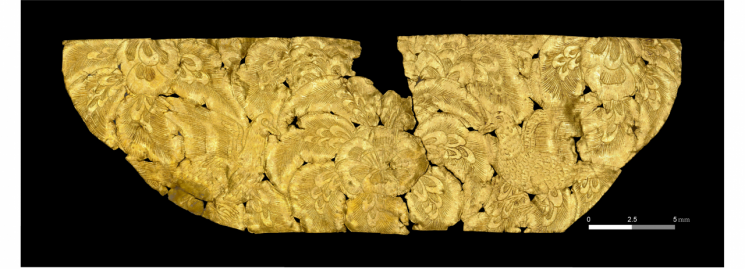
[Asia Economy Reporter Seomideum] An 8th-century Unified Silla gold leaf artifact excavated from Donggung Palace and Wolji Pond will be unveiled. It has been six years since its excavation during the November 2016 excavation survey on the north side of the 'Na' district at Donggung Palace and Wolji Pond.
There are two main reasons why the public unveiling took so long. First, it took a year to identify the artifact after the initial discovery of the Seongak Danhwa Ssangjo gold leaf. The artifact, found crumpled to the extent that its shape was difficult to distinguish at 20-meter intervals, was originally buried in mud, making the pattern hard to discern. A Cultural Heritage Administration official stated, "The pattern was confirmed during the artifact organization work the following year, and restoration began."
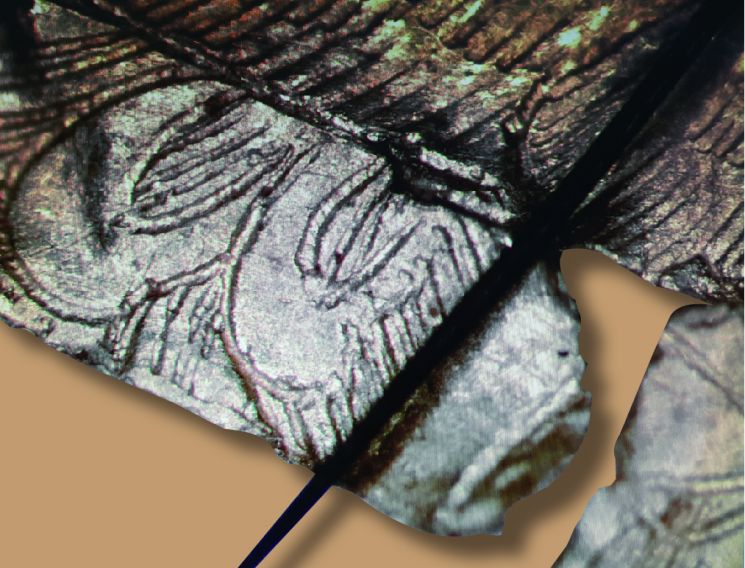
The painstaking restoration work also delayed the unveiling. A Cultural Heritage Administration official explained, "It took half a year just to flatten the gold leaf. It was a very delicate process," adding, "Fortunately, pure gold only stretches and does not break, so restoration was possible without major issues. Since there were no similar cases, a long time was spent on compositional analysis, 3D modeling, and experimental reproduction by metal artisans."
The size is very small. It measures 3.6 cm in width and 1.17 cm in height. Made of 0.3 grams of refined pure gold with 99.99% purity, its thickness is only 0.04 mm. Two birds are engraved thinner than a hair strand (0.05 mm). They can be seen only with a magnifying glass or microscope. Experts estimate them to be a pair of male and female wild pigeons. The Danhwa (團華), a decorative pattern from the Unified Silla period resembling a flower viewed from above, was also confirmed. A Cultural Heritage Administration official said, "Wild pigeons carry auspicious meanings, but these vary by region, so it is difficult to be certain," adding, "It is possible that it was used for offerings to deities."
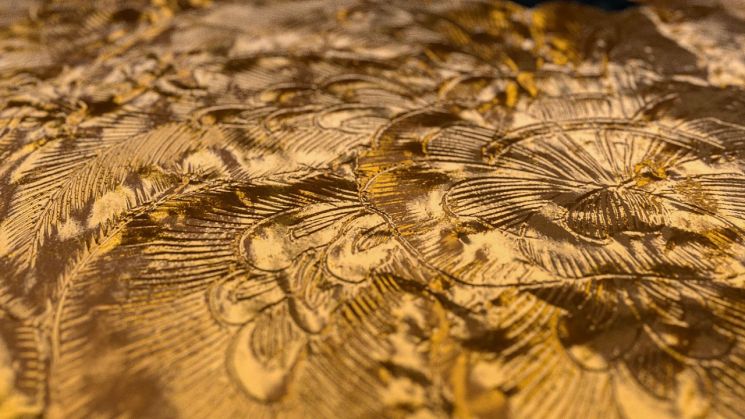
Due to the lack of similar cases, the exact purpose remains unknown. Since there is no hole for attaching a string, it is presumed to have been directly affixed to an object. A Cultural Heritage Administration official explained, "It is presumed to be a terminal fitting of an object with a trapezoidal cross-section." A terminal fitting refers to the end or cross-section of an item.
This artifact is regarded as demonstrating the most exquisite craftsmanship among all artifacts discovered so far. Its level of handcrafting is difficult to reproduce even with modern technology. An official said, "We consulted with craft artisans, but they responded that it is difficult to replicate with modern technology."
The artifact will be on display at the Cheonjongo Hall of the National Gyeongju Cultural Heritage Research Institute from the 17th until October 31st.
© The Asia Business Daily(www.asiae.co.kr). All rights reserved.
![Clutching a Stolen Dior Bag, Saying "I Hate Being Poor but Real"... The Grotesque Con of a "Human Knockoff" [Slate]](https://cwcontent.asiae.co.kr/asiaresize/183/2026021902243444107_1771435474.jpg)


















