Conflict Between Labor and Government Over Safe Freight Rates
Strike Ends in 8 Days with Dramatic Agreement
Industry Damage Estimated at About 2 Trillion Won
Lingering Tensions Over 'Sunset Clause' Abolition
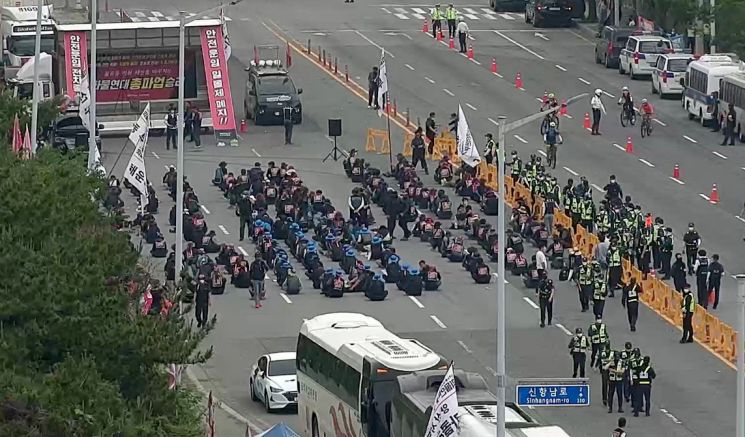 On the 11th, the fifth day of the Cargo Solidarity general strike, members of the Cargo Solidarity Busan Branch gathered on the road at Busan New Port. / Photo by Yonhap News
[Asia Economy Reporter Lim Juhyung, Intern Reporter Song Hyundo] The nationwide general strike by the Korean Confederation of Trade Unions (KCTU) Cargo Solidarity began on June 7 and lasted for 8 days until the 14th. After the fifth round of negotiations, the government and Cargo Solidarity reached an agreement to extend the core issue, the 'Safe Freight Rate System.' However, during the 8 days of the strike, the domestic logistics network was paralyzed, causing approximately 2 trillion KRW in damages to industries such as cement and steel. Although the strike has ended, conflicts may reignite during future discussions on expanding and extending the Safe Freight Rate System. We have summarized the causes and progress of this strike, which nearly led to a severe crisis in manufacturing, the scars it left behind, and the challenges that remain to be addressed.
◆ What is the 'Safe Freight Rate System,' the spark of the general strike?
The main reason Cargo Solidarity decided on the general strike was the Safe Freight Rate System. On May 28, Cargo Solidarity held a rally at Sungnyemun Gate in Seoul, warning that if the government did not respond to demands including ▲abolishing the sunset clause of the Safe Freight Rate System and expanding it to all vehicle types and cargo items ▲increasing transportation fees ▲abolishing the consignment system and reforming the cargo transportation industry structure, they would proceed with a general strike.
The Safe Freight Rate System legally guarantees a minimum freight rate (transportation fee) that cargo truck owners receive. It can be seen as the 'minimum wage' of the cargo transportation industry. This system was introduced in 2020 to prevent cargo truck owners from overworking, overloading, and speeding due to low freight rates.
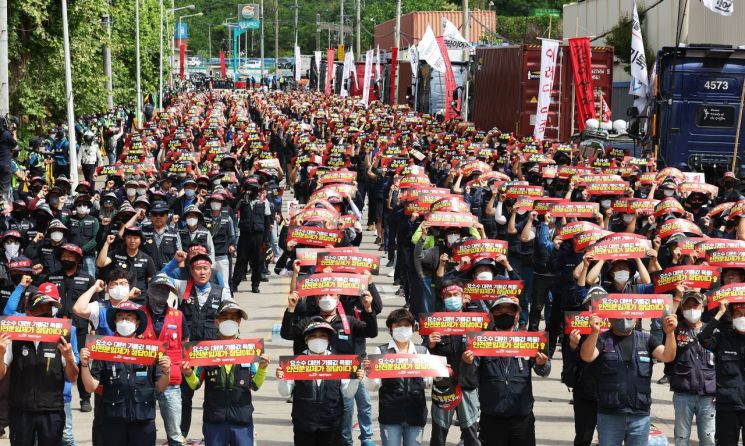 On the morning of the 7th, union members shouted slogans at the Cargo Solidarity Seoul-Gyeonggi Branch general strike departure ceremony held in front of the Inland Container Depot (ICD) in Uiwang-si, Gyeonggi-do. / Photo by Yonhap News
The problem is that the Safe Freight Rate System introduced at that time had a temporary duration (sunset clause) of three years. It is scheduled to end on December 31 of this year. Cargo Solidarity feared that if the Safe Freight Rate System were abolished amid the current high oil prices, it would severely impact the livelihoods of cargo workers, and thus demanded the government abolish the sunset clause.
◆Why couldn't the government prevent the strike?
The government formed a 'Safe Freight Rate System Task Force (TF)' on May 30 to begin discussions. On June 2, five days before the scheduled general strike on June 7, the Ministry of Land, Infrastructure and Transport attempted the first round of negotiations with Cargo Solidarity. However, the two sides sharply disagreed over abolishing the sunset clause of the Safe Freight Rate System. Ultimately, negotiations broke down without narrowing differences, and Cargo Solidarity proceeded with the general strike as planned on June 7.
◆Cargo trucks stopped... South Korea's industry stopped too
The damage caused by this strike was significant. For example, cement shipments were immediately disrupted. According to the Korea Cement Association, the average cement shipment volume during the first three days of the strike was 16,000 tons, about 10% compared to approximately 180,000 tons before the strike. The cumulative loss in the cement industry is estimated at 45.8 billion KRW.
The halt in cement shipments hit construction sites like a domino effect. On June 9, 95% of the Seoul-Gyeongin Ready-Mixed Concrete Industrial Cooperative, consisting of 145 ready-mixed concrete manufacturing plants in the metropolitan area, stopped operations.
Meanwhile, shipments and supply of products such as polypropylene (PP) produced by factories in the Ulsan and Onsan petrochemical complexes were also halted, and some convenience stores restricted alcohol sales due to reduced soju shipments from liquor companies.
Hyundai Motor Company, which procures auto parts through about 11,000 delivery vehicles daily, was also affected by collective transport refusals, causing a significant drop in manufacturing operation rates. Additionally, various transportation businesses including ports and inland logistics experienced disruptions during the strike. According to estimates by six domestic organizations including the Korea International Trade Association, the Federation of Korean Industries, and the Korea Cement Association, the industrial damage caused by this 8-day general strike is reported to approach approximately 2 trillion KRW.
◆Government vs. Cargo Solidarity, who ultimately conceded?
After the strike began, the Ministry of Land, Infrastructure and Transport continuously attempted negotiations with Cargo Solidarity. The peak was the second, third, and fourth rounds of negotiations held consecutively from June 10 to 12. Especially during the fourth round held over the weekend, negotiations lasted nearly 10 hours but ultimately failed to narrow differences. During this process, Cargo Solidarity claimed that the People Power Party had reneged on the agreement, while the People Power Party immediately denied this, leading to a war of nerves.
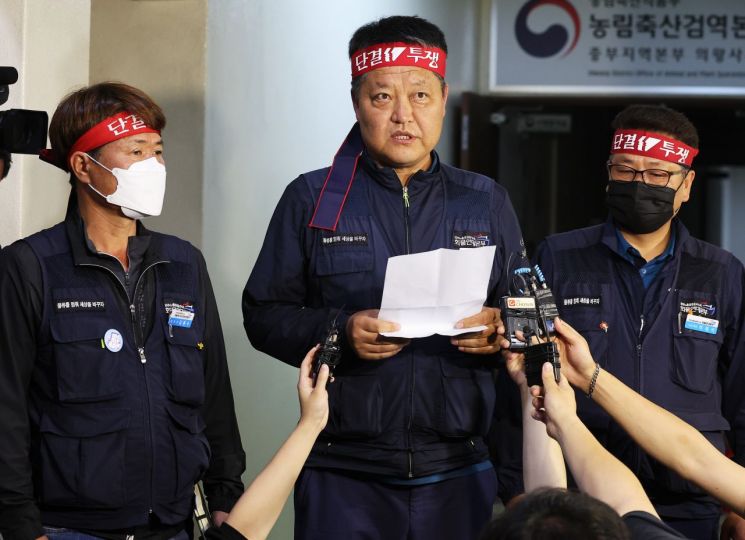 On the afternoon of the 14th, after the 5th practical negotiation held at ICD was concluded, representatives of the Cargo Solidarity are briefing the results. / Photo by Yonhap News
On June 14, during the fifth round of negotiations, the government and Cargo Solidarity finally reached a dramatic agreement. Both sides issued statements saying, "We agreed to continue promoting the Safe Freight Rate System" (Cargo Solidarity) and "We will continue to promote the extension of the currently operating Safe Freight Rate System" (Ministry of Land, Infrastructure and Transport). This effectively confirmed the extension of the Safe Freight Rate System, which was scheduled to end this year. Subsequently, Cargo Solidarity workers decided to return to their respective workplaces in 16 regional headquarters nationwide.
◆The unextinguished spark... 'True compromise' remains a challenge
The general strike has been settled for now, but conflicts surrounding the Safe Freight Rate System have not been fully resolved. Even the agreement issued by the Ministry of Land, Infrastructure and Transport and Cargo Solidarity on June 14 can be interpreted differently. Cargo Solidarity stated, "We agreed to continue promoting the Safe Freight Rate System," while the Ministry said, "We will continue to promote the extension of the Safe Freight Rate System." This leaves open the possibility that the system's application period may simply be extended. This is far from Cargo Solidarity's demand for abolishing the sunset clause and permanently legislating the Safe Freight Rate System.
Opinions are also divided in the National Assembly, which will make the final decision on abolishing the sunset clause of the Safe Freight Rate System. The Ministry of Land, Infrastructure and Transport has agreed to report the results of the Safe Freight Rate System implementation over the past three years to the National Assembly and support related discussions there.
First, the ruling party, the People Power Party, holds a cautious stance on abolishing the sunset clause. On June 15, People Power Party leader Lee Jun-seok said at a press conference, "Regarding the progress of the Safe Freight Rate System over the past three years, it was difficult to make an accurate evaluation due to volatile oil prices caused by COVID-19 and the Ukraine crisis," adding, "It was difficult to perfectly measure the system's performance during the sunset law period. I actively support extending the sunset law."
Meanwhile, Kwon Seong-dong, floor leader of the same party, said, "According to media reports, there were differences between the government's position and Cargo Solidarity's announcements," and added, "We will investigate the circumstances and decide our stance on extending the Safe Freight Rate System after internal discussions," expressing a reserved position.
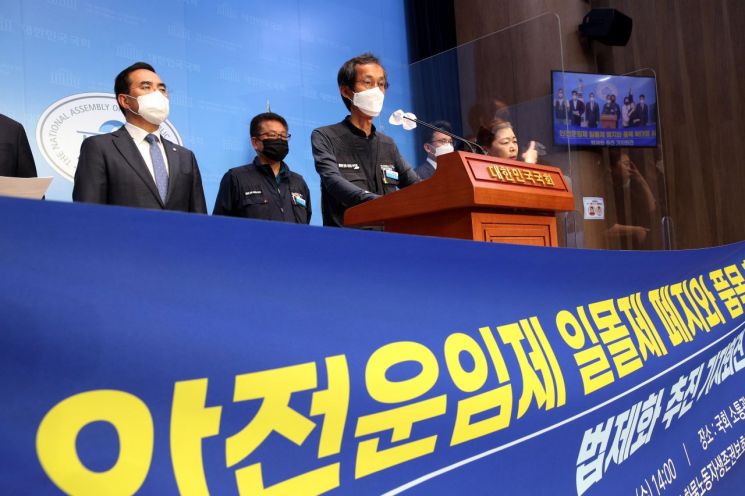 Lee Bong-ju, head of the Cargo Solidarity Headquarters of the Public Transport Union of the Korean Confederation of Trade Unions, is urging the abolition of the sunset clause of the Safe Freight Rate System at a press conference hosted by the Cargo Solidarity Headquarters of the Public Transport Union of the Korean Confederation of Trade Unions and the Euljiro Committee of the Democratic Party of Korea at the National Assembly Communication Hall on the afternoon of the 15th. / Photo by Yonhap News
The opposition party, the Democratic Party of Korea, appears to favor abolishing the sunset clause (permanent legislation). The Democratic Party held a joint press conference with Cargo Solidarity, stating, "We will pursue legislation in the National Assembly to abolish the sunset clause of the Safe Freight Rate System and expand it to all vehicle types and cargo items." Woo Sang-ho, chairman of the Democratic Party's Emergency Committee, also emphasized, "(Over time) Are we to let the truck drivers disappear? Abolishing the sunset clause is the answer."
On the same day, Lee Bong-ju, head of Cargo Solidarity, said at a press conference at the National Assembly Communication Office, "We will not stop fighting either on the ground or in the National Assembly until the bill to abolish the sunset clause is passed and the system's scope is expanded to all vehicle types and all cargo workers." This is interpreted as confirming Cargo Solidarity's demand for abolishing the sunset clause.
© The Asia Business Daily(www.asiae.co.kr). All rights reserved.



















