A 0.5% Point Increase Is an Unprecedented First
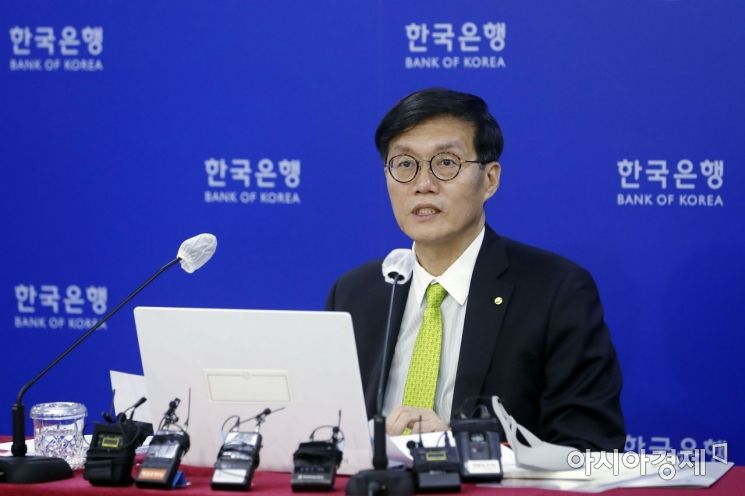
[Asia Economy Reporter Seo So-jeong] As the U.S. central bank took a 'giant step' by raising the benchmark interest rate by 0.75 percentage points at once in response to high inflation shocks, the Bank of Korea (BOK) is increasingly likely to take a 'big step' (0.5 percentage point hike) for the first time in history in July. So far, the BOK has lowered the benchmark interest rate by 0.5 percentage points at once but has never raised it by that amount.
Initially, the market widely expected the BOK to continue raising rates by 0.25 percentage points in each of the remaining four Monetary Policy Committee meetings this year. However, with the U.S. Federal Reserve (Fed) signaling the possibility of another giant step next month following this month’s hike, the pace of domestic rate hikes is also expected to accelerate significantly.
On the 15th (local time), after concluding the two-day Federal Open Market Committee (FOMC) regular meeting, the Fed announced it would raise the benchmark interest rate by 0.75 percentage points. This is the first time in 28 years since 1994 that the Fed has taken a giant step.
At a press conference that day, Fed Chair Jerome Powell said, "Inflation was too high," and indicated the possibility of consecutive giant steps by stating, "From today’s perspective, the most likely outcome at the next meeting is a rate hike of either 0.5 or 0.75 percentage points." The U.S. Consumer Price Index (CPI) for May rose 8.6% year-on-year, marking the highest level in 41 years, which has materialized concerns about aggressive tightening.
With the U.S. raising its benchmark interest rate significantly from the previous 0.75?1.00% range to 1.50?1.75%, changes in the pace of domestic rate hikes are inevitable. In particular, the market is highly anticipating that the BOK will take a big step at the Monetary Policy Committee meeting scheduled for July 13.
Following the U.S. rate hike, the benchmark interest rates of Korea and the U.S. are now equal at around 1.75%. If the Fed continues with another giant step next month, the interest rate differential between Korea and the U.S. will reverse. Jo Young-moo, a research fellow at LG Economic Research Institute, said, "If the interest rate inversion between Korea and the U.S. persists, foreign capital outflows could accelerate."
The domestic high inflation situation also supports additional rate hikes. The consumer price index in May rose 5.4% compared to the same month last year, marking the highest level in 13 years and 9 months. Especially due to the impact of rising raw material prices, concerns are growing that the inflation rate could realistically reach the 6% range in the future.
Accordingly, year-end forecasts for the domestic benchmark interest rate are being revised upward one after another. Park Seok-gil, head of JP Morgan’s Financial Market Operations Department, predicted, "The BOK will raise rates by 0.25 percentage points in August, October, and November following the big step in July, reaching a year-end benchmark rate of 3.0%." Park added, "The recently released minutes of the BOK’s Monetary Policy Committee suggest that members will proactively respond to inflation risks going forward. Even if the BOK does not take a big step in July, it is expected to raise rates by 0.25 percentage points until February next year, reaching a final rate of 3.25% in the first quarter of next year."
Baek In-seok, a research fellow at the Korea Capital Market Institute, said, "With the Fed taking a giant step, the possibility of a big step by the BOK has increased," adding, "As the U.S. continues aggressive tightening in the second half of the year, an interest rate inversion between Korea and the U.S. is inevitable for the time being."
© The Asia Business Daily(www.asiae.co.kr). All rights reserved.

















