Accommodation and Food Service Industry Sees 34,000 More Jobs Than a Year Ago... Senior Jobs Account for Half of Total Increase
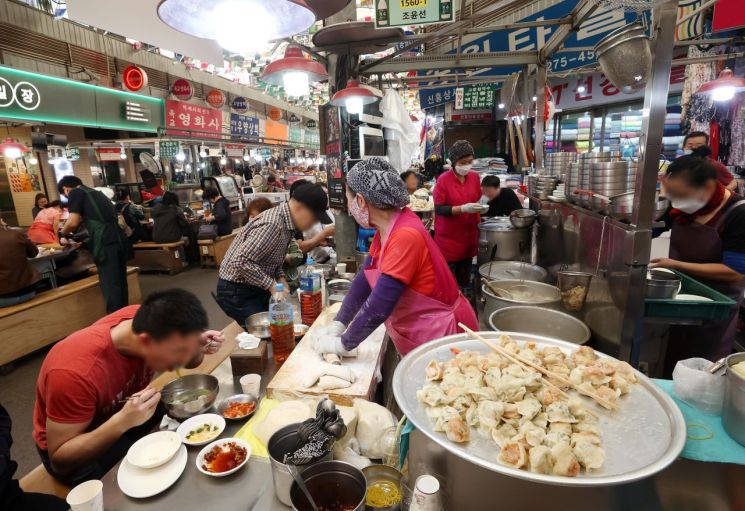
[Asia Economy Sejong=Reporters Kwon Haeyoung and Son Seonhee] The number of employed people in May increased by more than 900,000 compared to a year ago, marking the largest increase in 22 years for the same month. Employment in face-to-face industries such as accommodation and food services rose due to the recovery of daily life after COVID-19.
According to the 'May Employment Trends' announced by Statistics Korea on the 15th, the number of employed people last month was 28,485,000, an increase of 935,000 compared to a year ago. This is the largest increase for the same month since May 2000 (1,039,000) in 22 years.
The increase in the number of employed people was over 1 million in January (1,135,000) and February (1,037,000) this year, then dropped to the 800,000 range in March (830,100) and April (860,500), before rising again to the 900,000 range in May.
By industry, the number of employed people in accommodation and food services, a representative face-to-face industry, increased by 34,000 compared to a year ago due to the recovery of daily life after COVID-19. Employment in health and social welfare services (178,000), which includes government-funded direct job projects, and public administration (90,900) also increased. Employment in agriculture, forestry, and fisheries (122,000) and transportation and warehousing (120,000) also rose. On the other hand, employment in wholesale and retail trade (-40,500) and finance and insurance (-39,000), industries rapidly moving toward non-face-to-face operations, decreased during the same period.
Gong Misook, Director of the Social Statistics Bureau at Statistics Korea, explained, "The May employment trends showed an increase in employed people and a decrease in unemployed and economically inactive populations due to improvements in face-to-face industries following the recovery of daily life, indicating a sustained employment growth trend. Wholesale and retail trade are declining due to the spread of kiosks and unmanned stores, and finance and insurance are decreasing due to the increase in non-face-to-face services and store closures, but other industries are increasing."
Looking at the increase in employed people by age group, those aged 60 and over accounted for the largest increase with 459,000. Nearly half of the total job increase was still occupied by jobs for the elderly. Meanwhile, the number of employed people in their 30s, the core of the labor market, increased by only 6,000, and those in their 40s increased by 36,000.
By employment status, among wage workers, the number of regular workers increased by 900,000 and temporary workers by 79,000, while daily workers decreased by 91,000. Director Gong explained, "Daily workers have been decreasing for 13 consecutive months since May 2021, mainly in construction and accommodation and food service industries." Among non-wage workers, self-employed persons with employees increased by 65,000, and those without employees increased by 45,000. Unpaid family workers decreased by 64,000.
The employment rate for those aged 15 and over rose by 1.8 percentage points from a year ago to 63%, the highest level for the same month since statistics began in July 1982.
The number of unemployed people was 889,000, down 259,000 from a year ago. The unemployment rate fell by 1.0 percentage point to 3.0%, marking the lowest in nine years.
The economically inactive population was recorded at 15,871,000, down 480,000 from a year ago.
© The Asia Business Daily(www.asiae.co.kr). All rights reserved.

















