Opening the Path to Securing Quantum Information Preserved Despite Shocks
[Asia Economy Reporter Kim Bong-su] One of the advanced sensors inside smartphones, the Hall sensor, precisely measures the magnitude of magnetic fields to indicate direction or to guide robots along predetermined paths. A domestic research team has discovered the topological Hall effect, which can utilize Hall sensors in quantum information within magnetic quantum nanostructures.
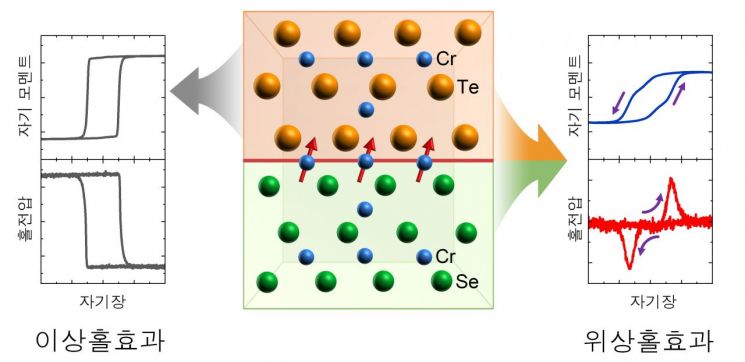
According to the Korea Research Foundation on the 14th, a joint research team led by Professors Cheon Seung-hyun and Kim Geon of Sejong University and Professor Park Seong-gyun of Pusan National University announced the discovery of the topological Hall effect, a hallmark of unusual spin distributions such as skyrmions, in ferromagnet-antiferromagnet bilayers. A skyrmion is a cluster where spins are twisted in a vortex shape. It has topological values such as 1, 0, and -1, allowing it to be used as a basic unit of data. It is very small and stable, resulting in almost no power consumption.
Recently, the quantum spin structure called ‘skyrmion,’ which is attracting attention as a core technology for next-generation neuromorphic computing devices, exhibits a unique phenomenon called the ‘topological Hall effect’ caused by a virtual magnetic field. Conversely, the discovery of the topological Hall effect also signals the existence of such skyrmions. Previously, the topological Hall effect was only found in combinations of materials with strong spin-orbit coupling, such as heavy metals like platinum or topological insulators, and ferromagnets. To develop artificial intelligence devices utilizing the topological characteristics of skyrmions or topological quantum computers, research on the topological Hall effect that can be expanded to a much wider range was necessary.
The research team, while conducting studies on two-dimensional magnetic materials using molecular beam epitaxy (MBE) equipment that stacks materials at the atomic layer level, discovered a new mechanism where the topological Hall effect appears. When only a ferromagnet was deposited on the substrate, the previously known anomalous Hall effect was observed, but when an antiferromagnet was co-deposited, the phenomenon changed to the topological Hall effect. Although ferromagnet-antiferromagnet bilayers are familiar nanostructures responsible for giant magnetoresistance effects and the core function of computer hard disk drive read heads, this is the first time the topological Hall effect has been discovered in them.
Professor Cheon Seung-hyun said, “This research result could provide a clue for quantum information device research that remains stable regardless of external environmental changes,” adding, “Through follow-up research attempting to combine two-dimensional magnetic materials and topological materials, we expect to discover new quantum phenomena and explore applications such as topological quantum computers.”
This research result was published online on the 27th of last month in the international nanoscience journal ‘ACS Nano.’
© The Asia Business Daily(www.asiae.co.kr). All rights reserved.

















