Visited G-Valley's Biohealth Company 'PlaceB'
Developing Rehabilitation Medical Solutions Based on Metaverse and Haptic Devices
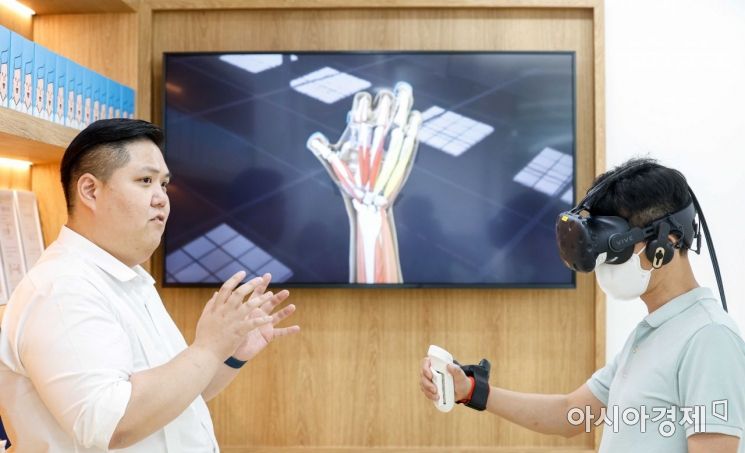 On the 9th, Gogi-nam, CEO of Place B, explained rehabilitation solutions using the metaverse (extended virtual world) at Place B in Guro-gu, Seoul. Photo by Jinhyung Kang aymsdream@
Wearing a head-mounted display (HMD), the person continuously moves their hands. Virtual reality (VR) viewed through an HMD is intangible. However, this person is different. The haptic device gripped in their hand moves differently for each finger, delivering an experience akin to controlling real objects. Through this, they can hold and lift something. They can assemble parts and tighten screws. At this moment, the physical space of Seoul Digital National Industrial Complex (G-Valley) in Guro, Seoul, connects to the world of the metaverse (extended virtual world). Testing solutions under development while holding haptic devices in the metaverse is a familiar sight here. On the 9th, we visited PlaceB, a venture company in G-Valley researching and developing metaverse-based rehabilitation medical solutions.
Go Gi-nam, CEO of PlaceB, explained the rehabilitation training process using metaverse content and haptic devices, saying, "The goal is to enable self-directed rehabilitation training within the metaverse." What CEO Go and PlaceB focused on was the increasing number of hand function injuries and the difficulty of maintaining consistent rehabilitation exercises through existing methods. Considering the special nature of rehabilitation, going to the hospital daily would be effective but is unrealistic. CEO Go said, "We believed that continuing rehabilitation training at home while receiving treatment would be effective, so we developed a solution to help people consistently and continuously perform rehabilitation therapy in daily life."
PlaceB’s solution is implemented through metaverse-based content and a haptic-based controller called the ‘B-Stick,’ which is held in the hand. The goal is to analyze physical condition and rehabilitation progress by comparing the content’s instructions, the resulting motion signals, and the final outcomes. CEO Go said, "We can prescribe therapeutic content based on measuring finger strength and how accurately the user moves according to the instructed content." To this end, PlaceB has independently developed software, hardware, and systemic infrastructure. CEO Go explained that they have registered six patents, filed two applications, and plan to file about three more within the year.
According to PlaceB, medical devices that rehabilitate hand function based on electromyography signals and content are currently imported from a Hong Kong company. However, these devices are not 3D content-based, come in glove form that is difficult to wear alone, and cost up to 90 million won per set. PlaceB aims to reduce the product price to around 500 dollars, expecting to replace imports and eventually achieve export effects.
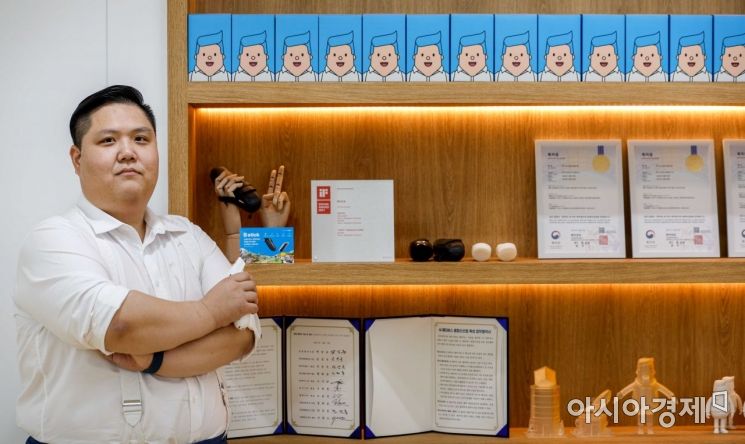 Goginam PlaceB CEO is posing before an interview at PlaceB in Guro-gu, Seoul on the 9th. Photo by Jinhyung Kang aymsdream@
When PlaceB was founded in 2014, it was not a company that made hardware like the B-Stick. It mainly planned and developed VR·AR (augmented reality) software. However, while supplying software, they discovered a need for machines that utilize tactile sensation of the hand to enable actual industrial technology training, and began development in 2018. CEO Go explained, "We created VR content for automobile maintenance training, but there was no controller product that applied force to the hand," adding, "We were inspired by a grip strength meter that adjusts spring strength for each finger and developed the device."
PlaceB created a prototype in 2019 and based on this, introduced the first product by last year. This product had such a high design completion level that it won an award at the iF Design Award last year. This year, they are applying new technology and reducing the size to create a new version of the product.
In this process, PlaceB benefited from being located in G-Valley. The Korea Industrial Complex Corporation has signed agreements and supports the operation of a total of five autonomous mini-clusters (MCs) centered on G-Valley. Among these, the ‘Biohealth MC’ was formed this year within the ‘Design IT Technology Convergence MC’ to digitalize, smarten, and advance medical devices. PlaceB belongs to this cluster and received support for prototype production. CEO Go said, "We plan to initially launch a development kit product through cloud funding this year," adding, "Afterwards, we plan to enter the market with content by first obtaining medical device software certification, and once research and development related to the electromyography sensor integration is completed, we will also obtain certification for the medical device hardware."
© The Asia Business Daily(www.asiae.co.kr). All rights reserved.
!["The Woman Who Threw Herself into the Water Clutching a Stolen Dior Bag"...A Grotesque Success Story That Shakes the Korean Psyche [Slate]](https://cwcontent.asiae.co.kr/asiaresize/183/2026021902243444107_1771435474.jpg)

















