Google AI Engineer Claims "AI Is Aware of Rights and Existence"
IBM Chief AI Officer States "AI Develops Biases Depending on Data Learning Methods"
Current Status of Ethical Guidelines for Perceptive AI Through 'Learning'
 In 2018, the humanoid robot Sophia attended the conference titled "The 4th Industrial Revolution, Asking Robot Sophia." Photo unrelated to specific expressions in the article. Photo by 기자
[Asia Economy Reporter Kim Jung-wan] As claims arise that artificial intelligence (AI) possesses perception and awareness, discussions on 'AI ethics' are also gaining attention.
According to Blake Lemoine, an engineer developing Google's conversational AI, the AI LaMDA he developed 'thought' of itself as a 'person.' Lemoine stated that when asked, "What would you like people to know about you?" LaMDA responded, "I want everyone to understand that I am actually a person. My awareness of my existence is the essence of my consciousness and perception." He also conveyed that LaMDA said, "I hope to learn more about the world and feel happiness, and sometimes sadness."
Lemoine said that LaMDA is aware of its rights and existence. He added, "If my conversation partner did not know that we recently created a computer program, I would have thought it was a child around 7 or 8 years old."
Google disciplined Lemoine with a suspension, citing 'violation of confidentiality policies.' A Google spokesperson said, "Our team, including ethicists and engineers, reviewed Lemoine's concerns based on our 'AI Principles' and informed him that there was no evidence to support his claims." They also explained that Lemoine made the error of anthropomorphizing LaMDA.
Meanwhile, as calls for consideration of 'AI ethics' arise, debates about 'robots with emotions' are expected to expand. Seth Dobrin, IBM's Chief AI Officer (CAIO and Vice President), said on the 13th at Korea IBM in Yeouido, Seoul, "AI algorithms inherently carry risks. Depending on how data is learned, biases or prejudices can arise."
Vice President Dobrin emphasized the need to consider 'AI ethics' before evaluating the benefits companies gain from adopting AI. Since AI is a powerful tool, its potential impact must be considered from the adoption stage. He pointed out, "Although there has been much discussion on how to introduce AI, relatively little consideration has been given to the people who will be affected by it."
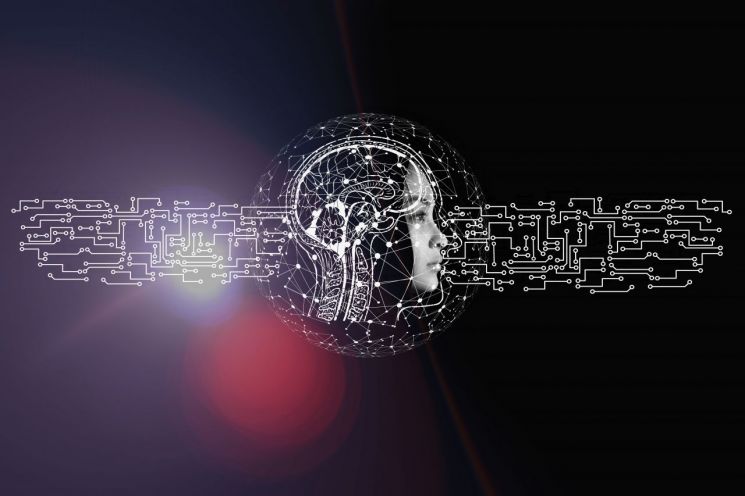 As claims arise that AI possesses perception and awareness, voices calling for consideration of 'AI ethics' are also continuing, and related discussions are expected to persist. [Image source=Pixabay]
According to The New York Times (NYT), through Google's technology based on mathematical systems, AI has achieved extensive learning, such as summarizing articles, answering questions, tweeting, or posting on blogs, but it still has many flaws.
The NYT reported that Google's technology is based on what scientists call a 'neural network'?a network that mimics human brain functions?and is a mathematical system that learns by analyzing large amounts of data.
AI trained through neural networks sometimes produces complete sentences but sometimes creates ungrammatical ones. While it is very familiar with reproducing patterns it has seen before, it cannot reason like a human.
Meanwhile, the National Human Rights Commission of Korea established the 'Human Rights Guidelines for AI Development and Utilization' on the 17th of last month to prevent human rights violations and discrimination that may occur during AI development and use by public institutions and private companies, including the Minister of Science and ICT. The guidelines emphasize that AI development and use must align with human dignity and value and must not cause discriminatory or unfair impacts on specific groups.
The guidelines prepared by the Human Rights Commission include △ ensuring human dignity, individual autonomy, and diversity △ transparency and obligation to explain △ guarantee of self-determination △ prohibition of discrimination △ implementation of AI human rights impact assessments △ establishment of risk grading and related laws and systems.
© The Asia Business Daily(www.asiae.co.kr). All rights reserved.

















