Rainfall from January to May at half the average... Historic drought deepens farmers' worries
Criticism grows over water-using festivals like Heumppeok Show and Waterbomb
"Ethical consumption concerned about environment increasing... Changes needed in response to criticism"
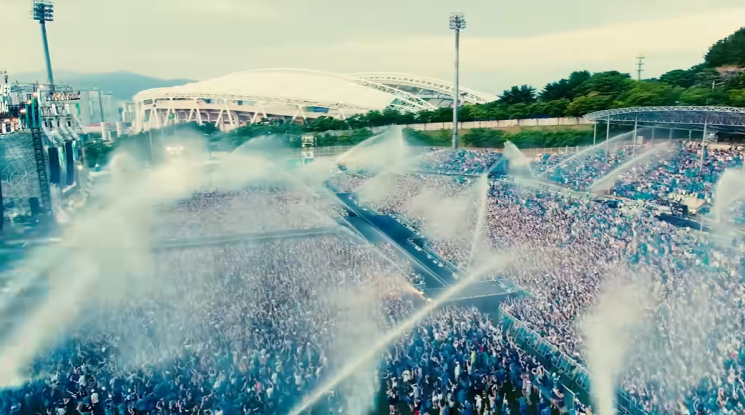 Festivals featuring concepts of enjoying by spraying water, such as singer Psy's concert and the Waterbomb Festival, are facing criticism. There are concerns that this type of festival is inappropriate amid an unprecedented drought. The photo shows a scene from Psy's concert featured in the music video for the song "Everyday." Photo by officialpsy, video capture.
[Asia Economy Reporter Park Hyun-joo] Following the return of singer Psy's Hmph Show after three years, the Waterbomb Festival is also facing heavy criticism. The Waterbomb Festival is held in a format where artists and singers form teams to enjoy music while engaging in water fights with opposing teams. However, there are concerns that such a festival is inappropriate as it wastes water amid severe drought conditions causing distress to farmers.
Actress Lee El took to Twitter on the 12th to criticize the upcoming Waterbomb Festival scheduled for the 24th, saying, "I wish the 300 tons of water used in the Waterbomb concert would be poured into the Soyang River." The Soyang River, which flows through Inje and Chuncheon in Gangwon Province, has been drying up since early this month due to the extreme drought.
The drought has persisted since this spring. According to the Ministry of Agriculture, Food and Rural Affairs, the Korea Meteorological Administration, and the Hydrometeorological Drought Information System, the nationwide cumulative rainfall from January to May this year was 160.7 mm, only 52% of the average (310 mm). From the 2nd of last month to the 1st of this month, the nationwide average cumulative rainfall was just 5.8 mm, which is 5.6% of the average (104.2 mm). As of the end of last month, reservoir storage rates were at 58.8%, about 91% of the average. Although some rain fell mainly in the southern regions early this month, it is far from enough to make up for the insufficient precipitation since last winter.
As a result, the shortage of agricultural water is affecting the growth of open-field crops. According to the National Statistical Portal (KOSIS) of Statistics Korea on the 13th, potato prices rose 32.1% compared to the same month last year. This contrasts with the overall vegetable prices last month, which increased by only 0.2% year-on-year, highlighting the severe impact on open-field crop production. Garlic, which has recorded double-digit price increases for five consecutive months, also rose 11.6% compared to the previous year.
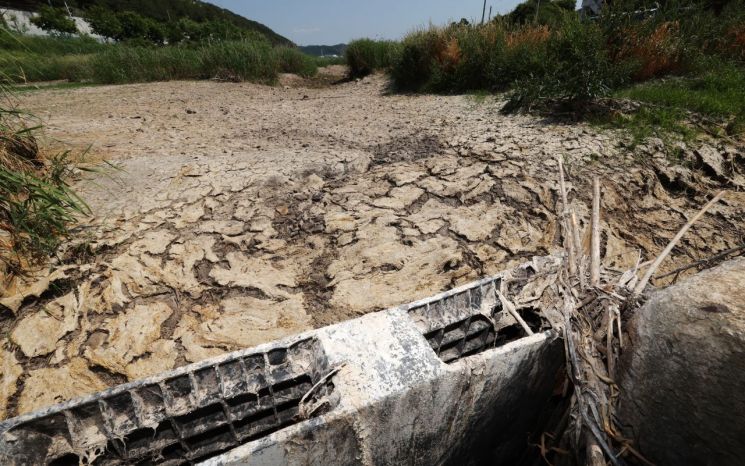 Due to the ongoing drought, a stream in Sojeong-myeon, Sejong City, was completely dried up on the 2nd. [Image source=Yonhap News]
In this situation, festivals that use water are receiving sharp criticism. Previously, Psy's 'Hmph Show' also faced public backlash because the concert concept involved getting soaked with water. Psy revealed on MBC's variety show 'Radio Star' last month that about 300 tons of drinking water are used per concert. Given the severe drought and the damage to farmers, there is widespread criticism that such festival formats are inappropriate. Other festivals planning to use water, such as the 'Sinchon Water Gun Festival' and the 'Songkran Music Festival,' are facing similar situations.
Regarding this, Professor Lee Eun-hee of Inha University's Department of Consumer Studies explained, "Consumption is a free act of consumers, but since we live together in a community, efforts to refrain from consumption that harms the common good of the community or negatively affects others are necessary. This is called ethical consumption." She added, "In this controversy, if the drought is severe, it is necessary to make changes such as altering the festival concept. Alternatively, it seems necessary to visibly demonstrate any efforts made in response to consumers' concerns."
© The Asia Business Daily(www.asiae.co.kr). All rights reserved.
![Clutching a Stolen Dior Bag, Saying "I Hate Being Poor but Real"... The Grotesque Con of a "Human Knockoff" [Slate]](https://cwcontent.asiae.co.kr/asiaresize/183/2026021902243444107_1771435474.jpg)

















