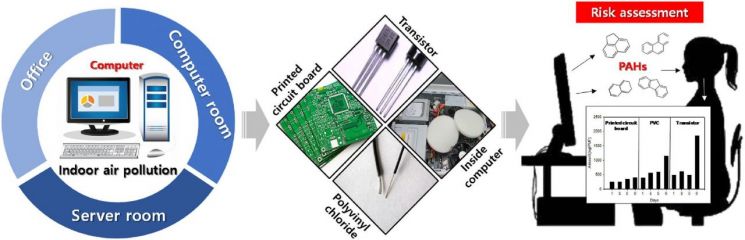
 Research image showing PAHs concentration measured higher in a computer server room than in general indoor environments.
[Asia Economy Yeongnam Reporting Headquarters Reporter Hwang Duyul] It has been confirmed that air pollutants emitted from factory chimneys are also emitted from overheated computers.
Professor Choi Seongdeuk's team from the Department of Urban Environmental Engineering at UNIST published research results in a prestigious international journal showing that polycyclic aromatic hydrocarbons (PAHs) are emitted from computers, polluting indoor air.
It is analyzed that PAHs, which are impurities contained in computer components, volatilize as the computer overheats.
Polycyclic aromatic hydrocarbons are known as "harmful air pollutants" generated and released into the air when burning petroleum, coal, wood, and other materials.
The research team discovered that the concentration of PAHs in computer rooms was about 2 to 4 times higher than in other indoor spaces while studying sick building syndrome, and began their research.
After collecting indoor air and air inside computers to analyze PAHs concentration, it was found that the smaller the indoor space and the more computers there were, the higher the PAHs concentration.
Computers with shorter usage periods emitted larger amounts of PAHs, which is similar to the sick building syndrome where there is a strong odor in newly occupied spaces.
When PAHs were directly extracted from computer components, PAHs were detected in all computer components used in the experiment.
In an experiment where computer components such as circuit boards and wire coatings were placed in sealed containers and heated at 60℃, the longer the heating time, the higher the PAHs concentration was measured.
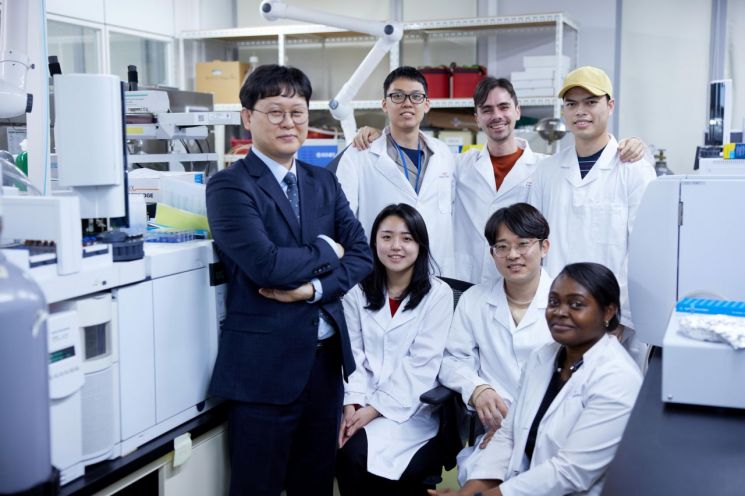
Professor Choi Seongdeuk explained, “Besides computers, there is a high possibility that PAHs are emitted from various electronic devices, and there are overseas reports that PAHs are emitted from laser printers. In enclosed spaces, exposure to PAHs and various harmful air pollutants can be high, so frequent ventilation and maintaining an appropriate indoor temperature are necessary.”
The research demonstrated that contrary to previous beliefs, exposure to PAHs from electronic devices indoors is possible, highlighting the importance of finding various indoor air pollution sources and analyzing their risks.
The research team is preparing follow-up studies to analyze the exact pollution sources by further analyzing the components of computer parts and to assess the mid- to long-term health risks.
The research results were published in the June issue of Building and Environment, a prestigious journal in the field of construction environment.
© The Asia Business Daily(www.asiae.co.kr). All rights reserved.
![Clutching a Stolen Dior Bag, Saying "I Hate Being Poor but Real"... The Grotesque Con of a "Human Knockoff" [Slate]](https://cwcontent.asiae.co.kr/asiaresize/183/2026021902243444107_1771435474.jpg)

















