National Average Gasoline Price 2,069.74 KRW · Diesel 2,069.32 KRW... Consecutive Record Highs
Temporary Expansion of Fuel Tax Reduction Rate Also Practically 'Useless'
"Fuel Prices Rising Noticeably"
Food Prices Continue to Rise
Experts: "Price Increase Due to International Political Instability... No Other Options"
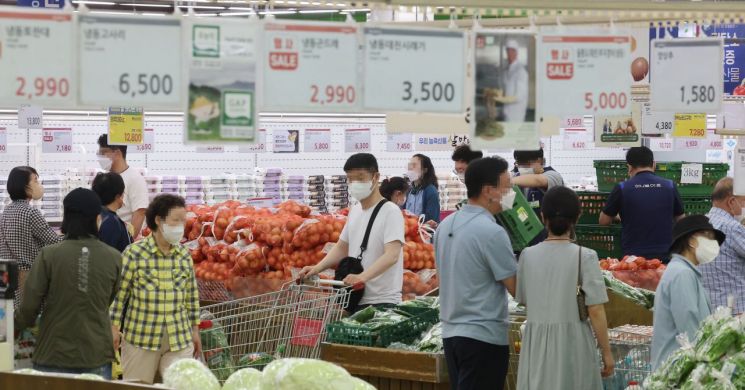 As prices continue to soar recently, citizens are shopping at a mart in Seoul on the afternoon of the 12th. [Image source=Yonhap News]
[Asia Economy Reporter Yoon Seul-gi] As domestic inflation continues, citizens are voicing their frustrations. Prices of common foods such as chicken, jajangmyeon, and tteokbokki have surged, while fuel prices have hit record highs daily, increasing the burden of living expenses. The government has introduced measures to curb inflation, including a temporary reduction in fuel taxes, but since the main cause of rising prices is the impact of the Ukraine crisis, it is expected to be difficult to find an immediate solution.
According to the Korea National Oil Corporation’s oil price information service OPINET on the 13th, the nationwide average gasoline price in the morning was 2,069.74 KRW per liter (ℓ). Gasoline prices surpassed 2,064.59 KRW on the 11th, breaking the previous record high of 2,062.55 KRW set on April 18, 2012, for the first time in 10 years and 2 months, and have continued to hit new highs daily.
The nationwide diesel price also rose for the third consecutive day, reaching 2,069.32 KRW per liter. Diesel prices broke the previous record of 1,947.75 KRW set on July 16, 2008, on the 12th of last month by reaching 1,953.29 KRW per liter, and have been hitting new highs every day since.
Earlier, the government implemented a temporary increase in the fuel tax reduction rate from 20% to 30% on gasoline, diesel, and LPG butane starting from the 1st of last month to curb fuel prices. However, this measure has become practically ineffective. The recent international oil price surpassed $120 per barrel, effectively nullifying the impact of the fuel tax reduction.
The main cause of this inflation is analyzed to be the prolonged Ukraine war. The strong economic sanctions imposed by the United States and the European Union (EU) on Russia, which invaded Ukraine, have led to increases in international raw material prices, including oil.
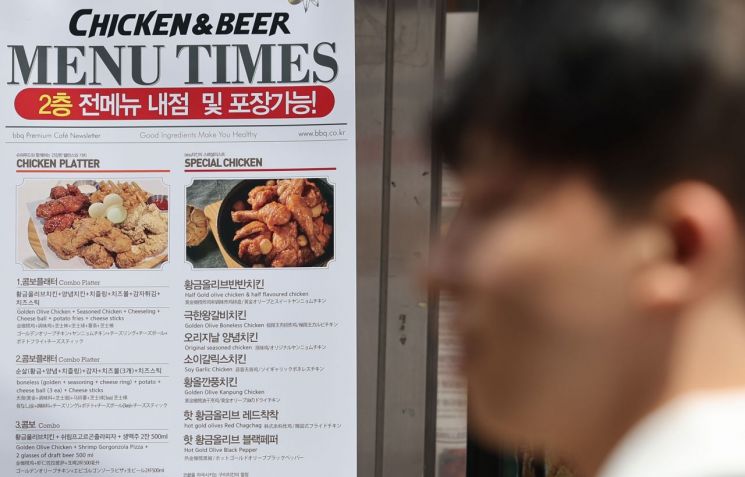 According to the National Statistical Office's National Statistical Portal (KOSIS) on the 12th, the dining-out price index last month rose by 4.2% compared to December of last year, exceeding the overall consumer price index increase rate of 3.4%. Prices of all 39 dining-out items increased compared to the end of last year, with chicken showing the highest increase rate at 6.6%. [Image source=Yonhap News]
Amid the ongoing high oil prices, food prices are also fluctuating. According to the consumer price trends for May released by Statistics Korea on the 3rd, the consumer price index last month rose by 5.4% compared to the same month last year. This is the highest increase in 13 years and 9 months since August 2008 (5.6%).
Dining-out prices are no exception. According to the National Statistical Portal (KOSIS) of Statistics Korea on the 12th, the dining-out price index last month rose by 4.2% compared to December of last year, exceeding the overall consumer price index increase rate of 3.4%.
Prices of all 39 dining-out items increased compared to the end of last year, with chicken rising 6.6%, recording the highest increase. This was followed by jajangmyeon (6.3%), tteokbokki (6.0%), kalguksu (5.8%), jjambbong (5.6%), gimbap (5.5%), ramen and coffee (each 5.2%), and fried rice (5.0%), all rising more than 5%. This is also believed to be due to the rise in prices of grains such as flour following the Ukraine crisis.
As prices rise sharply, citizens’ worries deepen. Yoon, a 31-year-old office worker, said, "Because I drive a compact car, the fuel cost was less than for other vehicles. Earlier this year, filling up the tank cost about 55,000 KRW, but now, even when the tank is not empty, the gasoline price is in the low 70,000 KRW range. I used to drive even for short distances, but now I think it’s better to take the subway or a taxi."
A 30-something self-employed person, Mr. A, said, "I commute daily by car, and while 50,000 KRW used to last for two weeks, now it feels like it only lasts about a week. For people whose livelihood depends on transportation, the rise in fuel prices is really felt on the skin."
Experts advise that since inflation has a more severe impact on low-income groups, related measures are necessary. Kim Tae-gi, emeritus professor of economics at Dankook University, explained, "The current inflation trend is largely influenced by external factors such as international political instability, so there are few options. Since inflation is expected to continue for the time being, relief through tax reductions is needed. Especially, policies that consider low-income groups facing livelihood difficulties are necessary."
© The Asia Business Daily(www.asiae.co.kr). All rights reserved.


















