Cumulative Trade Deficit of $13.8 Billion This Year... Faster Than Financial Crisis
Soaring Energy Import Costs Due to High Oil Prices... Deterioration in External Trade Conditions
Possibility of Trade Deficit for 3 Consecutive Months... First Time in 14 Years Since 2008
 April Current Account Deficit of 80 Million Dollars... Surplus Broken After 2 Years
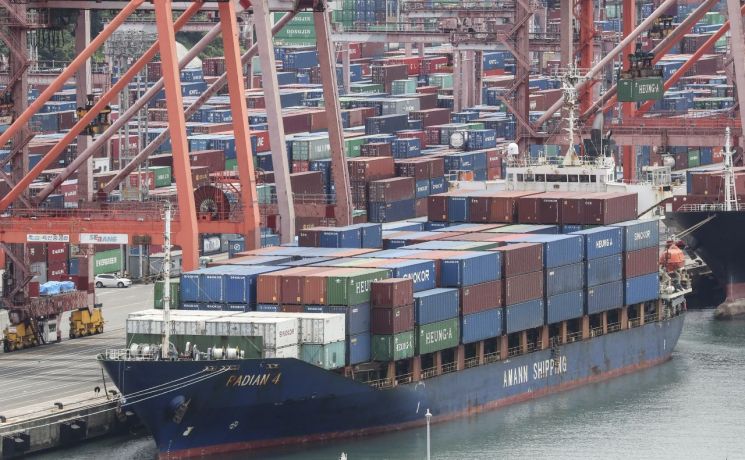
(Busan=Yonhap News) Photo by Kang Deok-cheol = On the 10th, container unloading work is underway at Sinsundae Pier, Busan Port. According to the preliminary balance of payments statistics announced by the Bank of Korea on the 10th, the current account recorded a deficit of 80 million dollars (about 150 billion won) in April. The current account turned to a deficit after 24 months. 2022.6.10
kangdcc@yna.co.kr
(End)
<Copyright(c) Yonhap News Agency, Unauthorized reproduction and redistribution prohibited>
[Asia Economy Sejong=Reporter Lee Jun-hyung] The cumulative trade deficit has exceeded $13.8 billion as of the 10th of this month, marking a faster pace than during the 2008 global financial crisis. Due to the impact of high oil prices, energy import costs have surged, raising concerns that the trade deficit may become prolonged.
According to the Korea Customs Service on the 13th, the trade balance from the 1st to the 10th of this month recorded a deficit of $6 billion. Imports increased by 17.5% year-on-year to $21.1 billion, while exports rose by only 12.7% to $15.1 billion. During the same period last year, the trade balance showed a deficit of $670 million.
The cumulative trade deficit this year has been calculated at $13.8 billion. Specifically, exports amounted to $307.7 billion, up 15.8% from a year earlier, while imports rose 26.8% to $321.5 billion. In the same period last year, the trade balance was a surplus of $12.3 billion. Even during the 2008 global financial crisis, the trade deficit exceeded $10 billion only after August.
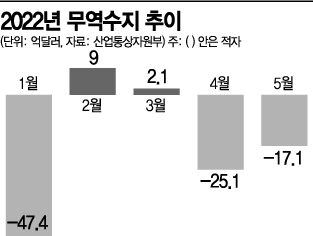
The sharp rise in the trade deficit is due to soaring energy prices. Since the onset of the Ukraine crisis, imports of the three major energy sources?crude oil (88.1%), coal (223.9%), and gas (10.1%)?have steadily increased. In particular, coal imports set a record high last month. Although major export items such as semiconductors (0.8%) and petroleum products (94.5%) performed well, the trade balance could not avoid a deficit.
Exports to major countries also contracted due to worsening external trade conditions, including China's lockdown measures. Exports to China and the United States decreased by 16.2% and 9.7%, respectively, compared to the same period last year. Exports to Vietnam (-8.3%), the European Union (-23.3%), and Japan (-17%) also declined simultaneously.
The possibility of the trade balance continuing its deficit streak for three consecutive months has increased. Previously, the trade balance recorded deficits in April and again last month. The last time Korea experienced a three-month consecutive trade deficit was in 2008.
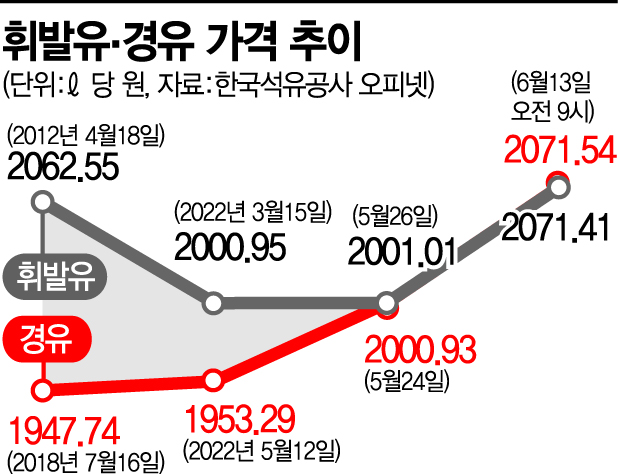
The trade deficit trend is expected to continue into the second half of this year. The international oil price has surpassed $120, prolonging the high oil price situation, and international grain prices continue to soar due to food protectionism. Agricultural imports have exceeded $2 billion for three consecutive months recently.
There are also forecasts that the trade deficit could reach an all-time high. The Korea Institute for Industrial Economics & Trade (KIET) projected in its recently released "Second Half Economic and Industrial Outlook" that this year's trade deficit will be around $16 billion. Since the Korea Customs Service began compiling export-import statistics in 2000, the largest annual trade deficit was $13.26741 billion recorded in 2008.
© The Asia Business Daily(www.asiae.co.kr). All rights reserved.



















