Lowest Ever Observed Ultrafine Dust Concentration at 20㎍/㎥
No 'High Concentration Days' Exceeding 50㎍/㎥ in Daily Average Ultrafine Dust Levels
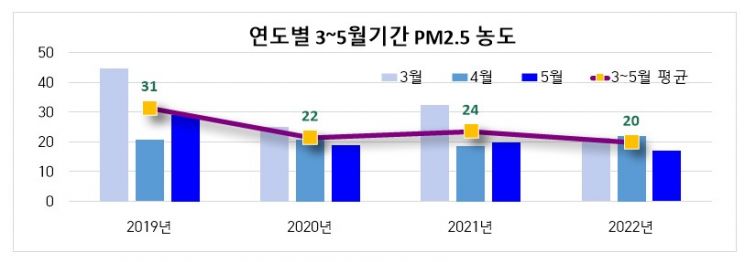
[Asia Economy Reporter Lim Cheol-young] This year, the concentration of fine particulate matter (PM2.5) in Seoul during spring recorded the lowest level since monitoring began, at 20㎍/㎥. This spring, emergency reduction measures were not issued even for a single day, and the PM2.5 concentration was recorded at 21㎍/㎥, marking the lowest monthly level since observations started.
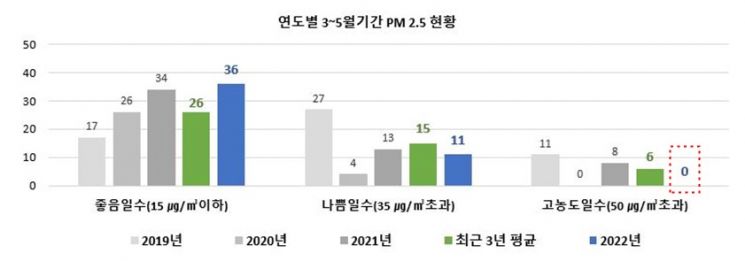
According to the Seoul Metropolitan Government on the 13th, the number of days with "Good" PM2.5 levels (~15㎍/㎥) during spring was the highest ever recorded since monitoring began, totaling 36 days, while days exceeding the "Bad" level were only 11. Compared to the past three years, the number of "Good" PM2.5 days increased by 10 days (from 26 to 36 days), and the number of "Bad" days decreased by 4 days (from 15 to 11 days). Additionally, there were no high concentration days (exceeding 50㎍/㎥), which pose significant health risks.
The Seoul Metropolitan Government explained, "The improvement in PM2.5 concentration is the result of a combination of internal policy effects, meteorological conditions, and external influences. Considering the long-term decreasing trend in concentration, it is interpreted that the effects of the fine dust policies promoted by the city have accumulated and yielded results."
Since 2003, the automobile low-emission project has been actively promoted, reaching the final stages with the complete conversion of CNG city buses and a cumulative total of approximately 520,000 vehicles. The policy focus is now shifting towards the distribution of zero-emission vehicles. Other measures have included the distribution of eco-friendly boilers (480,000 units), total emission regulation of air pollutants from workplaces, and support for replacing outdated prevention facilities (236 sites).
In particular, in March of this year, which recorded the lowest concentration ever for March (21㎍/㎥), Seoul implemented a "Spring Full Response" by strengthening reduction measures such as increasing reduction rates at large workplaces and expanding road water cleaning. This is seen as a factor contributing to the improvement in air quality. Large emission businesses that emit more than 10 tons of air pollutants annually maximized their reduction rates, with 16 businesses participating in reducing 1.1 tons of air pollutants.
Regarding the impact of external inflows, it is estimated that the PM2.5 concentration in the northeastern region of China, which recovered to pre-COVID-19 levels in 2021, decreased again this year, positively affecting Seoul's air quality. This spring, the concentration in northeastern China improved by 22% compared to last year's 44.2㎍/㎥, recording 34.6㎍/㎥.
Furthermore, the city is preparing for high-concentration ozone during the summer. Emphasis is placed on reducing volatile organic compounds (VOCs), which are major precursors of ozone as well as contributors to fine dust formation. VOCs are mainly emitted from facilities using organic solvents such as painting facilities, printing shops, and laundries, most of which are small-scale businesses that fall outside the scope of administrative supervision.
Accordingly, the city plans to move beyond previous VOC measures that focused only on regulated facilities and will specifically develop and implement reduction measures for emission sources outside regulation. First, the public sector will take the lead in using organic solvents with low VOC content and encourage expansion to the private sector.
In the mid- to long-term, through pilot projects, management plans for printing shops, which are representative non-regulated VOC facilities, will be developed by next year. Furthermore, in consultation with the Ministry of Environment, the city plans to improve systems to strengthen management of VOC emission sources in regulatory blind spots. Yoo Yeon-sik, Head of Seoul's Climate and Environment Headquarters, stated, "As daily life recovers from the pandemic, an increase in domestic and international emissions compared to the previous year is inevitable. Seoul will respond with more meticulous management," adding, "We will do our best to protect citizens' health through integrated management from summer ozone to winter fine dust."
© The Asia Business Daily(www.asiae.co.kr). All rights reserved.
![Clutching a Stolen Dior Bag, Saying "I Hate Being Poor but Real"... The Grotesque Con of a "Human Knockoff" [Slate]](https://cwcontent.asiae.co.kr/asiaresize/183/2026021902243444107_1771435474.jpg)

















