Busan Port Container Throughput Drops to 24%
Uiwang Container Terminal Also at 10% of Normal Levels
Business Community "Calls for Review of Work Commencement Order"
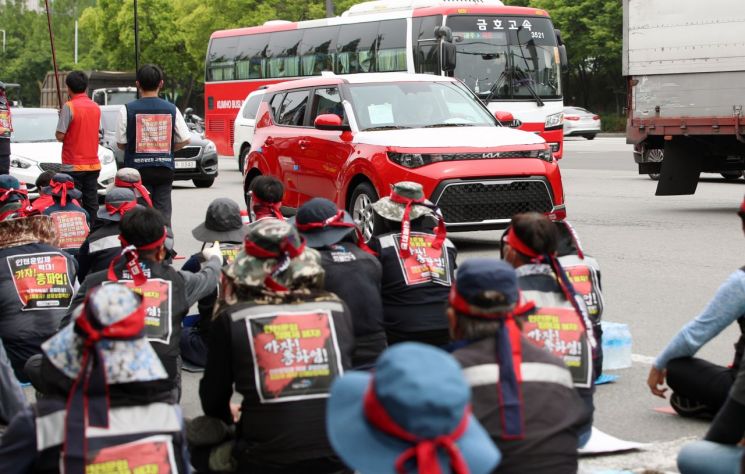 On the fourth day of the general strike by the Cargo Solidarity Headquarters of the Public Transport Union under the Korean Confederation of Trade Unions on the afternoon of the 10th, unlicensed finished vehicles being transported individually without car carriers passed by the rally site of Cargo Solidarity union members in front of the Kia Motors production plant in Seo-gu, Gwangju. (Image source=Yonhap News)
[Asia Economy Reporter Moon Chaeseok] The nationwide general strike by the Cargo Solidarity Headquarters of the Public Transport Workers' Union under the Korean Confederation of Trade Unions (Cargo Solidarity) has entered its sixth day on the 12th, prolonging the dispute and raising concerns over construction halts at frontline construction sites due to disruptions in cement transportation, with damages spreading. The government and Cargo Solidarity have continued talks to resolve the situation on this day as well as the previous day, but have yet to find a compromise.
According to the Ministry of Land, Infrastructure and Transport, although the number of participants in the strike on the sixth day decreased somewhat due to the holiday, transportation refusals continue in various places, and minor to major clashes have occurred. The ministry estimated that about 4,100 union members, approximately 19% of the 22,000 Cargo Solidarity members, are participating in rallies across 14 regions nationwide, continuing the strike. This scale of strike participation is about 2,500 fewer than the previous day.
The container occupancy rate by port (the ratio of containers actually stored to the port's container storage capacity) stood at 71.6%, slightly higher than the normal level of 65.8%. However, at some ports such as Busan Port and Ulsan Port, local transportation obstruction activities caused a decrease in import and export volumes compared to normal times.
At Busan Port, from 10 a.m. to 5 p.m. the previous day, container import and export volumes shrank to about a quarter (23.9%) of the same time last month, and at Incheon Port, cargo throughput at container terminals dropped to 10-20% of usual levels. The daily import and export volume at the inland container depot (ICD) in Uiwang, Gyeonggi Province, was also found to be less than 10% of normal.
The Ministry of Land, Infrastructure and Transport reported disruptions in production and shipment of certain items such as automobiles, steel, and cement. However, it stated that emergency shipments are being supported under police protection.
According to the Korea Petrochemical Industry Association, the daily average shipment volume in the petrochemical industry fell to about 10% of the pre-strike average (74,000 tons).
Industry sources report delays in the transportation of some finished vehicles, with export vehicles unable to be transported to ports and stuck in parking lots.
In particular, the cement industry is concerned that some plants may have to halt production starting this week due to blocked cement shipments. A representative from the Korea Cement Association said, "Currently, cement shipments have stopped at most distribution bases including the Seoul metropolitan area," adding, "Some plants are forced to suspend operations as silos storing cement are full."
Ready-mix concrete companies, which are major consumers of cement, are also facing difficulties in plant operations due to depleted cement inventories, and the construction industry is reportedly facing unavoidable delays in construction schedules due to the suspension of ready-mix concrete production.
In Jeju, where materials such as cement cannot be delivered from inland areas, it is forecasted that concrete pouring work, essential for framework construction sites, will face immediate construction halts starting from the 13th. Clashes of varying scales have also occurred at strike sites.
The Ministry of Land, Infrastructure and Transport reported illegal acts such as Cargo Solidarity union members throwing stones, eggs, and paint at cargo vehicles operating normally in regions including Busan and Jinhae, Gyeongnam. The ministry said police forces have been deployed at major logistics hubs to prevent illegal acts such as transportation obstruction, and efforts are underway to reduce logistics damage by deploying military-contracted container transport vehicles through emergency transport measures.
The business community has urged an immediate end to the strike, citing massive damage across industries caused by Cargo Solidarity's strike. On this day, 31 organizations including the Korea Employers Federation and six major economic organizations along with industry associations issued a joint statement demanding, "Cargo Solidarity must immediately stop the collective transportation refusal and return to transportation to prevent the efforts of our people to overcome the crisis from being wasted."
These organizations pointed out the economic compound crisis caused by the 'triple hardship' of the global supply chain crisis, rising raw material prices, and increased logistics costs, stating, "In this situation, the prolonged collective transportation refusal is causing disruptions not only in cement, petrochemicals, and steel but also in the supply of automobiles and electronic components, accumulating massive damage to manufacturing and trade, which are the pillars of our economy." They also urged the government to "actively consider issuing work commencement orders depending on the situation to promptly block the enormous ripple effects on the national economy."
The government has been holding 'marathon meetings' with Cargo Solidarity at the Government Complex Sejong from 2 p.m. on this day, continuing talks from the previous day. The Ministry of Land, Infrastructure and Transport's Logistics Policy Officer, a director-level official, is leading the government side, while Cargo Solidarity's senior vice chairman is participating, with discussions ongoing over agenda items such as the expansion of the Safe Freight Rate System.
In this strike, Cargo Solidarity demands the abolition of the sunset clause of the Safe Freight Rate System, expansion of applicable vehicle types and cargo items, and measures to address fuel prices. The Safe Freight Rate System was introduced to guarantee appropriate wages for cargo drivers to prevent overwork, overloading, and speeding, and is currently implemented with a 'three-year sunset clause,' scheduled to be abolished at the end of this year.
The government also engaged in over 10 hours of working-level negotiations with Cargo Solidarity from 11 a.m. the previous day but failed to narrow differences. After the talks ended without results, both sides issued press releases blaming each other for the breakdown in negotiations.
The Ministry of Land, Infrastructure and Transport claimed, "We agreed on the need to guarantee appropriate freight rates to truck owners and pledged active support during the legislative process in the National Assembly, but Cargo Solidarity repeated its existing position demanding the abolition of the sunset clause of the Safe Freight Rate System, leading to a halt in dialogue." Cargo Solidarity countered, "We tried to open some points in the government's proposal to find a compromise, but after internal discussions, the ministry ignored mutual compromise points and brought back a regressive proposal compared to the initial one, reverting to the original proposal at the end of hours-long negotiations."
However, it is reported that in today's talks, both sides presented proposals that retreated somewhat from their original positions, drawing attention to whether a compromise can be reached.
© The Asia Business Daily(www.asiae.co.kr). All rights reserved.

















