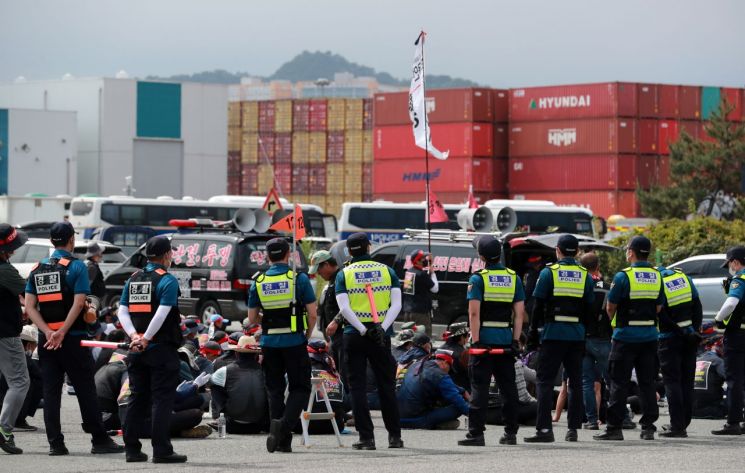
[Asia Economy Reporters Sunmi Park, Chaeseok Moon] The general strike by the Cargo Solidarity Headquarters of the Public Transport Workers' Union under the Korean Confederation of Trade Unions (KCTU) has continued for six days through the holiday on the 12th, causing widespread logistics disruptions. The Korea International Trade Association (KITA) has received 155 reports of difficulties related to the Cargo Solidarity strike. The business community has urged the government to consider issuing an order to resume work.
KITA Receives a Total of 155 Reports of Difficulties
As of 10 a.m. the previous day, the Korea International Trade Association had received a total of 155 difficulty reports related to the Cargo Solidarity strike from cargo owners. Among these, 53 cases (34.2%) were related to imports, including 24 cases (15.5%) of raw material procurement disruptions, 14 cases (9.0%) of production stoppages, and 15 cases (9.7%) of increased logistics costs. Export-related cases totaled 102 (65.8%), including 39 cases (25.2%) of delivery delays, 34 cases (21.9%) of penalty charges, and 29 cases (18.7%) of shipping disruptions.
In the midst of a global logistics crisis with a shortage of vessels for exporting products, cargo owners have reported losing secured vessels due to delays in export transportation caused by the Cargo Solidarity strike.
Company A, which imports and sells chemical products domestically, is facing additional demurrage and storage costs as well as air freight conversion expenses due to logistics halts caused by the strike. Company B, which produces and exports Samgyetang (ginseng chicken soup) and duck feathers, suffered damages amounting to 60 million KRW over three days due to the nature of duck feathers that must be shipped immediately after production. Company C, which exports railway vehicle parts, is at risk of incurring losses of up to several billion KRW as its production line has stopped because cargo imported from China could not be brought into Incheon Port.
The business community has condemned the prolonged Cargo Solidarity strike as an extreme struggle holding national logistics hostage and insists that the government should consider issuing an order to resume work. On this day, 31 organizations including the Korea Employers Federation and six major economic groups along with industry associations released a joint statement explaining, "The prolonged collective refusal to transport by the Cargo Solidarity, a transport operator group, is causing supply disruptions not only in cement, petrochemicals, and steel but also in automobiles and electronic components, accumulating enormous damage to manufacturing and trade, which are the pillars of our economy."
They added, "While the government is striving to minimize the logistics crisis through emergency transport measures and to resolve issues amicably through dialogue, the ongoing collective refusal to transport by the Cargo Solidarity is increasing national economic damage and public inconvenience. Now is the time for all economic actors to unite to overcome the crisis, not to refuse dialogue and engage in collective actions to enforce their unilateral demands."
Furthermore, they emphasized, "Despite the government's declaration to seek a path of coexistence through dialogue, the Cargo Solidarity's prolonged refusal to transport is nothing but an extreme struggle holding national logistics hostage. The Cargo Solidarity must immediately stop the collective refusal to transport and return to transportation so that the efforts of our people to overcome the crisis are not wasted."
They also stated, "The government must actively consider issuing an order to resume work depending on the situation to promptly block the enormous ripple effects on the national economy. In particular, if illegal acts such as obstruction of transport or violence by the Cargo Solidarity occur, the government must firmly respond according to law and principles to establish the rule of law in industrial sites."
Nationwide Cargo Solidarity Strike Damage... Cement Stock Depletion to Production and Transport Disruptions
The prolonged strike is causing increasing damage due to logistics transport disruptions across the country. Construction sites nationwide, including Gangwon, Chungbuk, Chungnam, and Jeju, are facing concerns over construction halts due to long-term suspension of cement transport.
The Cargo Solidarity held strike rallies nationwide on this day, urging cargo transport workers to join the strike. In Gangwon, strike rallies continued at three locations: Yeongwol Hanil Cement, Donghae Ssangyong C&E, and in front of Gangneung Halla Cement's Jeongmul site. Although no physical clashes occurred at the rallies, non-union members were reluctant to operate, and no bulk cement trailer (BCT) vehicles were seen entering or leaving.
In Chungbuk, rallies were held in front of Hanil Cement Danyang Plant, Sungshin Cement Danyang Plant, and Hanil Hyundai Cement Danyang Plant. With the suspension of cement land transport using BCTs, silos temporarily storing produced cement are full, raising concerns over factory shutdowns. Hanil Cement stated, "The silo is nearing full capacity, making the final process for finished product production impossible. Other companies are in similar situations," they lamented.
Ready-mix concrete companies are also struggling to operate factories due to depleted cement stocks. In Chungnam, strike rallies continued at more than ten locations including Seosan and Daesan Industrial Complexes. Since the strike, Hanil Cement in Gongju has almost completely stopped transporting goods. Steel companies in Seosan Industrial Complex and Dangjin are piling up goods in temporary yards and transporting only urgent goods during the time after strike rallies or vehicle operation monitoring end, from 9 p.m. to early morning. Companies are currently managing urgent issues but fear that if the strike continues into early next week, accumulated backlog could lead to an emergency situation.
The Cargo Solidarity Jeju Branch continues its strike at Jeju Port Pier 6, causing construction work to halt as materials such as cement cannot be brought in from inland areas. In Jeju, it is expected that construction work, especially for skeleton structures requiring concrete pouring, will be suspended starting from the 13th.
Production vehicle shipments and container imports and exports at major ports are also in emergency status. At Kia Motors Autoland Gwangmyeong, about 300 export-ready finished vehicles are lined up in a parking lot 5 km away at the Velodrome parking lot. With no place to transport vehicles to the port, nearby parking lots are rented to store finished vehicles.
Among 200 car carriers contracted with Autoland Gwangmyeong and Hwaseong plants, 98% belong to the Cargo Solidarity, causing delays in finished vehicle transportation. At Busan Port, container import and export volume dropped to 5,167 TEU from 10 a.m. to 5 p.m. on the 11th, which is only 23.9% of the same time last month. Container cargo volume at Incheon Port container terminal has fallen to 10-20% of normal levels. As of 10 a.m. that day, the container yard occupancy rate at Incheon Port container terminal was 81.1%, 2 percentage points higher than last month's average of 79.1%.
At the inland container depot (ICD) in Uiwang, Gyeonggi Province, where union members continue sporadic rallies and blockade struggles, daily import and export volumes are understood to be less than 10% of normal levels.
Regarding hydrogen gas, two of the seven supply points in Chungnam located in Daesan have been unable to dispatch supplies, resulting in suspension of supply to hydrogen charging stations in Daejeon and other locations.
© The Asia Business Daily(www.asiae.co.kr). All rights reserved.

















