[DTx Era⑤] Increased Sleep Disorders Due to COVID Blue
'Common Condition' Experienced by 20% of Population
Smartphones and Watches Analyze Data... 6-9 Weeks of Personalized Sleep Quality Improvement
Severe Insomnia Reduced by 45%... 76% of Clinical Patients Show Sleep Improvement
The number of people suffering from difficulty falling asleep on time every night is increasing. Excessive stress, irregular lifestyle habits, an aging population, and increased intake of medications or caffeine are cited as the main reasons. Recently, many cases have been reported of insomnia caused by depression related to the prolonged COVID-19 pandemic (known as "corona blue") or sleep disorders experienced as aftereffects following a COVID-19 diagnosis. Since sleep is the most important process for resting the human brain, prolonged insomnia not only disrupts daily life but can also worsen into severe depression or neurasthenia.
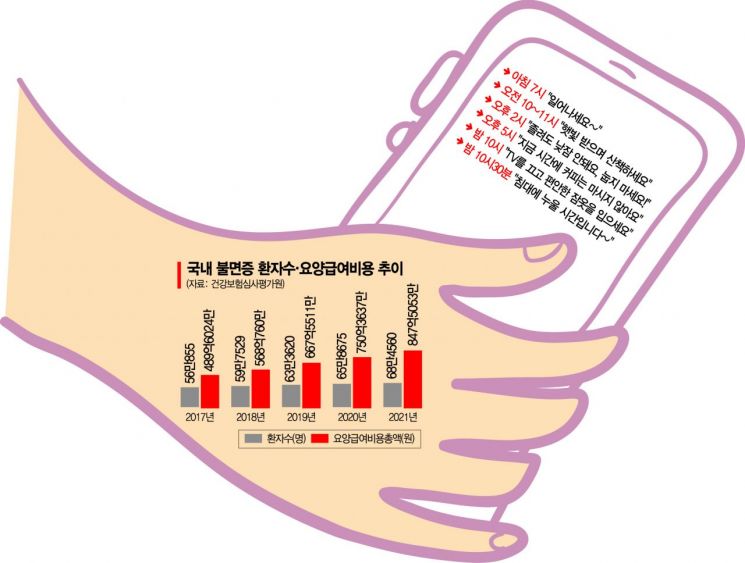
According to the Health Insurance Review & Assessment Service on the 21st, the number of patients visiting hospitals for insomnia in South Korea steadily increased from 560,000 in 2017 to 590,000 in 2018, 630,000 in 2019, and 650,000 in 2020, surpassing 680,000 last year. When adding patients suffering from disturbances in normal sleep due to mental and behavioral disorders, narcolepsy, sleep apnea, restless legs syndrome, neurological diseases, and others, the number becomes much larger. Experts point out that although insomnia is a common condition experienced by more than 20% of the population, its seriousness is often unrecognized, leading to delayed or inadequate treatment and excessive reliance on medications such as sleep-inducing drugs.
To address sleep problems, various IT devices have been developed, including wearable devices like sensors attached to beds, bands, and goggles worn during sleep, which measure lifestyle habits, biological rhythms, and sleep information to induce sound sleep. Health applications (apps) that play white noise (ASMR) such as rain or wind sounds to create a calming atmosphere, or guide meditation and simple stretching to promote a body state conducive to sleep, have also been released and are used not only by patients but also by the general public. Digital therapeutics (DTx) go a step further by collecting and analyzing sleep-related data of insomnia patients through smartphones or smartwatches, then providing personalized prescriptions for patients to follow, thereby expecting therapeutic effects.
DTx Changing the Paradigm of Insomnia Treatment
The standard treatment for insomnia is based on Cognitive Behavioral Therapy for Insomnia (CBTi). It is a non-pharmacological treatment aimed at blocking and restoring the mechanisms that cause chronic sleep disorders due to lifestyle habits, sleep patterns, distorted cognition, and incorrect health information. Compared to drug treatments, it inevitably takes some time to see therapeutic effects, but it has the advantage of fewer side effects and sustained effects even after treatment completion. Physicians identify the patient’s sleep rhythm and factors that disrupt it, then improve the patient’s behavior and environment through sleep scheduling, sleep restriction therapy, stimulus control therapy, relaxation training, and sleep hygiene education, training patients to control their own sleep state. DTx for insomnia implements this cognitive behavioral therapy through an app instead of direct verbal communication by a doctor.
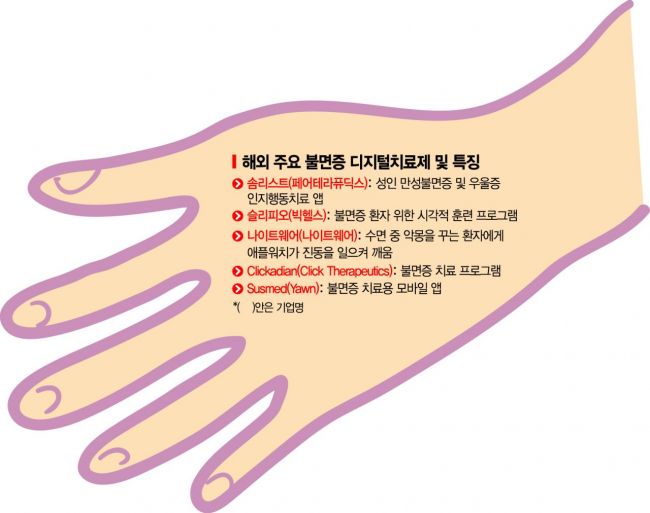
‘Somryst,’ developed by Pear Therapeutics in the U.S., was approved by the U.S. Food and Drug Administration (FDA) as a prescription DTx in March 2020. It offers a 6 to 9-week personalized education and task program designed by an algorithm to help restrict sleep and improve sleep quality according to CBTi guidelines. Physicians receive real-time patient data through a clinician dashboard to assist in patient management. Clinical trials showed that after using this DTx, insomnia patients fell asleep 45% faster, and nighttime awakenings decreased by 52%. The severity of insomnia symptoms was reduced by 45%, and continuous sleep improvement effects were observed 6 to 12 months after treatment.
‘Sleepio,’ developed by Big Health, is a six-step treatment program that manages factors affecting sleep such as negative thoughts, bedroom conditions, lifestyle patterns, and sleep schedules. Clinical trials confirmed better sleep effects in 76% of patients. The UK’s National Health Service (NHS) implemented a policy to support and prescribe Sleepio at the national level, providing costs for about 10 million London citizens and others in 2019.
Will the First DTx Come from Insomnia Treatments?
Among the five DTx products approved by the Korean Ministry of Food and Drug Safety and currently in confirmatory clinical trial phases, two are insomnia treatments. In September last year, Welt’s ‘PILLow Rx’ and AimMed’s ‘Somzz’ both entered patient registration and clinical trials, recently reaching the final stages. Both companies aim to apply for product approval within this year once confirmatory clinical trial results are available.
Somzz is designed for insomnia patients to use over 6 to 9 weeks. Patients write daily sleep diaries through a mobile app, which then provides various sleep habit education, stimulus control, sleep restriction, cognitive techniques, and other behavioral interventions or restrictions, along with training programs for insomnia patients. For example, it continuously reminds patients that a fixed sleep schedule is important and that taking naps naturally leads to difficulty sleeping at night. The app instructs patients on when to get out of bed, when to lie down, and prohibits naps.
Im Jin-hwan, CEO of AimMed, explained, “Patients continuously receive essential information and treatment processes for insomnia treatment, which psychiatrists would normally provide during consultations, remotely in their daily lives. They can be trained repeatedly and continuously without visiting the hospital every week.”
PILLow Rx also provides personalized schedules based on lifestyle data and sleep diaries collected from patients. Patients set alarms according to the app’s suggested bedtime and can consult anytime through the app if they have questions.
Kang Sung-ji, CEO of Welt, said, “The next-generation insomnia DTx currently under development collects various digital biomarkers from daily life, and AI analyzes them to automatically measure sleep data.” He added, “It accesses all information measurable by smartphones, such as patients’ bedtime and wake-up time, exercise time, steps, and heart rate, to provide a 360-degree view of the patient.” Kang also mentioned, “In the future, it will be possible to link patients’ digital biosignals with hospital data to retrieve medication and underlying disease information, and analyze daily life events such as card usage recognized by the smartphone app to reflect them in DTx prescriptions.”
© The Asia Business Daily(www.asiae.co.kr). All rights reserved.


















