Cargo Solidarity Targets Samsung Electronics
LS Nikko Dong and Korea Zinc Attempt Logistics Blockade at Ulsan Plants
Automobile and Cement Industries Also Hit Hard by General Strike
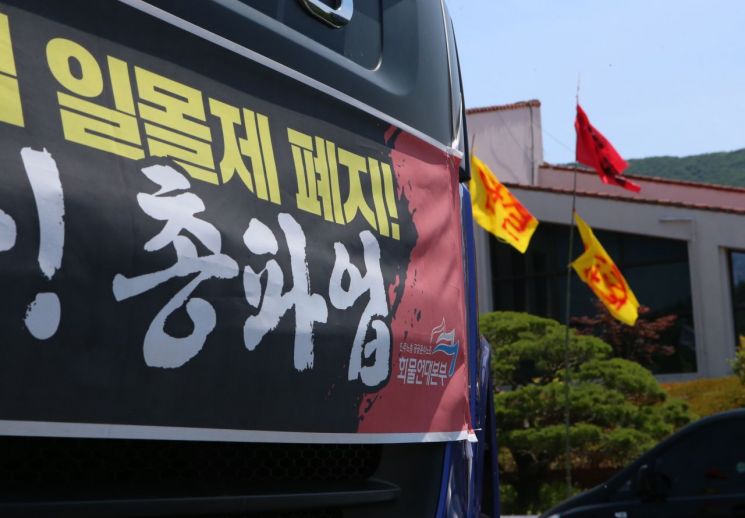
Companies are in an emergency state as distribution, product manufacturing, and exports have all come to a halt due to the total strike by the Cargo Solidarity Union, which has taken the national logistics system 'hostage.' There are concerns that damages will snowball, especially as the Cargo Solidarity Union targets the 'semiconductor' and 'automobile' sectors, which have played a pivotal role in the Korean economy. Companies, already struggling due to rising raw material prices caused by global supply chain disruptions, find themselves in a helpless situation.
According to the industry on the 10th, the Cargo Solidarity Union's Ulsan branch attempted to blockade logistics by visiting LS Nikko Dong and Korea Zinc's Ulsan plants the day before.
It is known that they acted according to internal guidelines of the Cargo Solidarity Union, which aim to target these two semiconductor raw material companies to strike Samsung Electronics' semiconductor business. This is analyzed as an effort to maximize the strike's effect by targeting 'semiconductors,' a core pillar of the Korean economy. However, when police forces were deployed that day, the union members withdrew without much commotion.
LS Nikko Dong and Korea Zinc produce high-purity sulfuric acid for semiconductors, which they supply to Samsung Electronics. This is an essential raw material used in cleaning silicon wafers for semiconductors, and any disruption in supply would inevitably impact semiconductor production. An industry insider said, "There has been no damage so far, but we are closely monitoring the situation," adding, "If they proceed with logistics blockades, we have an internal policy to take legal action through the police."
The automobile industry, including Hyundai Motor Company, has already been hit directly. Hyundai Motor's Ulsan plant has been repeatedly stopping and starting its production line for three days. Of the approximately 6,000 vehicles involved in parts, steel, delivery, and forwarding (shipping), only about 25% are currently operational.
The industry expects the transportation refusal to continue for some time and is responding both internally and externally. Internally, they are trying to minimize losses, while externally, they are appealing to truck owners by emphasizing that the automobile sector is unrelated to the controversial Safe Freight Rate System. Especially in the small and medium-sized automobile parts industry, which lacks sufficient financial capacity, there is a high possibility that difficulties will intensify in a short period, raising concerns about the survival of companies.
Damage to the tire industry is also increasing. Hankook Tire operates factories in Daejeon and Geumsan. On the first day of the strike, no products were shipped from Daejeon, and only about half were shipped from Geumsan. From the second day onward, shipments from both Daejeon and Geumsan have been at about 40% of normal levels.
The steel and petrochemical industries cannot arbitrarily stop and start processes depending on raw material supply or logistics conditions. The automobile industry also involves an organic supply and assembly process of tens of thousands of parts, so if problems occur in even one or two places, the entire new car production line inevitably comes to a halt.
The cumulative damage in the cement industry has increased to approximately 45.8 billion KRW, and the ready-mix concrete industry, unable to receive cement supplies, has been pushed to the brink of shutdown. The Korea Cement Association announced that as of the previous day, about 161,200 tons of cement had not been shipped, resulting in losses amounting to 45.8 billion KRW. Cement shipments have been suspended at all regional distribution bases, including the Seoul metropolitan area. Shipments from production plants where the Cargo Solidarity Union is holding rallies (Danyang, Jecheon, Yeongwol, Ok-gye) and distribution bases (Uiwang, Susaek, Incheon, Busan, Daegu, Mokpo, etc.) have been abandoned, and even at plants not holding rallies, vehicle operations have stopped due to anticipated threatening actions by union members if vehicles run.
© The Asia Business Daily(www.asiae.co.kr). All rights reserved.
![Clutching a Stolen Dior Bag, Saying "I Hate Being Poor but Real"... The Grotesque Con of a "Human Knockoff" [Slate]](https://cwcontent.asiae.co.kr/asiaresize/183/2026021902243444107_1771435474.jpg)
















