'Rare Disease' Monkeypox, Over 1,000 Cases in 29 Non-Endemic Areas
European LGBTQ+ Festivals Identified as Cause of Spread
Misconception of 'Monkeypox = STD' Spreads
Infection Possible Not Only Through Sexual Contact but Also Saliva, Urine, Vomit
"Prepare for Airborne Infection"... Possibility of Airborne Transmission
 There has been a possibility raised that monkeypox can be transmitted through the air. The photo is unrelated to specific expressions in the article. Photo by Kim Hyun-min kimhyun81@
[Asia Economy Reporter Yoon Seul-gi] As cases of monkeypox infection have appeared around the world, warnings are emerging that the spread could intensify. In non-endemic regions such as the United States and the United Kingdom, where monkeypox is classified as a rare disease, the virus has spread mainly among sexual minorities, leading to misinformation that this virus is a sexually transmitted disease. However, since airborne transmission cannot be ruled out, experts point out the need for related precautions.
As monkeypox spreads across countries worldwide, the number of confirmed cases reached 1,000 just one month after the initial cases were reported. According to foreign media, Tedros Adhanom Ghebreyesus, Director-General of the World Health Organization (WHO), stated at a media briefing held at the Geneva headquarters in Switzerland on the 8th (local time) that more than 1,000 confirmed cases of monkeypox have been reported in 29 non-endemic countries so far.
Director-General Ghebreyesus expressed concern, saying, "The risk of outbreaks in non-endemic countries has become a reality," warning that monkeypox could establish itself in non-endemic regions. He added that there are signs of local transmission in some countries and recommended self-isolation for infected individuals.
Fortunately, no deaths from monkeypox have been reported in non-endemic regions yet, but the situation is not one to be complacent about. Director-General Ghebreyesus pointed out that over 1,400 suspected cases and 66 deaths have occurred in the African region this year alone.
As monkeypox infection cases emerge worldwide, raising concerns about a 'pandemic,' governments are closely monitoring its domestic influx. On the 8th, the government designated monkeypox as a second-class legally notifiable infectious disease, alongside COVID-19 and tuberculosis. Second-class infectious diseases require isolation considering their transmission potential.
With another infectious disease showing signs of spreading even before COVID-19 has ended, public fatigue toward epidemics is increasing. Amid this, misinformation has spread among some sexual minorities that monkeypox is a sexually transmitted disease, as cases have appeared within this group. Some even argue that since monkeypox is an STD, wearing masks is unnecessary.
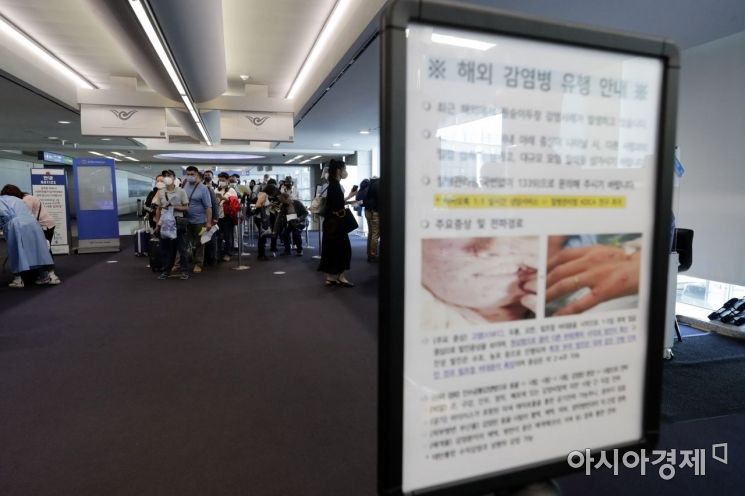 On the 27th, passengers arriving on a flight from Europe at Incheon International Airport Terminal 1 are waiting to undergo quarantine for overseas infectious diseases such as monkeypox. Photo by Mun Ho-nam munonam@
However, monkeypox is not a sexually transmitted disease. Last month, a WHO advisor mentioned that sexual contact at large parties held in Europe was a cause of the spread, which focused attention solely on 'transmission through sexual contact,' leading to the misconception that monkeypox is an STD.
Monkeypox can be transmitted not only through sexual contact and physical contact but also through contact of infected patients' bodily fluids such as saliva, urine, and vomit with skin wounds or mucous membranes. Moreover, airborne transmission cannot be excluded.
Previously, the U.S. Centers for Disease Control and Prevention (CDC) recommended mask-wearing for travelers regarding monkeypox but quickly withdrew the recommendation. However, it still advises infected individuals and their families to wear masks, causing confusion. The U.S. daily newspaper The New York Times (NYT) analyzed this as implying that, at least over short distances, airborne transmission of the virus is possible, a topic that had not been discussed before.
The NYT cited a 2017 case in a Nigerian prison where two healthcare workers contracted monkeypox without direct contact with confirmed cases, emphasizing the possibility of airborne transmission. The outlet explained, "Monkeypox has mainly been reported to spread through close contact with confirmed cases or animals, but in some instances, airborne transmission has been described as the 'sole cause.'"
Experts also point out the need to consider airborne transmission. Donald Milton, a virus expert at the University of Maryland, mentioned to the NYT that hospitals generally do not have universal precautions against aerosol transmission and said, "It is important to anticipate and prepare for the possibility that monkeypox can be transmitted through the air."
© The Asia Business Daily(www.asiae.co.kr). All rights reserved.
![Clutching a Stolen Dior Bag, Saying "I Hate Being Poor but Real"... The Grotesque Con of a "Human Knockoff" [Slate]](https://cwcontent.asiae.co.kr/asiaresize/183/2026021902243444107_1771435474.jpg)












