Even with tens of thousands of won spent on rounds, golf courses are crowded... High-end golf apparel rental businesses also thriving
Meal costs easily exceeding 100,000 won per serving are "not regretted"
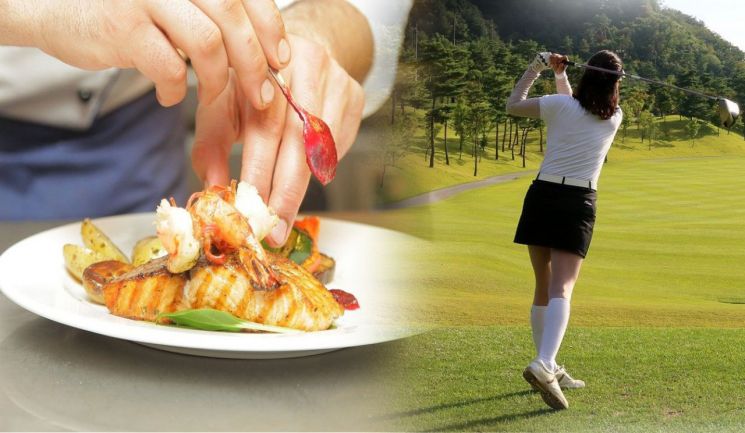
[Asia Economy Culture Young Intern Reporter] The number of 2030s who have fallen into golf is rapidly increasing. They go out for rounds every weekend and upload their records. Golf, once considered the exclusive domain of successful middle-aged people, is now becoming a sport for the younger generation.
According to the Korea Leisure Industry Research Institute on the 9th, the domestic golf population last year was 5.15 million. This means that at least one in ten people enjoys golf. In particular, the 2030 generation accounts for 1.15 million of them.
In the metropolitan area, the green fee alone is around 300,000 won, and considering caddy fees, round-trip transportation costs, and meal expenses, the cost per person for a round easily exceeds 500,000 won. On top of that, the cost of purchasing golf equipment and clothing is also considerable. So why is the 2030 golf population rapidly increasing despite these costs?
The most direct influence is cited as 'COVID-19.' The industry explains that with overseas travel routes blocked, the perception that outdoor activities have a relatively lower risk of infection caused a surge in the golf population. It is a kind of revenge consumption.
'Omakase' and 'fine dining' are also popular among the 2030 generation. Even though a single meal easily exceeds 100,000 won, customers flock to enjoy unique meals in private spaces. Even hotel bingsu costing over 50,000 won, so-called 'Geumbingsu,' is popular among the younger generation.
YouTuber 'Budongsan Il-eojuneun Namja (Real Estate Reading Man, Bu-il-nam)' refers to this emerging consumption trend among young people as 'Hose Inflation.'
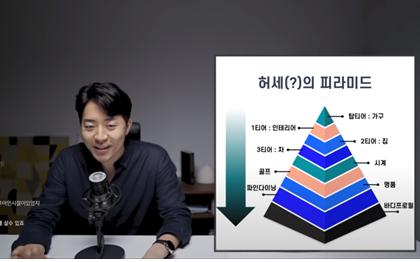 YouTuber 'Budongsan Ilgeo Juneun Namja (Bu-il-nam)' explains the 'Hose Pyramid,' saying "There is inflation even in showing off." Photo by Bu-il-nam YouTube screenshot
He explains this as a 'Hose Pyramid.' The upper part of the pyramid includes furniture, interior, houses, cars, watches, etc., which are so expensive that they are difficult to access without economic power, so demand is concentrated on golf, luxury goods, fine dining, and the like.
They also flaunt 'Hose Inflation' through SNS. If you search for 'Omakase' on Instagram, you will see high-end dishes on plates. There is even a joke that once you go for a golf round, you don't have to worry about uploading for a week. Because of this, the industry says that recently, at major golf courses, there have been increasing cases where the progress of the game is disrupted due to young golfers focusing more on taking certification shots throughout the round than on golf itself. Companies that rent out high-end brand golf clothing targeting them are also thriving.
Some analysts suggest that the recent decrease in bank savings and deposits among the 2030 generation and the rapid increase in cryptocurrency investment are not unrelated to this phenomenon.
In fact, the number of new savings accounts opened by the 2030 generation at the four major commercial banks?Kookmin, Shinhan, Hana, and Woori?was 4,026,688 in 2019, but decreased to 3,921,965 in 2020 and 3,332,224 last year. On the other hand, the number of new K Bank accounts created for coin trading at Upbit, the largest cryptocurrency exchange in Korea, reached 1.08 million in April last year alone, exceeding 5 million in total. Among them, 70% are from the 2030 generation.
Professor Lee Eun-hee of Inha University's Department of Consumer Studies said about this consumption phenomenon, "It is a consumption that has its own validity," but warned, "However, irresponsible consumption without household responsibility is dangerous."
© The Asia Business Daily(www.asiae.co.kr). All rights reserved.
![Clutching a Stolen Dior Bag, Saying "I Hate Being Poor but Real"... The Grotesque Con of a "Human Knockoff" [Slate]](https://cwcontent.asiae.co.kr/asiaresize/183/2026021902243444107_1771435474.jpg)

















