"Trends in Impi-je Judgments and Corporate Response Strategies Online Seminar"
Co-hosted by KCCI and Law Firm Sejong on the 9th
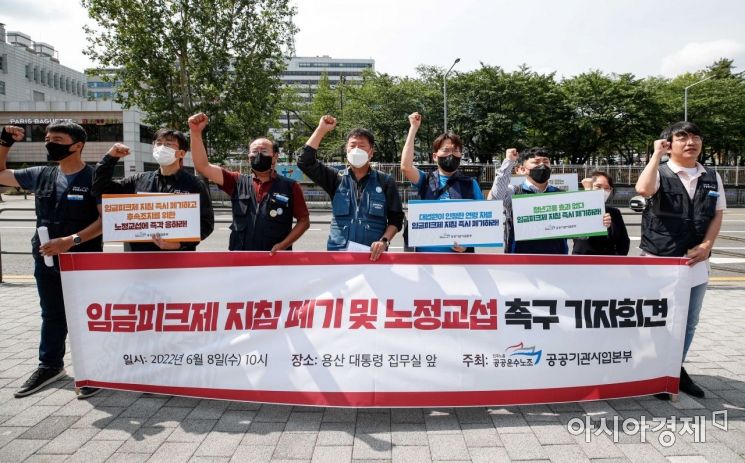 Officials belonging to the Public Institution Business Headquarters hold a press conference on the 8th in front of the Presidential Office in Yongsan-gu, Seoul, urging the abolition of the wage peak system guidelines and demanding labor-management negotiations. Photo by Kang Jin-hyung aymsdream@
[Asia Economy Reporter Moon Chaeseok] After the Supreme Court ruled that wage peak systems without 'rational reasons' are invalid, causing increased confusion among companies, the business and legal communities held an emergency briefing session. The employers advised caution, noting that applying a peak system that 'blatantly cuts wages' could be invalidated in court trials, while the labor side was advised not to recklessly file lawsuits aiming to abolish the system altogether.
The Korea Chamber of Commerce and Industry (KCCI), together with the law firm Sejong, announced that they held an 'Online Briefing on Wage Peak System Ruling Trends and Corporate Response Measures' on the 9th at the Sangyohui Building in Jung-gu, Seoul. Speakers from Sejong?attorneys Kim Dongwook, Kim Jongsu, and Lee Seri?gave lectures analyzing the Supreme Court ruling in detail, discussing issues and impacts related to the wage peak system, and outlining specific corporate response strategies.
Attorney Kim Dongwook advised, "Since the Supreme Court ruling did not deny the effectiveness of the wage peak system itself, excessive anxiety and fear are unwarranted," adding, "Companies need to accurately understand the intent of the Supreme Court ruling and review the validity of the wage peak systems they currently operate." He further warned, "If wage peak system lawsuits unfold, regardless of the outcome, they will increase corporate uncertainty and act as obstacles to employment expansion and extension," urging, "The labor sector should be cautious about filing invalidity lawsuits and calls for abolition following the ruling." In fact, after the Supreme Court ruling on the 26th of last month, the Federation of Korean Trade Unions (FKTU) issued field guidelines encouraging invalidation and abolition of the wage peak system. Bank unions have also begun legal reviews to initiate lawsuits.
Attorney Kim Jongsu explained that the Supreme Court, in its ruling on the Korea Electronics Technology Institute wage peak system case on the 26th of last month, judged that the system constituted age discrimination without 'rational reasons,' based on factors such as ▲ introduction before the amendment mandating retirement at age 60 ▲ wage cuts without extending retirement age ▲ purpose of management efficiency ▲ absence of measures like adjusting working hours or duties. He said, "Wage peak systems generally introduced by companies in response to the mandatory retirement age extension to 60 are relatively safe," but emphasized, "If the system does not meet the Supreme Court’s validity criteria?such as the legitimacy of the introduction purpose and the degree of disadvantage to workers?even if introduced to extend retirement age, it may be invalidated, so caution is necessary."
Attorney Kim Jongsu cited the case of Daekyo Co., Ltd., which the Seoul High Court invalidated last year, saying, "If the purpose is judged as wage reduction or workforce dismissal, like Daekyo’s wage peak system that cut wages by up to 50% starting at age 44 while extending retirement to 60, it is highly likely to be invalidated under the Supreme Court’s standards." The validity requirements set by the Supreme Court include ▲ legitimacy of the wage peak system’s introduction purpose ▲ degree of disadvantage to workers ▲ whether measures were taken regarding wage cuts ▲ whether the reduced funds were used for the original purpose of introducing the wage peak system.
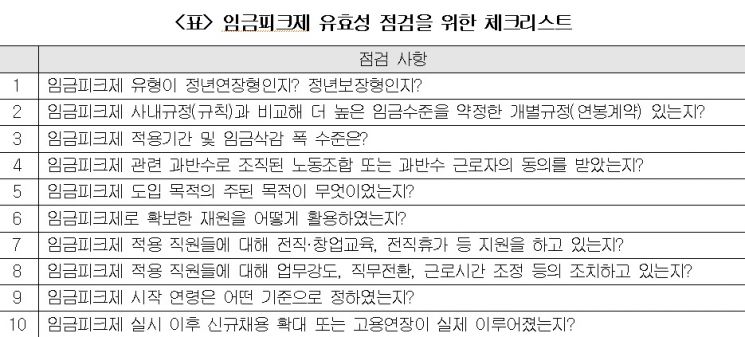 Corporate Impi-je Checklist Created by Lawyer Lee Seri of Sejong Law Firm. (Source: Korea Chamber of Commerce and Industry)
Attorney Lee Seri compared cases where courts recognized or denied the effectiveness of wage peak systems and presented corporate response measures. Lee advised companies to prepare by ▲ reviewing and improving current wage peak systems ▲ planning responses in case of lawsuits ▲ strategizing collective bargaining with unions. He said, "HR managers need to individually check each aspect such as the type of retirement system, the purpose of the wage peak system, and whether measures were taken for affected workers, to organize the operation status of the wage peak system." He also provided a 'Wage Peak System Validity Checklist' with 10 items useful for field application. The checklist includes criteria such as whether the wage peak system is a retirement extension type or a retirement guarantee type.
Yoo Ilho, head of the Employment and Labor Policy Team at KCCI, stated, "The wage peak system was introduced to alleviate the burden of retirement age extension under the seniority-based pay system and to minimize negative impacts on the employment market, such as the reduction of youth jobs," adding, "To fundamentally resolve the confusion caused by this (Supreme Court) ruling and the side effects of retirement age extension on jobs, a swift transition to a job-based pay system is necessary." The presentation materials can be found on the KCCI website under 'Online Seminar.'
© The Asia Business Daily(www.asiae.co.kr). All rights reserved.


















