[Asia Economy New York=Special Correspondent Seol Gina] Sean O'Hare, who lives in North Bergen, New Jersey, gave up commuting by car several months ago. This decision was made due to the difficulty of bearing soaring gasoline prices and parking fees. Recently, as oil prices surged, he even started reducing the number of trips. He said, "Last summer, when gasoline prices exceeded $3 per gallon, I already felt inflation was severe, but now it's a whopping $5," adding, "It seems like it will rise even more, and I can only sigh."
Both wallets and fuel tanks are empty. As U.S. inflation continues at its highest level in 40 years, voices complaining about the soaring gasoline prices are growing louder.
According to the American Automobile Association (AAA), on the 8th (local time), the average nationwide gasoline price in the U.S. reached a record high of $4.955 per gallon. This is a 62% surge compared to the same period last year when prices were around $3 per gallon. By major states, California recorded $6.390, New Jersey $5.032, and New York $4.988.
The Washington Post (WP) reported, "Drivers in 16 states are paying at least $5 per gallon," adding, "Depending on the vehicle, filling up the fuel tank costs over $100. This amount requires 14 hours of work after tax for low-wage workers."
The number of drivers stranded on the road due to fuel shortages has also been rapidly increasing recently. Last month, AAA received 50,787 fuel shortage calls, a 32% increase compared to the same month last year. WP reported that as gasoline prices rise sharply, such embarrassing scenes are becoming familiar. According to a survey, 44% of drivers responded that they are only partially filling their fuel tanks due to recent price surges. Among respondents earning less than $50,000, 61% answered similarly. Professor Roger Ware of Queen's University in Ontario predicted, "If gasoline prices rise further, more commuters will switch to public transportation or carpooling."
The upward trend in U.S. gasoline prices is expected to continue for the time being. JP Morgan forecasts that regular gasoline in the U.S. will rise to $6.20 per gallon by August. The period from late May, just after Memorial Day, to early September, Labor Day, is commonly called the 'driving season' due to summer vacation demand. Especially this year, suppressed travel demand is expected to fuel the rise in gasoline prices. In some states, the hurricane variable in August is also expected to act as an upward pressure.
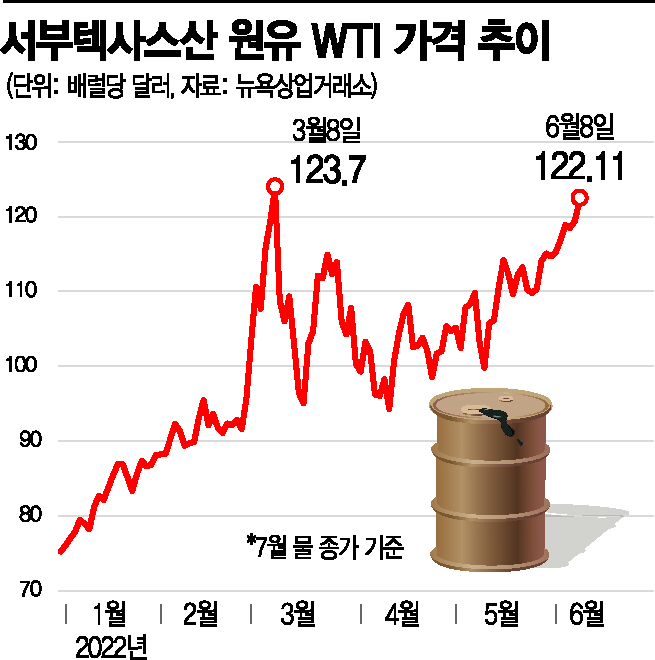
The international oil price, which underlies the rise in gasoline prices, surpassed $120 per barrel again after three months. On this day, the July West Texas Intermediate (WTI) crude oil price on the New York Mercantile Exchange closed at $122.11 per barrel, up $2.70 (2.26%) from the previous session. This is the highest closing price since March 8 and the second highest level this year. Brent crude oil August futures on the International Futures Exchange (ICE) in London also closed up 2.5% at $123.58.
In particular, the market widely believes that oil prices have not yet peaked. Goldman Sachs expects Brent crude prices to exceed $140 per barrel between July and September. Fatih Birol, Executive Director of the International Energy Agency (IEA), said, "I am worried about the oil market this summer," adding, "Supply shortages will continue into winter."
As oil prices soar again, inflation concerns are also spreading anew. Voices blaming U.S. President Joe Biden for inflation in the 8% range are growing louder. Robert Shiller, Nobel laureate and Yale University professor, said in an interview with Bloomberg News, "Inflation is affecting the American psyche more than the labor market," adding, "Every time people go to the store, they see inflation and get angry." The U.S. Consumer Price Index (CPI) for May will be released on the 10th.
On this day, U.S. Treasury Secretary Janet Yellen appeared before the House Ways and Means Committee hearing and confirmed that she is considering partially lifting high tariffs imposed on Chinese products to ease inflation. However, she also made it clear that such tariff reductions are not a 'panacea' for easing soaring inflation.
© The Asia Business Daily(www.asiae.co.kr). All rights reserved.
![Clutching a Stolen Dior Bag, Saying "I Hate Being Poor but Real"... The Grotesque Con of a "Human Knockoff" [Slate]](https://cwcontent.asiae.co.kr/asiaresize/183/2026021902243444107_1771435474.jpg)
















