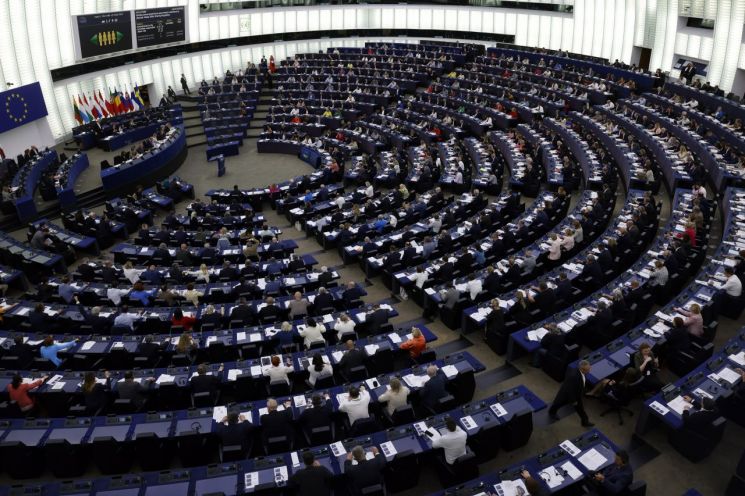
[Asia Economy Reporter Hyunwoo Lee] With the European Parliament, the decision-making body within the European Union (EU), passing a measure to ban the sale of new internal combustion engine (ICE) vehicles starting in 2035, the expansion of the electric vehicle market is expected to accelerate further. Although there was controversy over an amendment to retain some ICE vehicles such as diesel and hybrid cars, it is reported that a full 100% ban was agreed upon as reducing dependence on Russian energy emerged as a major priority.
According to Bloomberg on the 8th (local time), the European Parliament announced that the plan to stop the sale of new ICE vehicles from 2035 was passed that day, and negotiations with member states are scheduled to begin by the end of this year. Accordingly, within EU member countries, it is expected that from 2035, the sale of new ICE vehicles, including gasoline, diesel, and hybrid cars, will all be banned.
Previously, there were arguments for the necessity of retaining some ICE vehicles, but consensus was reached in favor of a 100% ban. An amendment proposing a 90% ban instead of 100% was raised mainly by the European People's Party (EPP), known as a centrist-conservative party within the European Parliament. The EPP reportedly expressed concerns that a 100% ban could cause serious employment issues for workers in existing vehicle manufacturing companies.
The automotive industry accounts for 7% of the GDP of EU member states and creates about 14.6 million jobs, raising concerns that a rapid market transition could cause significant disruption. However, a majority of European Parliament members argue that efforts to reduce vehicle emissions, which account for more than 21% of greenhouse gas emissions, must be accelerated.
The EU’s focus on strengthening eco-friendly policies is interpreted as an effort to address global warming issues and to expedite the reduction of dependence on Russian energy. Last month, the EU Commission announced the so-called 'REPowerEU' policy to accelerate the green economic transition in order to rapidly reduce dependence on Russian fossil fuels. Under this policy, the EU plans to increase the share of renewable energy generation to 45% by 2030 and invest 300 billion euros (approximately 404 trillion won).
© The Asia Business Daily(www.asiae.co.kr). All rights reserved.
![Clutching a Stolen Dior Bag, Saying "I Hate Being Poor but Real"... The Grotesque Con of a "Human Knockoff" [Slate]](https://cwcontent.asiae.co.kr/asiaresize/183/2026021902243444107_1771435474.jpg)
















