Cement Shipments Halted in All Areas Except Some Parts of Chungcheong Region
"Construction Sites Face Cement Shortage Chaos... Production Plants Overflowing with Cement, Production Adjustment Needed"
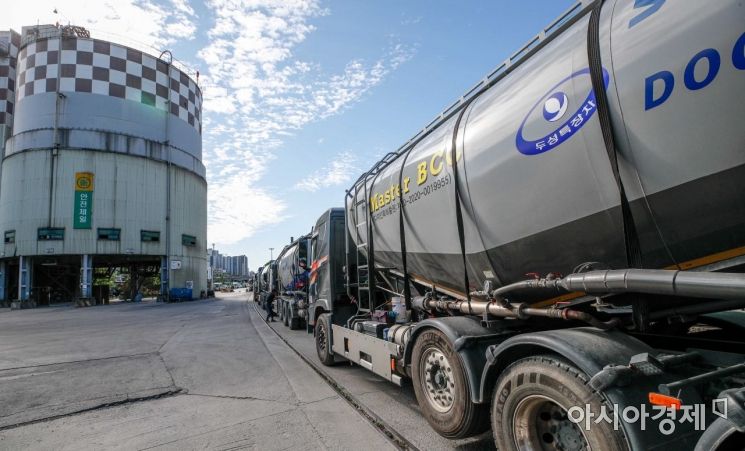 On the 7th, when the Cargo Solidarity of the Korean Public Service and Transport Workers' Union Confederation (KPTU) began an indefinite general strike, bulk cement trailer (BCT) vehicles were stopped and halted at the Seongsin Cement Suseok Plant in Mapo-gu, Seoul. Photo by Jinhyung Kang aymsdream@
[Asia Economy Reporter Kim Jong-hwa] The nationwide strike by the Cargo Solidarity of the Public Transport Workers' Union under the Korean Confederation of Trade Unions is causing increasing damage to the cement industry.
According to the Korea Cement Association on the 8th, on the second day of the Cargo Solidarity strike, cement shipments amounted to only 13,660 tons, down 1,840 tons from 15,500 tons the previous day. Even this volume is limited to some areas in the Chungcheong region, while most areas including the regions where production plants are located and the Seoul metropolitan area still have shipments at 'zero (0)'.
The scale of losses is estimated at about 166,340 tons of unshipped cement, as the normal shipment volume is about 180,000 tons but only 13,660 tons were shipped. Converted into monetary terms, this amounts to approximately 15.5 billion KRW, with losses estimated at 30.8 billion KRW over the two days of the strike.
Although cement is being shipped in some parts of the Chungcheong region, the shipment volume is minimal, and shipments have been halted at almost all distribution bases including the Seoul metropolitan area. The Cargo Solidarity is holding rallies at production plants (Danyang, Donghae, Ok-gye) and distribution bases (Uiwang, Susaek, Incheon, Busan, Daegu, Mokpo, etc.), causing shipments to stop. Even at plants where rallies are not held, non-Cargo Solidarity union members have abandoned vehicle operations due to anticipated threats from union members.
About 360,000 tons of cement at production plants and about 420,000 tons at distribution bases nationwide, totaling 780,000 tons, have not been shipped and are accumulating as inventory. The storage capacity at local production plants is about 750,000 tons, and excluding the current inventory of 320,000 tons (47% stock), an additional 430,000 tons can be stored, according to the Cement Association.
A representative from the Cement Association said, "If the produced volume continues to accumulate as inventory due to shipment stoppage caused by the Cargo Solidarity strike, a critical situation will be reached in three days where there will be no space to store production, potentially leading to production adjustments. Construction sites are in chaos due to cement shortages caused by the strike, but ironically, production plants are overflowing with cement and may have to adjust production, which is very frustrating."
Regarding the sunset clause on the safe freight rate system, the association stated, "The cement industry, as the shipper, has borne almost all costs for Bulk Cement Trailer (BCT) drivers not only before the introduction of the sunset clause but also during the three years of applying the safe freight rate. The increase in diesel prices is naturally reflected in the freight cost and will be settled later. We do not agree with the claim that the strike is due to the rise in diesel prices." The association urged, "We ask Cargo Solidarity-affiliated drivers to end the strike promptly and return to the front-line sites."
© The Asia Business Daily(www.asiae.co.kr). All rights reserved.

















