Strike Participation Rate Decreases by 11 Percentage Points Compared to Previous Day
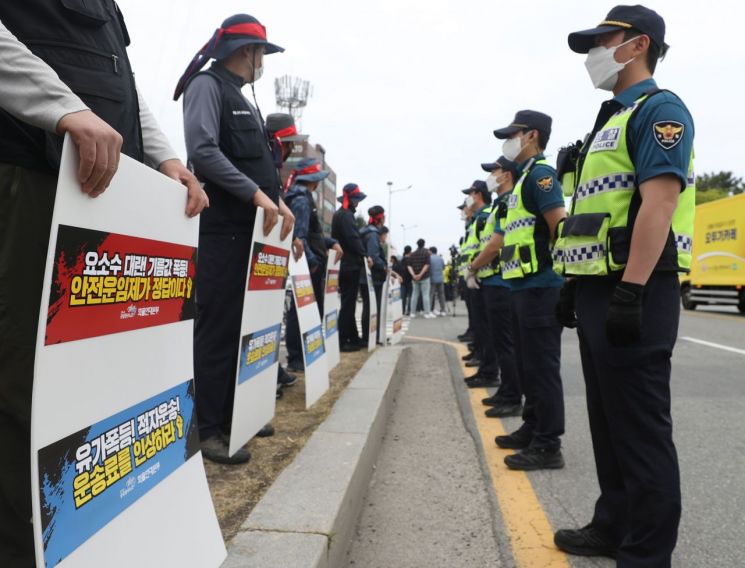
[Asia Economy Reporter Kim Young-won] On the 8th, the second day since the National Democratic Labor Confederation Cargo Solidarity began their general strike, the participation rate was recorded at 29%.
The Ministry of Land, Infrastructure and Transport estimated that about 6,500 of the 22,000 Cargo Solidarity union members, approximately 29%, participated in the strike that day. This is about an 11 percentage point decrease compared to the previous day, when about 9,000 members, or 40%, took part.
However, the Ministry stated that logistics damage is not yet significant. They explained that major shippers and transport companies had preemptively transported 2 to 3 days’ worth of cargo in preparation for the Cargo Solidarity’s collective transport refusal, so logistics damage appears to be limited so far.
Currently, all 12 ports nationwide are operating normally without any blockade at their entrances. The Ministry confirmed that no container yards or factory entrances have been blocked.
The container occupancy rate at each port stands at 69.4%, similar to the usual level of 65.8%. However, the volume of container imports and exports at major ports such as Busan Port and Incheon Port has decreased compared to normal times. On the first day of the strike, from 10 a.m. to 5 p.m., the container import and export volume at Busan Port was about 19,000 TEU, down by approximately 6,000 TEU from the previous day’s 25,000 TEU.
Nevertheless, due to the Cargo Solidarity strike, various clashes and logistics disruptions occurred nationwide again on this day. In Icheon, Gyeonggi Province, 15 union members were arrested by police for blocking cargo vehicles entering and exiting the Hite Jinro Icheon factory. In Busan, two union members who blocked the progress of trailer vehicles and one union member who damaged a garbage collection vehicle in Geoje, Gyeongnam Province, were arrested by police.
Damage in industrial sites has also been reported. According to the cement industry, in regions such as Danyang, Jecheon, Yeongwol, and Ok-gye, where the Cargo Solidarity effectively blocked the front and back gates of cement production plants the previous day, access for bulk cement trailer (BCT) vehicles transporting cement was completely restricted.
The Cement Association reported that cement shipments dropped to 15,500 tons the previous day, less than 10% of the usual volume, and estimated the industry’s daily sales loss at about 15.3 billion KRW.
In the automotive industry, delivery vehicles affiliated with the Cargo Solidarity began refusing transport to Hyundai Motor’s Ulsan plant from 2 p.m. that day, causing some production lines at the Ulsan plant to repeatedly start and stop from around 4 p.m.
Since the automotive production system follows a 'just-in-time production method' to minimize product inventory, even the failure to deliver some parts inevitably disrupts the entire production process.
At around 5 p.m. that day, the Ministry held an emergency countermeasure meeting chaired by the second vice minister to review the strike situation and the implementation status of emergency transport measures.
The government stated that while it will guarantee the Cargo Solidarity’s legitimate assembly, it will strictly respond according to law and principles in cooperation with the police against acts that obstruct the transport of normally operating vehicles.
© The Asia Business Daily(www.asiae.co.kr). All rights reserved.
![Clutching a Stolen Dior Bag, Saying "I Hate Being Poor but Real"... The Grotesque Con of a "Human Knockoff" [Slate]](https://cwcontent.asiae.co.kr/asiaresize/183/2026021902243444107_1771435474.jpg)
















