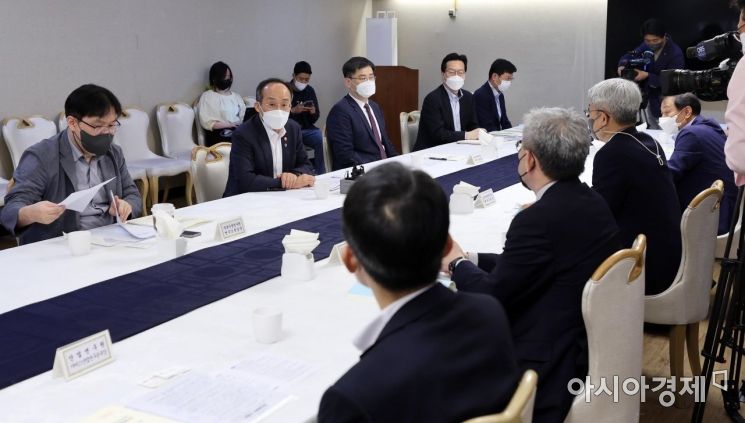
 Deputy Prime Minister and Minister of Economy and Finance Choo Kyung-ho is giving a greeting at the meeting of economic policy experts from research institutions held on the 8th at Gwanghwamun Hall, Government Seoul Building, Jongno-gu, Seoul. Photo by Hyunmin Kim kimhyun81@
[Asia Economy Sejong=Reporter Kim Hyewon] Deputy Prime Minister and Minister of Economy and Finance Choo Kyung-ho said on the 8th, "To prevent South Korea's potential growth rate from falling into the 0% range, structural reforms must be undertaken in five major sectors: public, labor, education, finance, and services."
On the same day, Deputy Prime Minister Choo held a meeting with economic policy experts from major research institutions at the Government Seoul Office Complex and stated, "We need to heed the warning from the Organisation for Economic Co-operation and Development (OECD) that without a bold policy shift and intensive structural reforms, the potential growth rate could fall into the 0% range." The OECD had predicted that South Korea's potential growth rate would gradually decline from 2.4% in 2020 to 1.3% in 2030, and 0.9% in 2033, entering the 0% range.
Deputy Prime Minister Choo emphasized, "We must fundamentally change the structure of our economy through structural reforms in the five key sectors?public, labor, education, finance, and services?that are critical to improving total factor productivity, along with bold regulatory innovation."
At the meeting, Ko Young-sun, Research Fellow at the Korea Development Institute (KDI), proposed reform measures for education grants, such as determining the size of education finance grants based on the school-age population and extending grants to higher education. He also suggested easing enrollment regulations to strengthen university competitiveness and promoting university restructuring by granting responsibilities and authority to local governments. Additionally, to reduce the side effects of the 52-hour workweek system, he recommended expanding flexible working hours and raised the need for differentiated minimum wages by industry.
Professor Jeong Seung-guk of the Department of Social Welfare at Joongang Seungga University argued that to increase labor time flexibility, the selective working hours settlement period should be extended and support for the introduction of job-based pay should be strengthened to reform the wage system. Kwon Gu-hoon, Executive Director at Goldman Sachs, stated that to curb inflation caused by external factors, it is necessary to actively consider exchange rate stabilization policies, such as signing a strategic currency swap agreement with the U.S. Federal Reserve (Fed).
Cho Yong-hyuk, Director of the Regulatory Legislation Research Center at the Korea Legislation Research Institute, said that to expedite institutional improvements, temporary permits should be actively utilized, while simultaneously implementing new regulations to respond to emerging risks. Ahn Seong-bae, Director of the International Macroeconomics and Finance Division at the Korea Institute for International Economic Policy, proposed expanding tax benefits for foreign-invested companies eligible for tax reductions to increase foreign direct investment (FDI). As part of livelihood measures, he suggested expanding the energy voucher program and implementing a temporary fixed-fare public transportation pass system.
© The Asia Business Daily(www.asiae.co.kr). All rights reserved.

















